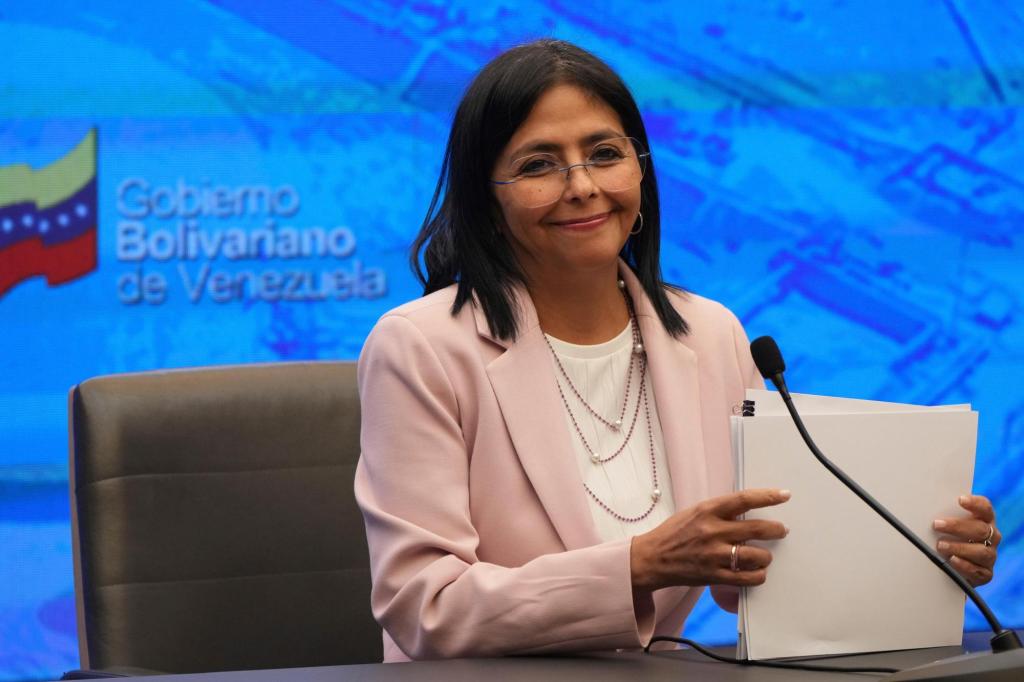
The Strategic Moves Behind Delcy Rodríguez’s Rise in Venezuela
As a new political era unfolded in 2017 with Donald Trump taking office, Delcy Rodríguez, then Venezuela’s foreign minister, sought to navigate the shifting landscape. Her strategy involved a bold financial move—directing Citgo, a subsidiary of Venezuela’s state oil company, to make a $500,000 donation to Trump’s inauguration. At a time when Venezuela was grappling with severe economic challenges, Rodríguez’s actions aimed to foster American investment and bolster her country’s struggling economy.
Despite her efforts, the plan did not yield the anticipated results. Within weeks, Trump, influenced by then-Sen. Marco Rubio, prioritized the restoration of democracy in Venezuela, in light of President Nicolas Maduro’s actions against political opposition. Nonetheless, Rodríguez’s attempts did not go unnoticed and bolstered her image within U.S. business and political spheres, setting the stage for her own political ascent.
Lee McClenny, a former U.S. diplomat in Caracas, remarked on Rodríguez’s pragmatic approach, noting, “She’s an ideologue, but a practical one.” This attitude reflected her understanding of Venezuela’s need to revitalize its oil-dependent economy, even if it meant working with the Trump administration.
Venezuela’s Political Landscape Shifts
Fast forward nearly a decade, and Rodríguez has emerged as Venezuela’s interim president, proclaiming the nation’s openness to business. This stance seems to have resonated with Trump, who, after Maduro’s unexpected capture, has praised Rodríguez while also cautioning her to maintain control over the ruling party and ensure U.S. access to Venezuela’s oil reserves. Yet, discussions surrounding the constitutionally mandated elections remain conspicuously absent from public discourse.

Rodríguez’s Formative Years and Political Revival
Rodríguez’s political journey has deep roots, fueled by a personal tragedy that shaped her ideological stance. In the turbulent political landscape of the 1970s, her father, a socialist leader, died while in custody, a loss she attributes to U.S. influence in Venezuela. This event, alongside her brother Jorge Rodríguez’s political involvement, catalyzed her own entry into the leftist movement initiated by Hugo Chávez.
Her initial ascent was slow and fraught with challenges, including a significant fallout with Chávez during a 2006 diplomatic tour. However, her career saw a resurgence under Maduro’s leadership, leveraging her international education and experience to re-establish her influence within Venezuelan politics.

Entering the Global Stage
With her return to prominence, Rodríguez became a key player in Venezuela’s international relations. Her refined tastes and global perspective made her a favored figure among the “boligarchs,” an elite class that thrived during Chávez’s tenure. This network facilitated secret diplomatic efforts, including a covert meeting with U.S. Congressman Pete Sessions in Caracas.
Elevated to the role of vice president in 2018, Rodríguez gained significant control over Venezuela’s oil sector and enlisted foreign advisors to navigate complex international markets. Her strategic moves included engaging experts to manage Venezuela’s foreign debt amidst stringent U.S. sanctions.

Challenges and Opportunities Ahead
Rodríguez’s growing influence coincided with internal power struggles, where she effectively sidelined rivals like Tareck El Aissami, the former Oil Minister. Her leadership style has drawn comparisons to Deng Xiaoping, reflecting a pragmatic approach to governance.
Hans Humes of Greylock Capital Management highlights her capacity to navigate Venezuela’s complex political and economic landscape, warning against abrupt political transitions that could destabilize the country. “We’ve seen how expats who have been outside of the country for too long think things should be the way it was before they left,” he notes, emphasizing the need for leaders familiar with current realities.

A Future Uncertain for Venezuelan Democracy
The trajectory of Venezuela’s democracy under Rodríguez remains unclear. While Trump’s comments post-Maduro’s capture underscore a lack of support for María Corina Machado, who won a significant electoral victory, the absence of discussions on elections raises questions about the country’s democratic future.
Elliott Abrams, a former special envoy to Venezuela, highlights the challenges of achieving Trump’s goals of eradicating criminal elements without a clear transition plan from Chavismo’s power structures. “Nothing that Trump has said suggests his administration is contemplating a quick transition away from Delcy. No one is talking about elections,” Abrams asserts, pointing to ongoing complexities in Venezuelan politics.