
By BILL BARROW, JONATHAN J. COOPER and JACK BROOK
WASHINGTON (AP) — As the dust settles on Capitol Hill following the approval of President Donald Trump’s ambitious budget-and-policy package, the conversation is set to expand nationwide. The newly minted law is poised to greatly influence the 2026 midterm elections, pivotal for determining the future balance of power in the House of Representatives and the latter half of Trump’s presidency.
For Democrats, the path to reclaiming the House requires a net gain of three seats, which would break the current Republican stronghold in the capital. However, winning back the Senate poses a greater challenge due to the Republican-leaning states up for grabs.
Republicans tout the new law as a victory, highlighting its extensive tax cuts, reinforced immigration enforcement, and tightened restrictions on social safety net programs. Conversely, Democrats criticize it as a rollback of health insurance access, a boon for the wealthy at the expense of the middle class, and a hindrance to green energy initiatives and worker rights.
“It represents the broken promise they made to the American people,” said Rep. Suzan DelBene, a Washington Democrat and chair of the party’s House campaign arm. “We’re going to continue to hold Republicans accountable for this vote.”
Parties Prepare for Midterm Showdown
With 435 House districts in play, only 69 contests were decided by less than 10 percentage points in the 2024 general election, indicating potential battlegrounds. The Democratic Congressional Campaign Committee has identified 26 seats to defend and 34 Republican-held seats ripe for flipping. Meanwhile, the National Republican Congressional Committee is focusing on 18 GOP incumbents and two open districts due to retirements.
The number of crossover districts remains low, with only 13 Democrats representing districts Trump carried in 2024 and just three Republicans in districts won by Democratic presidential nominee Kamala Harris. As both parties recruit challengers and prepare for retirements, the competitive landscape will continue to change.
In California, despite its Democratic lean, nine House districts are anticipated to be contested, including three in the Central Valley and six in southern California. Pennsylvania features four tightly contested districts, including a suburban Philadelphia seat held by Rep. Brian Fitzpatrick, a Republican who opposed Trump’s bill due to Medicaid cuts.
Vice President JD Vance is scheduled to visit Republican Rep. Rob Bresnahan’s district in northwest Pennsylvania to promote the GOP package, as Bresnahan’s seat is targeted by Democrats.
Iowa and Wisconsin also have key GOP-held districts where Trump’s tariff policies may sway voter opinions.
Democrats Aim to Define GOP Policies
Beyond the rhetoric of “Big Beautiful Bill” and “Big Ugly Bill,” the 900-page legislation includes numerous policies with varied impacts. Democrats are focusing on cuts to Medicaid and food assistance, which are set to fully take effect post-2026 midterms, and the non-expansion of tax credits for Affordable Care Act enrollees.
The Congressional Budget Office projects that if the bill becomes law, 11.8 million more people will be uninsured by 2034, and 3 million more will lose eligibility for food stamps.
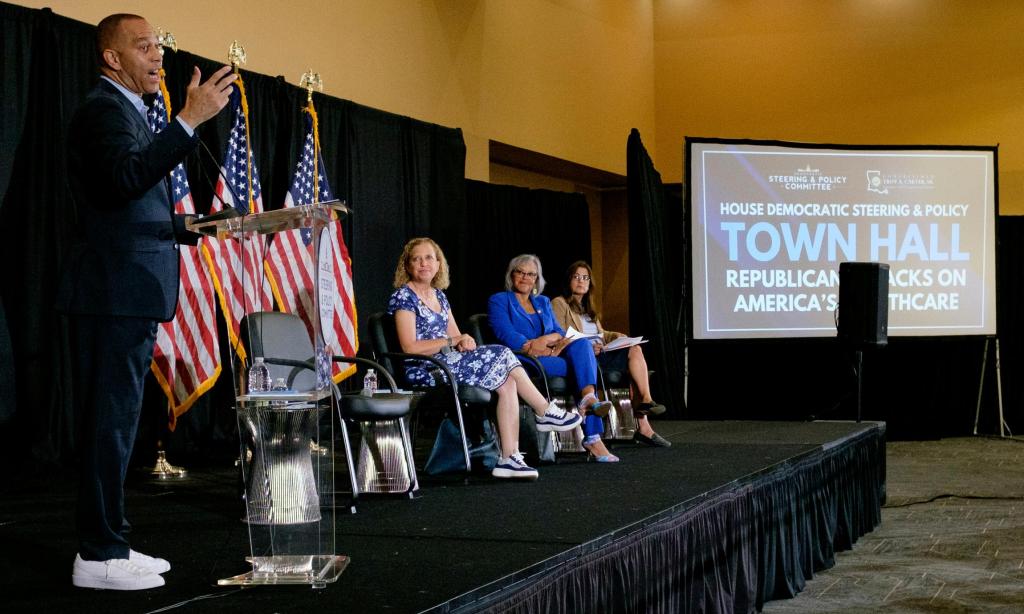
“Folks will die here in Louisiana and in other parts of the country,” warned House Minority Leader Jeffries during a town hall in Republican Speaker Mike Johnson’s home state of Louisiana.
He highlighted vulnerable Republicans like California Rep. David Valadao, representing a district where over half the population qualifies for state-federal insurance programs like Medicaid.
Republicans advocate for the bill’s tightened Medicaid work requirements, claiming it strengthens the program. “I voted for this bill because it does preserve the Medicaid program for its intended recipients — children, pregnant women, the disabled, and elderly,” Valadao said, emphasizing its importance to his constituents.
Republican Strategy: Focus on Lower Taxes
The package includes $4.5 trillion in tax cuts, maintaining rates and brackets from Trump’s first term. Republicans accuse Democrats of increasing household costs by opposing the bill.
GOP campaign aides highlight popular provisions such as an increase in the child tax credit from $2,000 to $2,200, new deductions on tip and overtime income, and a deduction for older adults earning under $75,000 annually.
“Everyone will have more take home pay. They’ll have more jobs and opportunity,” Johnson stated in a Fox News Sunday interview. “The economy will be doing better and we’ll be able to point to that as the obvious result of what we did.”
Democrats argue that Trump’s tax code predominantly benefits the wealthy and corporations. Coupled with cuts to the safety net, Florida Rep. Debbie Wasserman Schultz remarked, “The cruelty is the point.”
Immigration remains a key issue for Trump, with the NRCC asserting that investments in enforcement will continue to resonate. However, Democrats believe the administration’s aggressive deportation stance may backfire.
The Trump Factor
The president remains a significant variable in the upcoming elections. Democrats recall their 2018 success, gaining 40 House seats due to voter dissatisfaction with Trump. Recent special elections have shown a double-digit swing towards Democrats compared to 2024 results, reminiscent of trends after Trump’s initial election.
Republicans counter that Trump’s approval is higher now than in 2017. Still, replicating Trump’s coalition without him on the midterm ballot poses a challenge, especially as Democrats gain affluent white voters while Trump attracts more working-class individuals from diverse backgrounds.
Democrats focus on mobilizing voters who may not support Republicans but could otherwise abstain from voting. Jeffries expressed determination to prevent voter apathy. “We’re going to do everything we can until we end this national nightmare.”
—-
Cooper reported from Phoenix. Brook reported from New Orleans. Associated Press reporters Michael Blood in Los Angeles and Marc Levy in Harrisburg, Pennsylvania, contributed.
Originally Published: