
Florida’s recent initiatives to address illegal immigration have led to the establishment of new detention centers, sparking discussions on their effectiveness and conditions. The state’s approach, including the opening of Alligator Alcatraz, aims to provide additional facilities to house detainees while their cases are processed.
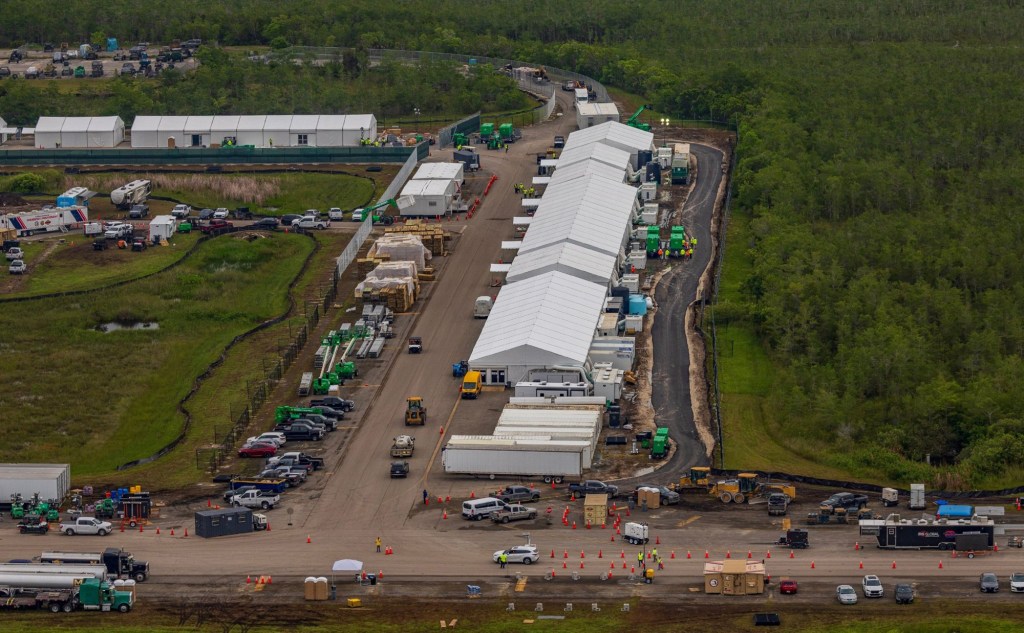
In July, Florida launched Alligator Alcatraz on a former airstrip within Big Cypress National Preserve. This move came after Florida officials presented a plan to the federal government in May, proposing new strategies to manage illegal immigration. Homeland Security Secretary Kristi Noem commended the state for its efforts to increase detention capacity, expressing gratitude for Florida’s cooperation in expanding space for detainees.
Alligator Alcatraz
Florida Attorney General James Uthmeier introduced the concept of utilizing the site for immigrant detention via a video on X, highlighting the minimal investment needed for rapid establishment. The center, managed by the Florida Division of Emergency Management, was operational within eight days, opening on July 1. Running the facility is projected to cost $450 million annually, with potential funding assistance from a $608 million grant request to the Federal Emergency Management Agency.
Alligator Alcatraz can accommodate up to 5,000 individuals but faced criticism for conditions described as crowded and unsanitary. Environmental and human rights groups, alongside lawmakers, have voiced concerns. A federal judge ordered its closure in August, yet a U.S. Court of Appeals panel paused this order during an appeal review.
Noelle Damico from the Workers Circle remarked, “The conditions in these facilities are both reprehensible and unconstitutional.” The center’s presence in ICE’s database has been inconsistent, complicating efforts for families and attorneys to locate detainees. Hector Diaz from Your Immigration Attorney in Miami pointed out the lack of coordination due to the state’s detention expansion.
Deportation Depot
In September, Florida opened another state-run center, Deportation Depot, at Baker Correctional Institution near Jacksonville. Initially accommodating 1,300 beds, it has potential expansion plans to hold up to 2,000 detainees. Florida Governor Ron DeSantis emphasized the center’s name as a nod to the perceived success of Alligator Alcatraz.
Former Mexican consul in Orlando, Juan Sabines, noted the distance challenges for families visiting detainees, complicating support for the immigrants held there.
Panhandle Pokey
Plans for a third detention facility in Florida’s Panhandle remain vague. Governor DeSantis highlighted logistical challenges faced by law enforcement when transporting detainees to existing centers, noting significant travel times.
Krome North Service Processing Center
Krome, a federal facility, struggles with overcrowding, holding more detainees than its designed capacity of 600. Videos on social media platforms depict the cramped conditions. Human Rights Watch and others have raised concerns about delayed medical care and increasing emergency calls from the center.
Setareh Ghandehari from Detention Watch Network pointed out, “That’s too many deaths in less than one year,” referencing recent fatalities among detainees. However, ICE maintains that all detainees are well cared for and have access to communication with family and attorneys.
Baker County Detention Center
Located near Jacksonville, this center has faced lawsuits and allegations of poor treatment. ACLU of Florida and Sanctuary of the South have been involved in legal actions against the facility, citing prolonged solitary confinement and abuse reports.
Glades County Detention Center
Detention capacity was expanded at Glades County Jail earlier this year, despite previous contract terminations due to persistent concerns. The center’s current population is close to its maximum capacity.
Broward Transitional Center
This federal center, managed by GEO Group, has faced scrutiny for reported abuses. Recent incidents, including the death of a detainee, have prompted visits from U.S. representatives who noted inadequate healthcare procedures.
Federal Detention Center Miami
Overcrowding and limited access have drawn criticism from immigration advocates. While the facility can house around 500 detainees, recent figures indicate a slightly lower population.