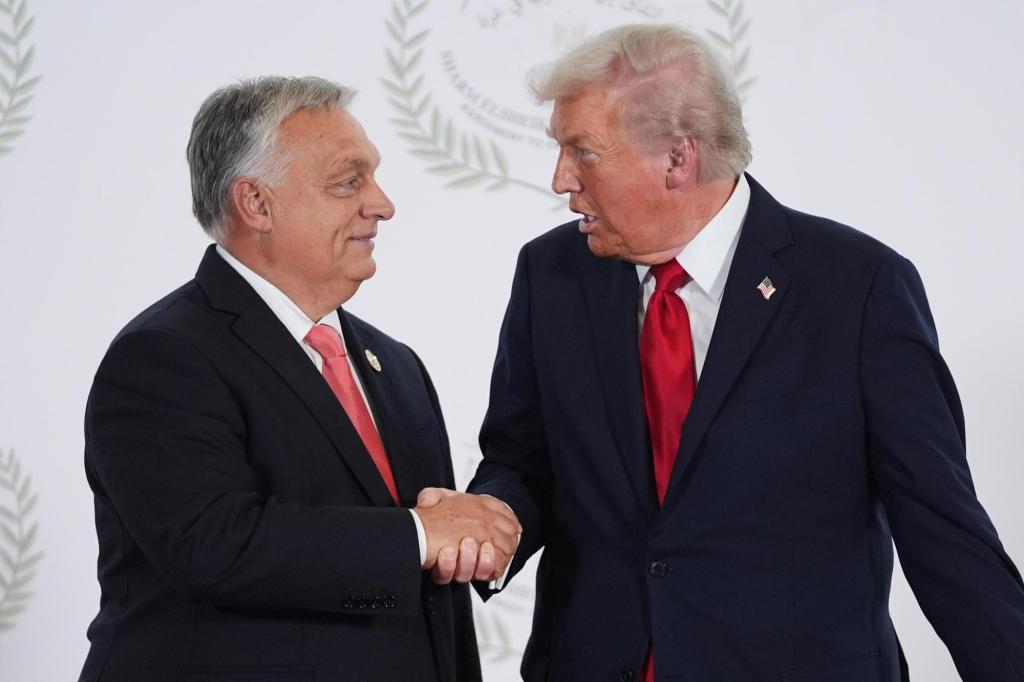

BUDAPEST, Hungary (AP) — In a notable diplomatic development, Hungary is set to host a significant meeting between U.S. President Donald Trump and Russian President Vladimir Putin. The anticipated discussions in Budapest aim to address the ongoing war in Ukraine.
President Trump disclosed plans for his second meeting this year with Putin, scheduled to precede his talks with Ukraine’s Volodymyr Zelenskyy at the White House. The date for the Budapest meeting is yet to be confirmed, but Trump suggested it might occur in about two weeks.
Hungary’s Unique Position
Prime Minister Viktor Orbán, a staunch ally of Trump and regarded as Putin’s closest ally within the European Union, emphasized Hungary’s peace-oriented stance as a factor in choosing Budapest for the talks. “Budapest is essentially the only place in Europe today where such a meeting could be held, primarily because Hungary is almost the only pro-peace country,” Orbán stated.
Known for his critical stance towards Ukraine and Zelenskyy, Orbán has consistently opposed Western military and financial support for Ukraine, portraying himself as a peace advocate. Critics, however, argue that Hungary’s position favors Russia and disrupts EU unity.
Hungary, a NATO member, has refused to supply weapons to Ukraine or allow their transit through its territory. Orbán has also threatened to veto certain EU sanctions against Moscow and delayed major funding packages to Kyiv. Despite EU efforts to reduce reliance on Russian energy, Hungary has increased its Russian fossil fuel imports since the conflict began.
Péter Krekó, director of Budapest’s Political Capital think tank, remarked that the Trump-Putin talks in Hungary, devoid of Ukrainian or EU representation, mark a “huge victory” for Putin, taking place in a NATO country without pro-Ukraine leaders.
Logistical Challenges for Putin’s Visit
Organizing a meeting in Budapest entails navigating complex logistics, as Putin would need to fly over several NATO territories. Though his assets are frozen in the EU, no travel ban prevents him from entering Europe. While Russian aircraft are barred from EU airspace, exceptions can be made by member countries.
Hungary, a signatory to the International Criminal Court, would be obliged to arrest Putin due to a warrant for war crimes issued by the ICC. However, Orbán announced plans to withdraw from the ICC following a visit from Israeli Prime Minister Benjamin Netanyahu, who also faced an ICC warrant.
Krekó highlighted a shared foreign policy theme among Trump, Putin, and Orbán: a disdain for multilateralism. “The EU is irrelevant, NATO to a certain extent is irrelevant, the ICC is irrelevant. What matters is when strong men are sitting around the table and deciding over the fate of the world,” he declared.
Symbolic Venue for Negotiations
Budapest, as the venue for the Trump-Putin meeting, holds symbolic value. It was here in 1994 that the U.S., U.K., and Russia assured Ukraine of sovereignty in exchange for dismantling its nuclear arsenal. Many Ukrainians, however, view the Budapest Memorandum negatively, feeling its promises were voided by Russia’s annexation of Crimea and the subsequent full-scale invasion.
Sergiy Gerasymchuk from the Ukrainian Prism think tank expressed concern that the talks might lead to another agreement where Ukraine’s interests are compromised. He suggested the choice of Budapest might be intended to bolster Orbán’s political standing as he faces a challenging election.
Orbán, on his part, remarked that while the upcoming negotiations are “not about Hungary,” the event in Budapest represents a “political achievement.”
Associated Press writer Lorne Cook contributed from Brussels. Béla Szandelszky contributed from Kyiv, Ukraine.
Originally Published: