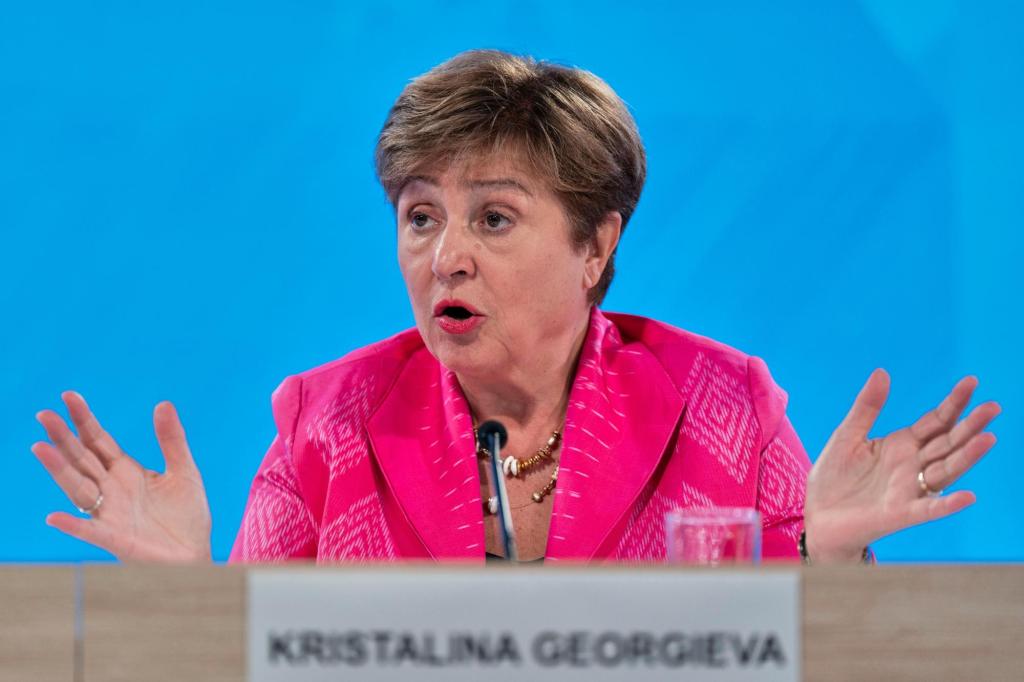

WASHINGTON (AP) — The latest projections from the International Monetary Fund reveal that both the U.S. and global economies are on track to experience slightly more growth this year than previously anticipated. Despite initial concerns, tariffs introduced by the Trump administration appear to have had a less severe impact than expected, though the full consequences remain to be seen.
According to the IMF’s World Economic Outlook, the United States’ economic growth is projected to reach 2% in 2025. This is an increase from the 1.9% forecast in the July update and 1.8% in April. Next year, the U.S. economy is expected to grow by 2.1%, slightly above the earlier projection.
Globally, the IMF forecasts a 3.2% growth rate for this year, up from the 3% estimated in July, with a steady 3.1% projection for 2026.
This revision marks a near return to the IMF’s January forecast of 3.3% global growth, prior to the initiation of tariffs by Trump. Although the economies have shown resilience, the IMF cautions that uncertainties persist as trade tensions continue.
IMF chief economist Pierre-Olivier Gourinchas explained the improved performance in a blog post: “The United States negotiated trade deals with various countries and provided multiple exemptions,” he noted. “Most countries refrained from retaliation, keeping instead the trading system largely open. The private sector also proved agile, front-loading imports and speedily re-routing supply chains.”
Many companies managed to avoid or delay price increases by increasing imports before tariffs took effect.
However, the IMF warns that these are temporary measures rather than indicators of robust economic fundamentals.
Furthermore, U.S. import price data indicates that domestic importers and retailers are bearing the brunt of tariffs, contrary to some expectations within the Trump administration. Over time, these costs may be passed on to consumers.
The IMF report also highlights emerging challenges, such as a rise in core inflation to 2.9% from 2.7% last year and a slowdown in hiring, potentially due to cautious business behavior amid tariff-related uncertainties.
The IMF’s outlook is slightly more optimistic than that of many private-sector economists. The National Association for Business Economics recently predicted a 1.8% growth rate for the U.S. this year and 1.7% for 2026. Nearly two-thirds of NABE economists believe the tariffs are dampening growth by up to half a percentage point.
Some factors are mitigating the tariffs’ adverse effects, Gourinchas stated. Reduced immigration has constrained the labor supply, contributing to a low unemployment rate, even as hiring slows. Additionally, investments in AI-driven technology have bolstered economic activity.
China has adapted to U.S. tariffs by shifting exports towards Europe and Asia, benefiting from a weaker currency that makes its goods more competitive. The IMF anticipates China’s economy will grow by 4.8% this year and 4.2% in 2026, consistent with previous estimates.
In Europe, Germany is enhancing growth through increased military spending, leading to a revised growth forecast of 1.2% for the eurozone this year, up from 1% in July, with a stable 1.1% estimate for next year.
The IMF, comprising 191 member nations, aims to foster economic growth, financial stability, and reduce global poverty.
Originally Published: