
White House Ballroom Plan Under Scrutiny Amid Legal Challenges
In the midst of a legal battle, the proposal for a new ballroom at the White House is under the spotlight. As the debate unfolds, the focus is on the National Trust for Historic Preservation’s concerns and the federal planning commission’s review process.
The National Trust for Historic Preservation’s president, Carol Quillen, expressed her confidence in Will Scharf, the Trump-appointed chairman of the National Capital Planning Commission. Quillen emphasized her belief in Scharf’s commitment to a thorough review of President Donald Trump’s proposal for a White House ballroom, following Scharf’s assurance at a recent panel meeting.
“I take him at his word that the process will be conducted as it always is, deliberately and seriously, and that the commission will do its job,” Quillen stated, underscoring her trust in the commission’s methodology.
Scharf projected that the commission would receive the ballroom plans this month, promising a “normal and deliberative pace” for their review. However, the White House remains unresponsive to inquiries about when the plans will be submitted for review by Scharf’s panel and the Commission of Fine Arts. The planning commission has listed the “East Wing Modernization Project” on the agenda for its January meeting, marking an initial step in evaluating the proposal.
Meanwhile, the National Trust has sought judicial intervention to pause the ballroom construction pending comprehensive independent reviews and congressional approval. The federal government countered, labeling the lawsuit as premature. A federal judge recently dismissed the National Trust’s request for an immediate restraining order but scheduled a January hearing for a preliminary injunction, potentially delaying the project for months.
Quillen clarified that the nonprofit organization seeks these reviews not merely for procedural compliance but to enhance the project through diverse feedback. The National Trust’s foundational mission includes ensuring public involvement in decisions impacting historic resources, with the White House being “arguably the nation’s most iconic building.”
Legal action was a last resort for the National Trust, as they traditionally collaborate with administrations. The organization refrained from speculating on Trump’s reasons for delaying submission of ballroom plans, despite his quick action to begin construction following his return to office. Trump has criticized the inadequacy of existing White House spaces for large gatherings, proposing a 90,000-square-foot ballroom capable of hosting 999 guests.
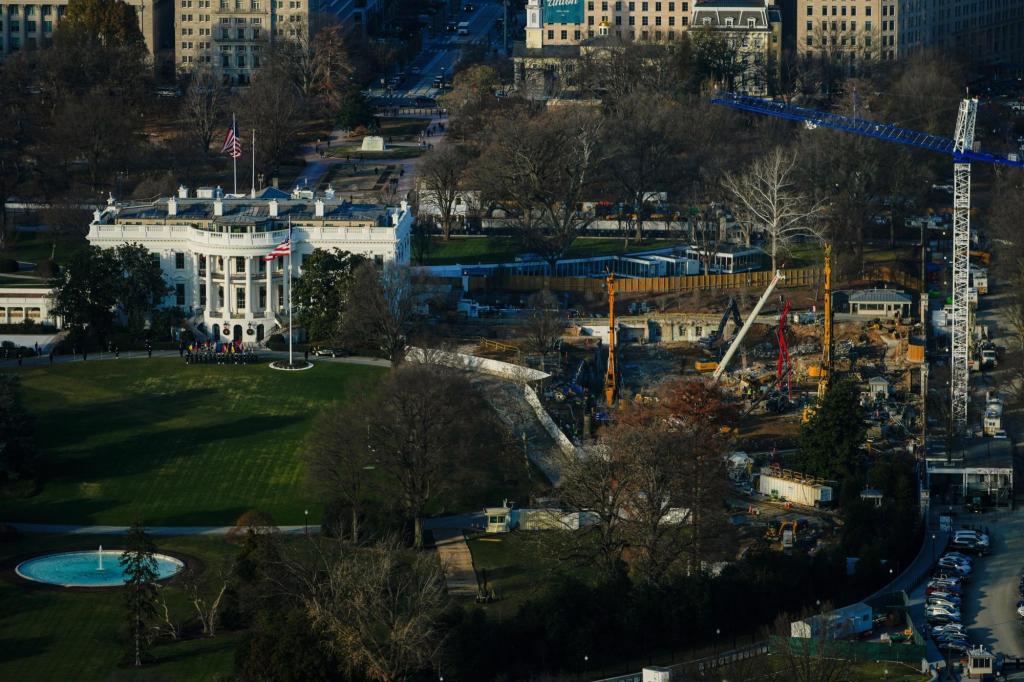
Trump’s decision to demolish the East Wing in October, a move that “caught us by surprise,” according to Quillen, is part of his vision for the new ballroom. The construction cost estimate has doubled to $400 million, with Trump asserting that public funds will not be used. The ballroom is projected to be completed by January 2029.
The National Trust’s lawsuit highlights the necessity for the ballroom plans to be vetted by the National Capital Planning Commission, the Commission of Fine Arts, and Congress before proceeding. Following the demolition’s initiation, the organization requested a halt until federal compliance was verified but received no response.
The government’s response indicated that while planning is ongoing, construction is not slated to start before April 2026. It also argued that Trump possesses the authority to make alterations to the White House, citing historical precedents of modifications to the Executive Mansion over two centuries, and asserted that the statutes in question do not apply to the president.