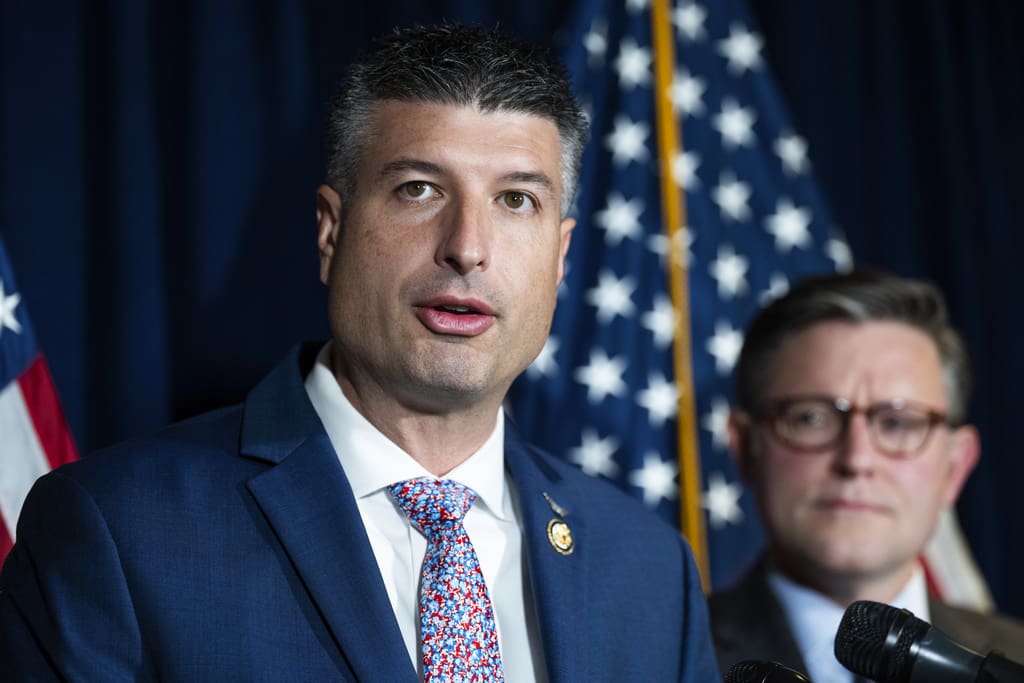
As the One Big Beautiful Bill Act (OBBB) stirred debates in Congress, it also brought financial benefits to certain individuals and corporations, notably for Michigan Rep. Tom Barrett. His campaign received substantial contributions from those who later reaped rewards following the bill’s enactment.
Tom Barrett, representing Michigan’s 7th District, encompassing Lansing, is identified as one of the most vulnerable House Republicans facing reelection this year, according to political analysts. The Democratic Congressional Campaign Committee has also highlighted his district as a key battleground.
Between March and June 2025, Barrett’s campaign coffers swelled with nearly $50,000 from eight billionaires. Among them were Richard Uhelin and Jeffrey Yass, notable supporters of MAGA causes, each contributing $7,000. Ross Perot Jr., a real estate heir, also donated $7,000.
Additionally, Barrett secured $17,500 from executives in the oil and gas sector, including those from Chief Oil and Gas, Sable Periman, and Arrington Oil and Gas. Koch, Inc.’s political action committee contributed another $2,000.
The OBBB legislation provided significant tax cuts to large corporations and wealthy individuals, directly benefiting Barrett’s donors. These tax breaks come at the cost of reduced funding for Medicaid and other government services, potentially affecting over 13,000 of Barrett’s constituents by stripping them of health insurance.
Despite potential drawbacks, Barrett has praised the legislation as a “significant win” for Michigan families and expressed his enthusiasm in an interview with WILX News, stating he was “championing all of the great things out of the big, beautiful bill.”
The OBBB also slashed funding for clean energy initiatives, removing tax incentives for solar and wind energy expansion. It further relaxed restrictions on oil and gas exploration, a move applauded by industry leaders.
Mike Sommers, president of the American Petroleum Institute, described the bill to CNBC as a “dream come true,” highlighting its alignment with industry priorities. “This bill will be the most transformational legislation that we’ve seen in decades in terms of access to both federal lands and federal waters,” Sommers noted.
The legislation may lead to higher utility bills for American consumers. The OBBB also facilitates the construction of AI data centers, which could further stress local power grids and elevate energy costs, as discussed in a report by PBS NewsHour.
A nonpartisan analysis by Energy Innovation, detailed in The Atlantic, projects that Michigan households could face an annual increase of $473 in utility costs by 2035 due to the OBBB.
Barrett’s political career has previously been scrutinized for his connections with special interests. While in the Michigan Senate, he supported measures favoring car insurers, receiving $5,000 in contributions following his votes. In 2018, he backed legislation opposing paid leave and delaying minimum wage hikes, receiving nearly $197,000 from PACs against these policies.
The Democratic candidate to challenge Barrett will be determined in the upcoming primary on August 4.