Restoration of Confederate Statue in Washington Sparks Debate
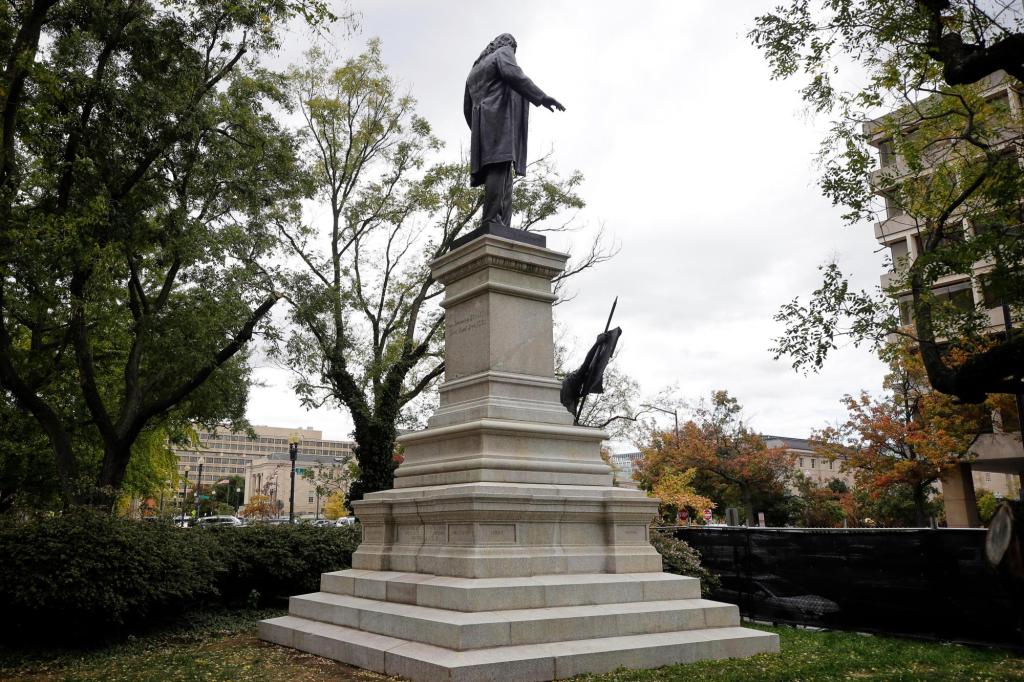
In a move that has reignited discussions about how history should be commemorated, the Trump administration has reinstated the statue of Confederate General Albert Pike in Washington, D.C. This decision follows the statue’s removal during the 2020 racial justice protests, where it was toppled and set aflame on Juneteenth—a day marking the end of slavery in the U.S. and later recognized as a federal holiday.
The memorial to Albert Pike, a figure who served as a Confederate general and later as a justice on the Arkansas Supreme Court, stands as the sole outdoor statue of a Confederate leader in the nation’s capital. Erected in 1901, the statue has long been a source of controversy.
The National Park Service’s announcement to restore the statue came in response to executive orders signed by President Trump in the spring, aimed at revising how American history is represented. These orders mandate reviews of interpretive materials across historical properties, urging the removal or alteration of content that may “inappropriately disparage Americans past or living.”
Controversial Memorial Sparks Political Tensions
Located in Judiciary Square, the statue’s return has met with mixed reactions. Some conservative voices have welcomed the restoration, viewing it as a corrective to what they consider the excesses of the 2020 protests. In contrast, critics argue the statue’s public placement implicitly endorses Pike’s views and actions.
Eleanor Holmes Norton, D.C.’s non-voting congressional delegate, expressed her disapproval, describing the statue’s return as “morally objectionable.” Norton has introduced legislation aiming to permanently remove the statue. “Confederate statues should be placed in museums as historical artifacts, not remain in parks or other locations that imply honor,” she stated, adding that Pike “represents the worst of the Confederacy and has no claim to be memorialized in the nation’s capital.”
President Trump had previously criticized the statue’s removal, calling it a “beautiful piece of art.” The removal of Confederate monuments has been a focal point of activism, particularly following the 2015 murder of nine Black churchgoers by a white supremacist who admired Confederate symbols. The Southern Poverty Law Center notes that over 480 Confederate symbols and statues have been removed nationwide since then.
Pike’s Legacy and the “Lost Cause” Narrative
Albert Pike, a Massachusetts native, was a Confederate general, poet, and slave owner. During the Civil War, he led Confederate forces in Arkansas and engaged in negotiations with slave-owning Native American tribes. Although he received amnesty from President Andrew Johnson in 1865, Pike was later accused of involvement with the Ku Klux Klan.
The authorization for Pike’s statue came from Congress in 1898, and it was erected with the support of the Freemasons, who sought to honor his leadership within their society. Despite opposition from Union veterans, the statue was installed under the condition that Pike be depicted in civilian attire. The accompanying plaque highlights his roles as an author, poet, and philanthropist, omitting any mention of his Confederate military service.
The installation of Pike’s statue was part of a broader movement to romanticize the Confederacy, known as the “Lost Cause,” which sought to downplay the role of slavery in the Civil War. This movement prompted Northern states to erect statues of Union figures in response, with several Washington, D.C. neighborhoods named after Union generals situated near Pike’s statue.