In recent events that have stirred controversy, former President Donald Trump finds himself at the center of a storm of criticism. This backlash arises from religious and conservative circles, including his own political followers, as a result of provocative statements and alarming war rhetoric.
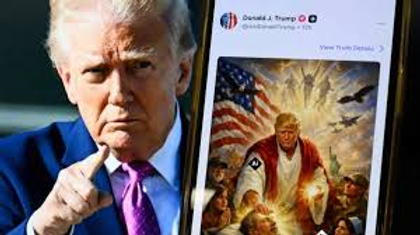
One of the latest points of contention is an AI-generated image shared by Trump portraying himself as Jesus Christ. The depiction, which shows Trump in robes and glowing hands with a menacing figure in the background, has sparked significant outrage. Despite Trump’s usual steadfastness in the face of criticism, he removed the image approximately twelve hours after posting it. The sharpest criticisms did not emerge from political opposites but from conservative and religious leaders.
Isabel Brown, a Catholic voice on the Daily Wire, expressed her disapproval, calling the post “frankly, disgusting and unacceptable, and also a profound misreading of the American people experiencing a true and beautiful revival of faith in Christ.” Similarly, conservative commentator Riley Gaines, known for her presence at Trump events, remarked, “I cannot understand why he’d post this. A little humility would serve him well. God shall not be mocked.”
The reaction was not limited to individual commentators. Rev. James Martin, representing the Catholic publication America, told CNN the portrayal was “the most Jesus-looking picture I think I could imagine,” challenging Trump’s claim that the image showed a doctor.
This incident follows Trump’s ongoing dispute with Pope Leo XIV, the first American-born pope. After the Pope’s calls for peace and criticism of Trump’s aggressive stance towards Iran, Trump branded Leo “weak on crime” and “terrible on foreign policy.” In response, Pope Leo XIV confidently declared, “I have no fear of the Trump administration.”
The Iranian threats that Trump alluded to exacerbate the ongoing tensions, with language suggesting the potential annihilation of an entire civilization. These statements caused concern among his Republican allies and bipartisan unease on Capitol Hill. The unpredictability of the situation has led some critics to voice worries about the administration’s approach not having a clear strategy or exit plan.
This heated atmosphere is igniting further debate about Trump’s social media activities. Earlier incidents include sharing a video with a racially insensitive depiction of Barack and Michelle Obama, which he claimed to overlook, and an unsympathetic comment about the murder of director Rob Reiner and his wife.
The accumulation of contentious actions has even prompted public critique from those previously aligned with Trump. Figures such as retired generals and former diplomats have questioned his conduct, and Ty Cobb, a former White House lawyer during Trump’s first term, has described him as “clearly insane.”
According to a Reuters/Ipsos poll from February, 61% of Americans perceive Trump as increasingly erratic, particularly given his age. Congressional Democrats are responding by proposing a commission to assess the president’s mental health, though this move will likely face opposition from the Republican majority.
The greater question emerging from these events is whether Trump’s self-representation as a champion of Christian values aligns with his public actions and statements. His behavior is raising doubts even among his supporters about the congruence of his claims with the principles he professes to uphold.