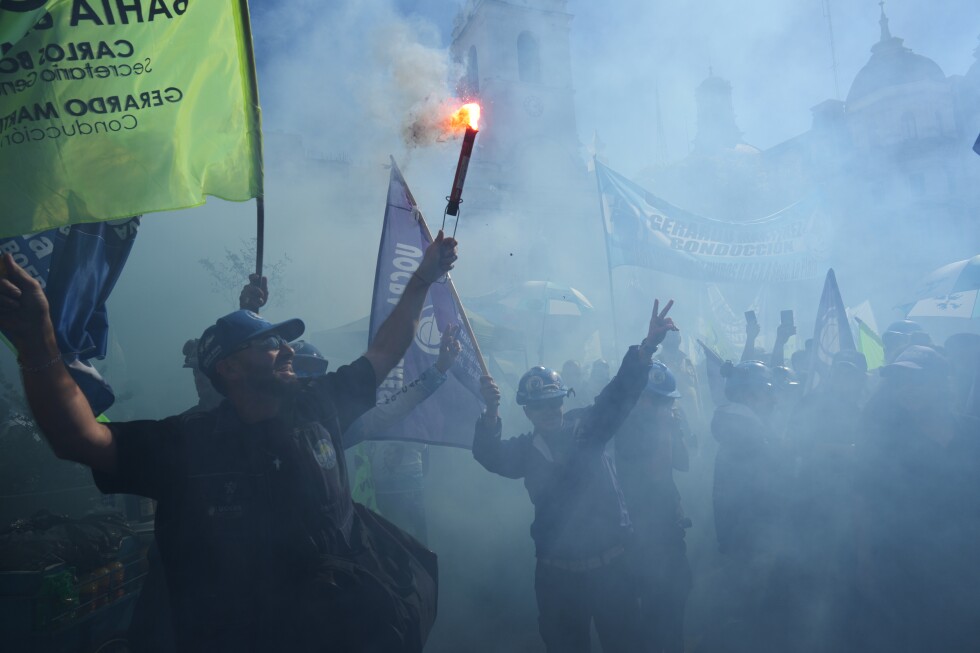
In Buenos Aires, mounting discontent reached a boiling point as Argentine workers staged protests in response to President Javier Milei’s sweeping changes to the nation’s labor laws. The demonstrations, coinciding with the annual May Day observance, underscored the growing unrest among workers over the erosion of long-established labor protections.
On the eve of International Workers’ Day, Argentina’s most prominent union, the General Confederation of Labor (CGT), gathered at the capital to voice opposition against the labor reforms. These reforms, enacted by Milei, aim to dismantle labor codes that have been in place since 1974, offering significant worker protections but also perceived as burdensome by businesses.
Addressing the participants, Octavio Argüello, a CGT leader, declared, “We want to say to this government, enough is enough. Our patience has run out, Mr. President.” The crowd, comprising drum-beating, banner-waving workers, echoed his sentiments, demanding the preservation of their rights.
Historically, Argentina’s unions have successfully thwarted attempts to liberalize the labor market. Despite recent demonstrations and a nationwide strike, Milei’s administration succeeded in passing the labor-law package in February, securing a victory for his free-market agenda.
Opponents of Milei’s reforms are actively pursuing an appeal process questioning the constitutionality of the new law. Union leaders intend to submit additional petitions after a court recently overturned an injunction that had temporarily halted the law’s implementation. The matter is projected to reach the Supreme Court.
The labor reforms have reignited tensions in a nation where worker unions have historically been pivotal in shaping the left-leaning Peronist movement that has dominated Argentine politics since the 1940s. As Milei’s efforts to curb inflation flounder, wages fail to keep pace with rising prices, and unemployment edges up, discontent grows.
“The economy is not growing as strongly as the government thought it would,” observed Marcelo J. García, Americas director for Horizon Engage, a geopolitical risk consultancy. “The majority of Argentines may feel that they’re not seeing the benefits of (Milei’s) economic program. And that’s Milei’s biggest political risk at the moment.”
The new legislation facilitates extended workdays, longer probation periods, and replaces overtime pay with time off. It also limits the power of unions on salary negotiations and restricts court discretion on severance compensations. Critics argue these changes discourage formal employment, leaving nearly half of Argentines working off the books.
Economic indicators present a grim outlook. Argentina’s construction and manufacturing sectors are showing signs of recession. Fundación Pro Tejer, representing textile manufacturers, reported a nearly 30% decline in textile production for the year’s first two months.
Job losses are mounting, with the formal labor market shedding around 200,000 positions since Milei assumed office, as reported by the Ministry of Human Capital. The unemployment rate rose to 7.5% in the last quarter of 2025.
Milei, who rose to power in late 2023 amid dissatisfaction with the previous government’s fiscal policies, dismisses reports of economic challenges as media exaggerations. “We receive international recognition for our achievements,” he stated at an economic conference. “But as the saying goes, ‘No one is a prophet in his own land.’”
The protests indicate potential future clashes between Milei’s administration and the labor sector. Manuel Correa, a textile worker, expressed the protesters’ resolve: “We’ll stay in the street until the government changes or backtracks. We don’t have an alternative.”
Follow more coverage of Latin America and the Caribbean at https://apnews.com/hub/latin-america