Handwriting Analysis Suggests Common Authorship of Notes Found in Epstein’s Cell
Recent scrutiny over two notes linked to Jeffrey Epstein’s time in jail has revealed compelling similarities in their handwriting. Experts in forensic document examination have analyzed these notes, concluding that they likely share a common author, which could shed light on Epstein’s state of mind prior to his death.
Three handwriting specialists, consulted by The Associated Press, have reported a notable correlation between a note discovered by Epstein’s former cellmate and another note found in Epstein’s cell posthumously. The experts highlighted consistent characteristics such as spacing, letter shapes, and punctuation.
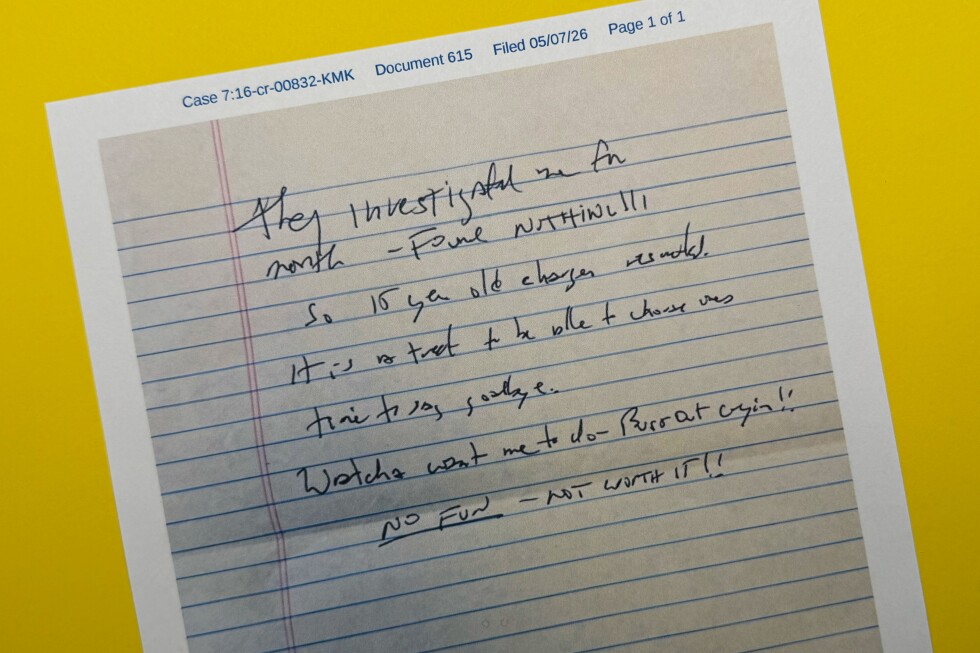
The first note, which recently came to public attention, mentions being investigated for months with no findings and hints at choosing a “time to say goodbye.” The second note, known for years, is a list of complaints about the jail conditions, including issues with the showers, food, and pests.
Although no definitive conclusion has been reached regarding Epstein’s authorship of these notes, they reflect his bleak outlook before his death, mirroring frustrations he had previously shared with jail officials about his confinement conditions at the Metropolitan Correctional Center in Manhattan.
Both notes possess identical elements, such as the underlined phrase “NO FUN” and concluding with double exclamation marks, with a unique curvature in the first. Initial words in each note are emphasized in size, and the lines display a consistent leftward slant.
Thomas Vastrick, president of the American Society of Questioned Document Examiners, noted, “These are the kinds of things that would suggest that we’re dealing with the same writer.” Bart Baggett, founder of Handwriting Experts Inc., affirmed, “They are written by the same person.”
Grace Warmbier, previously with the New York City Police Department, also supported the shared authorship hypothesis. However, the lack of confirmed samples of Epstein’s handwriting complicates a conclusive attribution.
In addition to Epstein’s notes, Warmbier and Vastrick examined samples from Nicholas Tartaglione, Epstein’s cellmate, who had claimed to discover the initial note. Tartaglione has denied any connection to Epstein’s death, a stance he reiterated in a note to the New York Daily News in 2019. Warmbier dismissed Tartaglione as the author, citing significant differences in handwriting.
Vastrick, however, found some similarities warranting further investigation, stating, “At this point, I certainly would not eliminate him as a potential writer,” while also clarifying that he doesn’t suggest Tartaglione is the author.
The note Tartaglione reported finding remained largely unknown until last summer when it was mentioned on a podcast by writer Jessica Reed Kraus. This revelation led The New York Times to seek its release, resulting in a judge unsealing it on Wednesday as part of an unrelated case.
This note was reportedly discovered after Epstein’s initial suicide attempt on July 23, 2019, when he was found with a bedsheet around his neck. Despite being placed on suicide watch, Epstein was later found dead on August 10, 2019, without a cellmate.
Following Epstein’s arrest on sex trafficking charges, he and Tartaglione shared a cell for approximately two weeks until the suspected suicide attempt. Tartaglione informed his lawyer about the note four days after the incident; however, there is no evidence that jail officials or Epstein’s representatives were notified.
While the note was submitted as evidence in Tartaglione’s case, it remained sealed amid legal disputes. It was absent from government reports on Epstein’s death and the Justice Department’s files, although the other note was shown on CBS’ “60 Minutes” in 2020.
Beyond handwriting, the notes’ phrasing may offer clues to their origins. The note Tartaglione claimed to find includes the line: “Watcha want me to do — Bust out cryin!!” Epstein had previously referenced similar language in emails, mimicking a 1931 “Little Rascals” film, including one sent to his brother months before his incarceration.
___
Associated Press videojournalist David R. Martin contributed.
___
EDITOR’S NOTE — This story includes discussion of suicide. If you or someone you know needs help, the national suicide and crisis lifeline in the U.S. is available by calling or texting 988. There is also an online chat at 988lifeline.org.