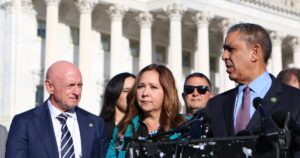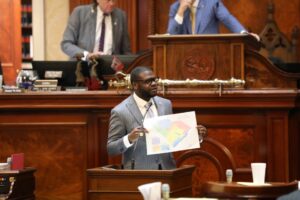
In a political landscape where the power of the vote is paramount, recent developments in Florida have sparked intense debate over representation and fairness. The state’s Supreme Court has upheld congressional maps championed by Governor Ron DeSantis, a move that critics claim undermines Black voter influence.
Four years into redistricting efforts, the Florida Supreme Court’s decision supports the controversial maps, arguing that maintaining a majority Black district could breach the 14th Amendment’s Equal Protection Clause. This reasoning has been met with strong opposition from groups like Black Voters Matter Capacity Building Institute and the League of Women Voters of Florida. They argue the new maps violate the 2010 Fair Districts Amendment by diluting Black voter power, as detailed by Democracy Docket.
Governor DeSantis insists that his map aligns with constitutional requirements, a stance supported by several court rulings. However, this has not quelled criticism that the maps fragment Black voters from Florida’s 5th Congressional district among four different districts, weakening their collective electoral influence.
The debate centers on the “non-diminishment” clause of Florida’s Fair Districts Amendment, which bars the creation of districts that hinder racial or language minorities from electing their chosen candidates. Legal challenges remain, including a case involving Congressional District 26 and another concerning Florida Senate District 16, as reported by the ACLU of Florida.
Amidst these challenges, the Legal Defense Fund highlights ongoing issues like unfairly drawn districts and other barriers that persist in Florida. Their statement stresses, “Conditions that can foster voting discrimination… endure throughout Florida.” The persistence of such conditions underscores the need for robust federal oversight to protect minority voting rights.
The contentious redistricting in Florida is part of a broader national struggle over voting rights and representation. Advocates call for legislative action to restore and bolster the Voting Rights Act of 1965, especially after the U.S. Supreme Court’s decision in Shelby County v. Holder weakened its provisions.
As the battle over voting rights continues, the importance of sustained advocacy and legislative action remains critical. Ensuring equal access to the ballot and fair representation is vital for the health of American democracy.
SEE ALSO:
Federal Judges Rule Florida Gov. Ron DeSantis’ ‘Race-Neutral’ Congressional Map Is Constitutional
Redistricting: Majority Black Voting Maps Rejected In Louisiana