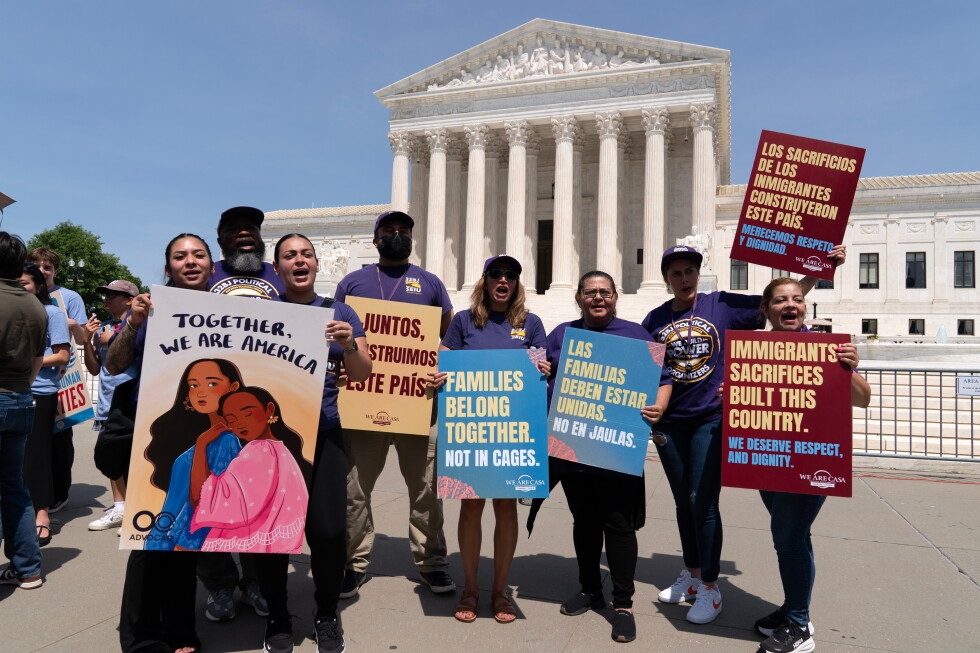
The Supreme Court recently played a decisive role in shaping the U.S. immigration landscape, primarily supporting the Trump administration’s stringent policies. Yet, a significant exception emerged with the decision to uphold birthright citizenship.
Despite facing setbacks in lower courts, the Trump administration found support from the Supreme Court, which approved the termination of temporary protections for those escaping conflict and allowed the government to impose restrictions on asylum applications. Additionally, immigration officers were granted more authority in handling cases involving green card holders returning from abroad.
A pivotal moment occurred when the Supreme Court maintained the principle of birthright citizenship, ensuring that those born in the U.S. are granted citizenship, regardless of their parents’ immigration status. This decision was a major blow to the Trump administration’s efforts to redefine American citizenship.
Birthright Citizenship Upheld
The Trump administration’s attempt to prevent children born to undocumented or temporary immigrants from gaining U.S. citizenship was thwarted by the Supreme Court. The court, in a narrow 5-4 decision, upheld the 14th Amendment’s provision of birthright citizenship, reaffirming a long-standing interpretation that grants citizenship to anyone born on American soil. This decision thwarted an executive order signed by President Trump on his first day in office, which sought to limit birthright citizenship but faced legal challenges.
The ruling prompted reactions across the political spectrum. Advocates praised the decision, while some Republicans proposed new measures to limit birthright citizenship.
Temporary Protections for Haitians and Syrians Removed
The Supreme Court’s decision permitted the Trump administration to rescind protections for migrants from Haiti and Syria, leaving many at risk of deportation. The court’s conservative majority ruled that the judiciary cannot question the process used by immigration authorities to revoke these protections. This decision affects not only hundreds of thousands from Haiti and Syria but also approximately one million individuals under Temporary Protected Status (TPS).
Republican critics argue that TPS should remain temporary, while immigration advocates highlight ongoing dangers in countries like Haiti and Syria.
Asylum Applicants Face New Limits
The Supreme Court cleared the way for an asylum-metering policy, initially introduced under the Obama administration and expanded under Trump. This policy limits the number of asylum applications processed daily at the southern border. Although not currently in effect, the administration may choose to reinstate it, despite concerns that the policy had previously led to humanitarian crises at the border.
Greater Leeway with Green Card Holders
In another 6-3 decision, the Supreme Court granted immigration officers increased discretion in handling cases involving green card holders returning from abroad. The case stemmed from an incident involving Muk Choi Lau, a lawful permanent resident who faced challenges upon returning from China due to past accusations of counterfeiting.
Justice Ketanji Brown Jackson expressed concern that the decision afforded the government excessive power over lawful permanent residents. The American Immigration Council noted that while Congress intended to provide travel protections for green card holders, the recent ruling raises questions about its broader implications.