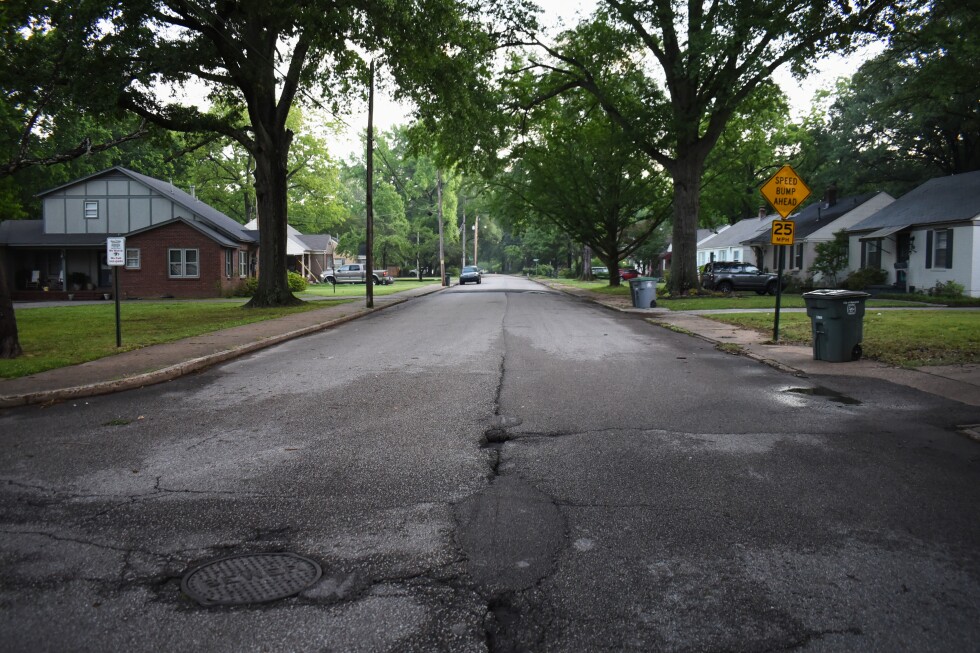
MEMPHIS, Tenn. (AP) — In the heart of Memphis’ Beale Street, Steve Fowler and Sam Wilson have been bandmates for over two decades. For the last ten years, they’ve also been neighbors on a tranquil street, sharing more than just music.
However, a political shift has now divided their voting districts despite their proximity.
The Republican-led Tennessee legislature redrew Memphis’ congressional map, a city traditionally holding a Democratic-leaning seat. The redistricting has fragmented the city into three districts favoring Republicans, effectively splitting its majority-Black population into predominantly white, rural areas diverging from Fowler and Wilson’s East Memphis locale.
A dividing line now separates Fowler into the 8th Congressional District, stretching into central Tennessee, while Wilson remains in the 9th District, extending toward Nashville’s suburbs.
“I think it’s horrible,” Fowler, who is white, expressed. “This isn’t just going to be bad for Black folks in Memphis, but poor whites in these new districts also aren’t going to get services. How are any of these congressmen going to serve all these different counties?”
Part of a National Redistricting Trend
The changes stem from a U.S. Supreme Court decision by the conservative majority that potentially jeopardizes congressional representation for majority-Black Southern communities like Memphis.
For 60 years, the Voting Rights Act necessitated that district maps did not discriminate against racial minorities, ensuring minority communities could elect representatives of their choice rather than having their votes diluted.
On April 29, the justices significantly weakened this requirement, prompting Southern Republicans to swiftly redraw maps before the upcoming November elections, aiming to eliminate Democratic-held, majority-minority districts.
Tennessee was the first Republican-majority state to complete its new map, joining other Southern states like Alabama, Florida, and South Carolina in a widespread redistricting effort.
Critics have long argued that the Voting Rights Act hindered their ability to redraw Democratic-leaning, majority-Black districts in a manner akin to what Democrats do to conservative-leaning areas in states they control. Tennessee Republicans previously attempted a similar strategy in Nashville, a majority-white city.
“Tennessee is a conservative state and our congressional delegation should reflect that,” commented Republican state Sen. John Stevens, who supported the new map making all congressional districts Republican strongholds.
A ‘Central Place’ in the Fight for Racial Justice
Wilson, a Black musician from Memphis, perceived the redistricting as another challenge for the city, similar to the federal agents deployed by President Trump to tackle crime, and narratives about Memphis’ safety concerns from surrounding areas and lawmakers.
“It’s a hustling community. We’re going to make ends meet for our families,” Wilson stated, emphasizing the city’s rich musical and civil rights legacy. “Hard times mean you’re going to try and find your gift. That’s what we do here; music in Memphis is a way of life.”
The Memphis district’s existence predates the Voting Rights Act, reflecting Tennessee’s belief that its major city should possess its own congressional district. However, attempts to split the district for partisan reasons were previously subject to lawsuits. Now, legal risks have diminished.
Despite this, Democrats and civil rights advocates are challenging the map. The city’s symbolic significance is highlighted by its hosting of the National Civil Rights Museum, located at the site of Martin Luther King Jr.’s assassination. Protests erupted during the map’s passage, with accusations of reviving Jim Crow laws.
“Memphis is not just any city; it holds a central place in the national story of our quest for racial justice in this country,” remarked Eric Holder, former U.S. attorney general and chair of the National Democratic Redistricting Committee. “Black citizens protested, marched and died there for the right to vote.”
Complex Relations within Tennessee
Memphis has experienced contrasting narratives recently. Significant investments have flowed into the city, yet regional economic concerns persist among local businesses.
Residents voice worries about safety and public services while challenging perceptions of rampant crime. This duality is evident in the cityscape, where economically diverse neighborhoods coexist closely.
Memphis’ relationship with Tennessee’s conservative legislature has been contentious, especially after the state voted overwhelmingly for Trump in 2024.
Conflicts have arisen over management accusations, and the legislature has blocked police reforms in Memphis post-Tyre Nichols’ death. Additionally, measures have been enacted to assume control over Memphis’ airport board and other local entities, extending powers to the state attorney general.
“The state legislature is trying to take it over,” said U.S. Rep. Steve Cohen, a white Democrat representing Memphis until the new district lines take effect. “And that’s absurd. It was all partially because it’s a majority Black city.”
Impact on Black Representation in Tennessee
Rhodes College professor Thomas Goodman warns that the new districts could escalate competition for resources among constituents in differing regions. Memphis residents will share districts with Republican areas with contrasting demographics and economies.
“It would not only deprive Black Tennesseans of proper representation,” Goodman noted. “These changes also break up the city of Memphis as an entity into multiple districts, thereby removing a dedicated agent in government who knows the people, who understands their concerns and can speak for them and deliver on behalf of their interests and desires.”
Chris Wiley, residing on a street now intersecting three districts, reflects the sentiment, stating, “Tennessee is all about the dollar” rather than its residents.
“Memphis is majority Black, so if you mess with that, what’s the point of even voting in Tennessee?” remarked Wiley, a Black sports stadium worker. “Whatever the congressional numbers, whatever that is, we don’t count on the scale as high, anyway.”