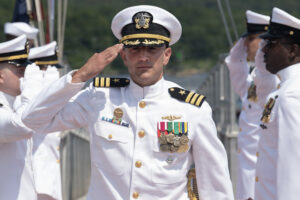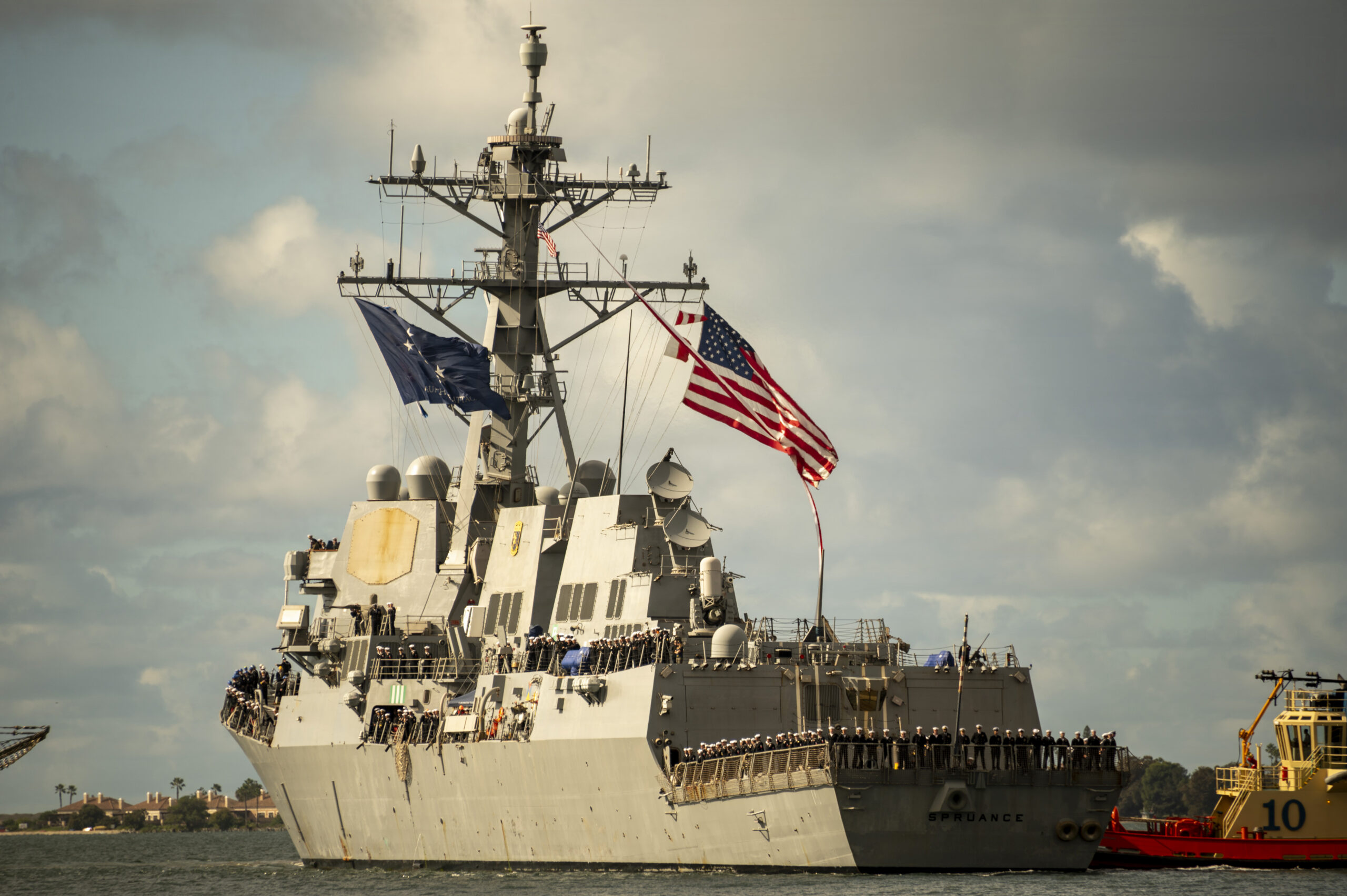
After nearly a year in some of the world’s most contested waters, two U.S. Navy destroyers have finally come home. The USS Michael Murphy and the USS Spruance — two Arleigh Burke-class guided-missile destroyers that served at the center of U.S. military operations during the Iran war — returned to their homeports on Friday, bringing their crews back after deployments lasting 11 and 12 months respectively.
The Murphy docked at Joint Base Pearl Harbor-Hickam in Hawaii, while the Spruance returned to Naval Base San Diego in California. Both ships saw significant combat action during Operation Epic Fury and played a critical role in enforcing the maritime blockade in the Strait of Hormuz.
What These Ships Did Downrange
The Spruance deployed as part of the USS Abraham Lincoln Carrier Strike Group and accumulated an impressive combat record over its 12 months at sea. The destroyer shot down 12 unmanned aerial vehicles and four anti-ship cruise missiles, launched Tomahawk Land-Attack Cruise Missiles at Iranian targets, logged 43 underway replenishments delivering 8.6 million gallons of fuel, and supported 190 sorties and 1,150 flight hours for its embarked helicopter squadron.
Cmdr. Leigh R. Tate, commanding officer of the Spruance, reflected on the deployment upon return:
“Leading the ship and crew has been the honor of a lifetime. Spruance sailors made a difference.”
The Murphy operated under Destroyer Squadron 21 as part of Carrier Strike Group 3, sailing alongside the Lincoln and Spruance. It transited the Strait of Hormuz 12 times while facing surface, air, and mine threats, and defended 14 U.S. and allied vessels throughout the deployment. The ship covered 97,000 nautical miles, completed 43 replenishments-at-sea and eight combat in-port refuelings, and delivered more than 10 million gallons of fuel. Its helicopter detachment flew 330 sorties and over 900 mishap-free flight hours, including 273.4 combat flight hours.
Cmdr. David Nicolas, commanding officer of the Michael Murphy, credited his crew with
“defeating incoming air and surface threats”
and
“leading operations through contested choke points.”
Service members aboard both ships were awarded the Presidential Unit Citation and the Combat Action Ribbon in recognition of their service.
The Shadow of Minab
The homecoming, however, is not without controversy. Iranian government officials have claimed that munitions fired from the USS Spruance on February 28 were responsible for a strike in Minab, Iran, that killed 156 civilians — 120 of them children. Reuters first reported on March 5 that an initial internal U.S. military investigation found American forces were likely responsible for the fatal strike on the opening day of the war.
Bloomberg reported on October 15 that the Pentagon planned to withhold its internal investigation results until after the midterm elections, even as multiple independent investigations were already pointing to U.S. involvement in the strike. On Friday, the Iranian government appeared to threaten the commanding officer and executive officer of the Spruance in a social media post.
Separately, the Murphy’s deployment was marked by an unusual command change. On September 27, the Navy relieved Cmdr. Caitlin Cunningham of command due to a loss of confidence in her ability to lead the ship. The circumstances surrounding that decision have not been fully disclosed publicly.