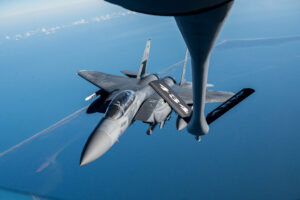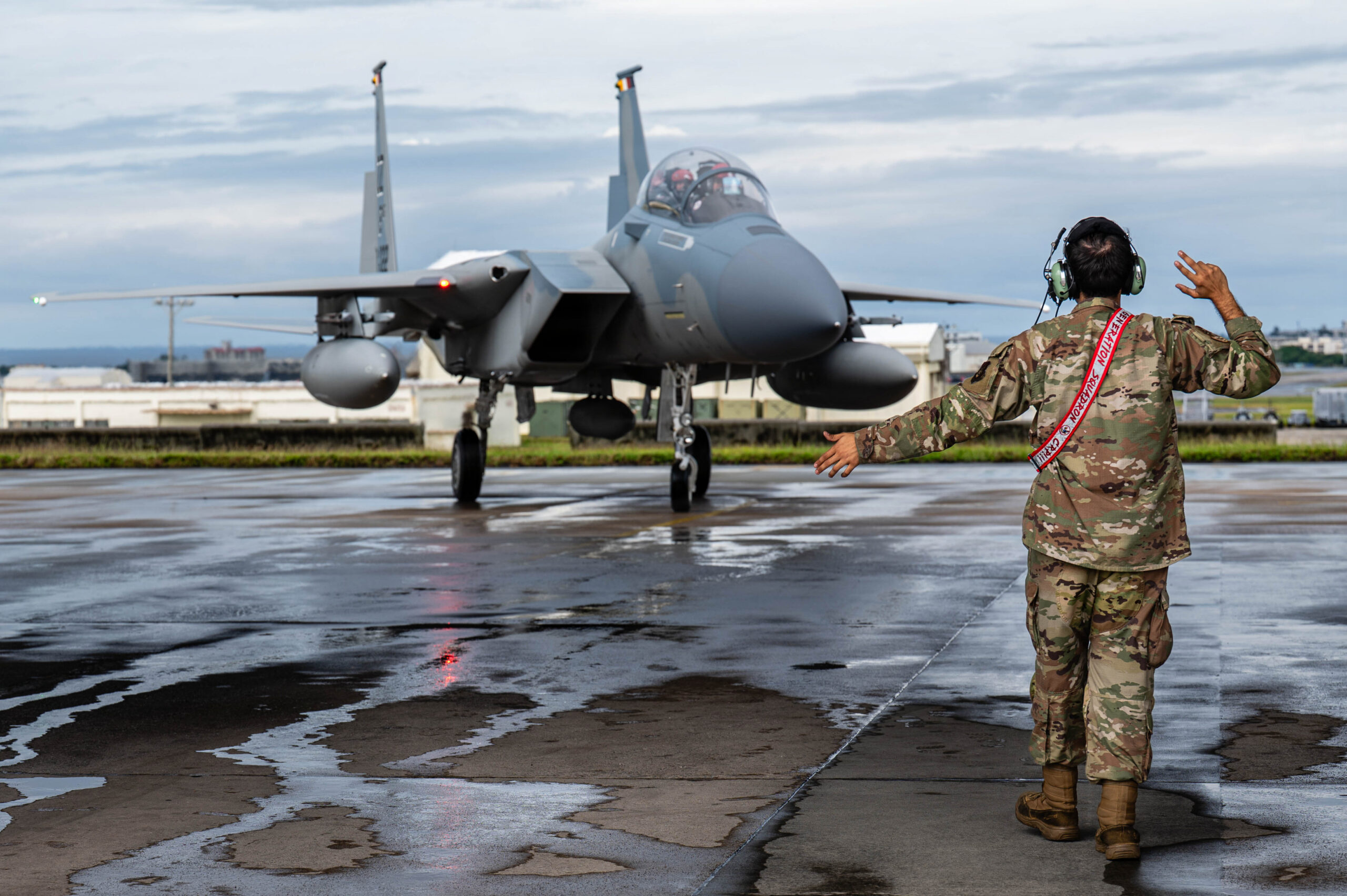
For the first time ever, an American military base outside the United States has received permanently assigned F-15EX Eagle IIs — a milestone that signals a significant shift in how the U.S. projects airpower across the Pacific. The move puts one of America’s most capable fighter jets on the front lines of a region that military planners consider among the most strategically sensitive on the planet.
Kadena Air Base in Okinawa, Japan, accepted two of the advanced fighter aircraft on Sunday, becoming only the second Air Force location ever to field the fighter jet, according to a recent Air Force release. The arrival marks a critical step in the service’s broader effort to modernize and reinforce its forward-deployed forces in the Indo-Pacific.
Replacing a Fleet Decades in the Making
The transition at Kadena has been years in the works. Back in November 2022, the base began phasing out its aging F-15C/D aircraft, which had been stationed there for more than 40 years. To fill the gap during the changeover, the Air Force relied on rotational deployments of fourth- and fifth-generation fighters while personnel trained up on the new platform.
Now that the F-15EXs have arrived, Kadena’s 44th and 67th Fighter Squadrons are both expected to operate them. The 67th Fighter Squadron — part of the base’s 18th Operations Group — sent pilots to Eglin Air Force Base in Florida and Portland Air National Guard Base in Oregon to complete aircraft qualification training ahead of the jets’ arrival. The Oregon Air National Guard was the first unit to receive the F-15EX, doing so two years before Kadena’s permanent assignment.
Maintenance crews also put in extensive preparation work. Personnel from the 18th Aircraft Maintenance Squadron coordinated directly with Boeing — the jet’s manufacturer — as well as teams at Eglin and Portland to build technical proficiency. They also supported F-15E operations at Seymour-Johnson Air Force Base in North Carolina and Mountain Home Air Force Base in Idaho to, as the release puts it, “keep their skills sharp.”
What the F-15EX Brings to the Pacific
The F-15EX Eagle II is a substantial upgrade over the aircraft it replaces. It features advanced avionics, modernized electronic warfare systems, and a significantly higher weapons-carrying capacity — all capabilities designed to support counterair operations and bilateral readiness alongside Japan’s Air Self-Defense Force and other regional partners.
18th Wing Commander Brig. Gen. John Gallemore made clear why the Air Force views this deployment as more than just a hardware swap.
“[F-15EXs] strengthen our ability to deter aggression, respond to emerging threats and defend Japan alongside our allies and partners,”
he said in the release.
Gallemore added that the jets’ permanent presence carries a broader diplomatic weight as well:
“Their permanent presence at Kadena reinforces our commitment to the U.S.-Japan alliance and ensures we continue to bring advanced combat capabilities to one of the most strategically important regions in the world.”
A Growing Fleet with Big Ambitions
Kadena’s milestone comes at a moment when the Air Force is aggressively expanding its F-15EX inventory. Earlier this year, as part of its fiscal year 2027 budget request, the service announced a goal to more than double the fleet — from a previously planned 129 aircraft to 267 total jets.
That expansion got a concrete push forward when the Air Force awarded Boeing a $2.38 billion contract to produce 22 additional F-15EX Eagle IIs, bringing the total number of jets contracted under Lots 1 through 7 to 120 aircraft. With permanent deployments now beginning overseas, the F-15EX program is moving from a domestic rollout into its next phase as a globally stationed combat asset.