The U.S. Army is quietly repositioning some of its most powerful weapons systems along the edge of the Pacific — and China is paying close attention. From the southern tip of the Philippines to the northern reaches of Japan, American soldiers have spent the past several years testing, moving, and firing long-range missiles in drills that are growing more ambitious by the year.
This buildup along what military planners call the “first island chain” — the arc of islands stretching from Japan through the Philippines — is a direct response to China’s expanding missile arsenal. U.S. military officials worry that in a future conflict, China’s weapons could prevent American forces from operating freely across the Western Pacific. To counter that threat, the Army has been freed from Cold War-era restrictions on missile development and has invested heavily in new and upgraded long-range systems.
HIMARS: Island-Hopping Firepower
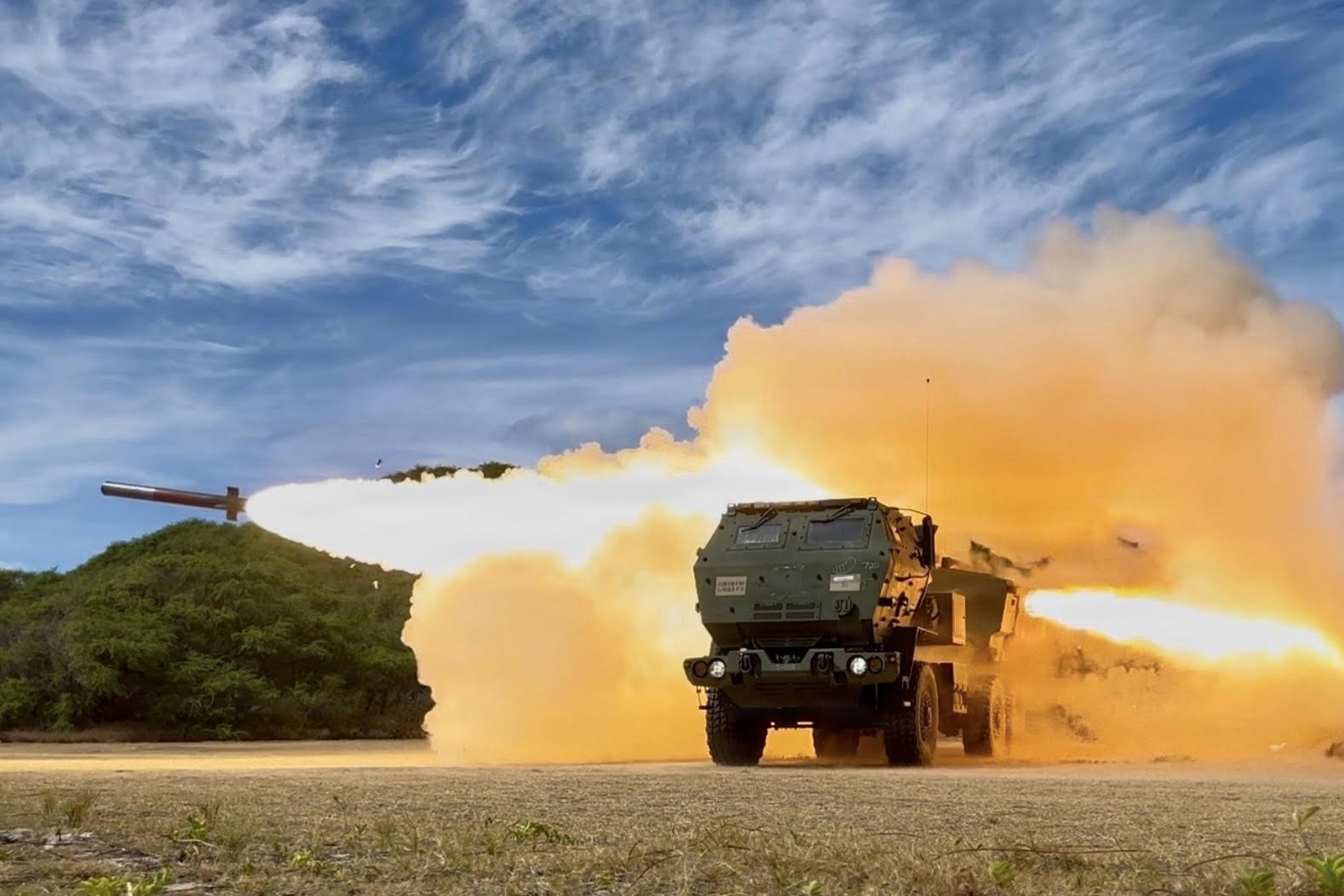
At the center of much of this activity is the High Mobility Artillery Rocket System, known as HIMARS. This truck-mounted launcher can fire guided rockets with ranges of several dozen miles or ballistic missiles reaching several hundred miles — capable of striking both land and sea targets.
HIMARS first operated in Japan in 2021 during exercises in Hokkaido. By 2022, it had moved to Japan’s Southwest Islands — the chain separating the East China Sea from the Pacific — for drills near Okinawa. Most recently, Army HIMARS were deployed during the Keen Sword exercise to a Japanese island just 150 miles east of Taiwan.
In the Philippines, HIMARS has been active even longer, but recent years have brought new roles and new locations. Exercises in 2024 and 2025 brought the system to Palawan, overlooking the South China Sea, and to Luzon’s northern coast, facing Taiwan.
This year’s Balikatan exercise — the largest annual U.S.-Philippines military drill — showcased the ability to move HIMARS by land, sea, and air across the archipelago. In April, U.S. soldiers and airmen flew a HIMARS launcher to Itbayat, the Philippines’ northernmost municipality, just 100 miles from Taiwan, for a dry-fire exercise. Weeks later, an Army watercraft transported a HIMARS launcher to Balabac Island, south of Palawan, for a live-fire exercise — a first for that location — which demonstrated its ability, as the Army stated, “to protect shipping going into the Sulu and Celebes Sea.”
Gen. Ronald Clark, commander of U.S. Army Pacific, described the overall effort at the Association of the U.S. Army’s annual conference in Washington, D.C.
“It’s really a joint success story,”
Clark said.
He highlighted one recent operation where soldiers loaded HIMARS onto aircraft at a Washington state base and flew them to the Philippines — all in plain sight of potential adversaries.
“We then join munitions from Korea that were drawn out of stocks there to the Philippines, where our adversary could see it, and then we conduct a live-fire on the backend of a HIMARS rapid-infiltration operation,”
Clark said.
“Being able to do that, it, one, takes a lot of skill. Second, it takes a tremendous amount of partnership with, in this case, allies to assist us.”
Clark said the increasingly complex exercises are designed to affect how adversaries think.
“To be able to conduct operational maneuver and have tremendous tactical effects that then have a strategic effect on our adversary is exactly what we were looking to gain, because what that does is it gives them pause.”
Typhon: A More Powerful Addition
Over the past two years, the Army has introduced an even more capable weapon to the region: the Mid-Range Capability system, known as Typhon. This ground-based launcher can fire SM-6 missiles against air and sea targets hundreds of miles away, and Tomahawk cruise missiles against land targets up to 1,000 miles distant — putting large portions of both China and Russia within potential range when deployed in the Philippines or Japan.
Typhon’s first overseas deployment came in 2024 in the Philippines, where it has stayed ever since. In May of this year, it was test-fired for the first time in the country, striking a target in central Luzon from nearly 400 miles away. The Army also sent a Typhon to Japan in August 2025 for exercises; it lingered until November before returning this summer, conducting exercises in June and September before moving to a storage base on Okinawa in October. U.S. officials have told Tokyo the deployment is not intended to be permanent, though no official end date has been set.
Maj. Gen. Bernard Harrington, who commands the recently established 7th Infantry Division/Multi-Domain Command-Pacific, said Typhon was sent to the Philippines at Manila’s request and
“has maintained forward presence for now over 30 consecutive months.”
That sustained presence has given U.S. troops valuable real-world training time.
“How do we sustain in the environment? How do you protect those types of systems in the environment? How do you connect sensor to shooter?”
Harrington said, describing what soldiers have been learning.
“To be able to do that persistently forward and persistently with our ally in the Philippines and our partners is incredibly important for us.”
China’s Response — and Real Challenges
Beijing has not stayed quiet. Chinese officials regularly criticize U.S. military exercises with Japan and the Philippines as provocative and destabilizing, and have singled out Typhon deployments for particular criticism. Experts cited in Chinese state media also argue that weapons like HIMARS, when deployed on small islands near Taiwan, face significant disadvantages — limited space and terrain restrict mobility and concealment, while the islands’ remoteness makes resupply harder to hide.
That logistical challenge is real, and U.S. war games have also highlighted the difficulty of keeping small islands near Taiwan resupplied during conflict. But Harrington argued the challenge points toward a solution rather than a weakness — U.S. forces should diversify toward lower-cost, lower-visibility weapons operating alongside the larger, more expensive missile systems.
“This maximizes options for the Joint Force while also enhancing the protection and survivability of our soldiers,”
Harrington told Defense News.
“For example, the employment of systems such as long-range one-way-attack drones, unmanned surface vessels, and long-range launched effects may enable our division to achieve a desired effect for the Joint Force while also preserving our larger, more exquisite systems until needed for a specific purpose.”
Beyond the high-profile weapons, the Army is also using these deployments to quietly improve communications networks and command-and-control systems — ensuring that allied forces can share a common operating picture of the battlefield and coordinate their weapons effectively in a real conflict. The Army is also continuing to invest in upgraded missiles and new, longer-range systems to further extend its reach across the Pacific.