As the United States enters its eighth month of conflict with Iran, American soldiers may soon need to know exactly who they’re facing on the ground. The U.S. Army has taken a concrete step toward that readiness by releasing an official recognition guide for Iranian ground forces.
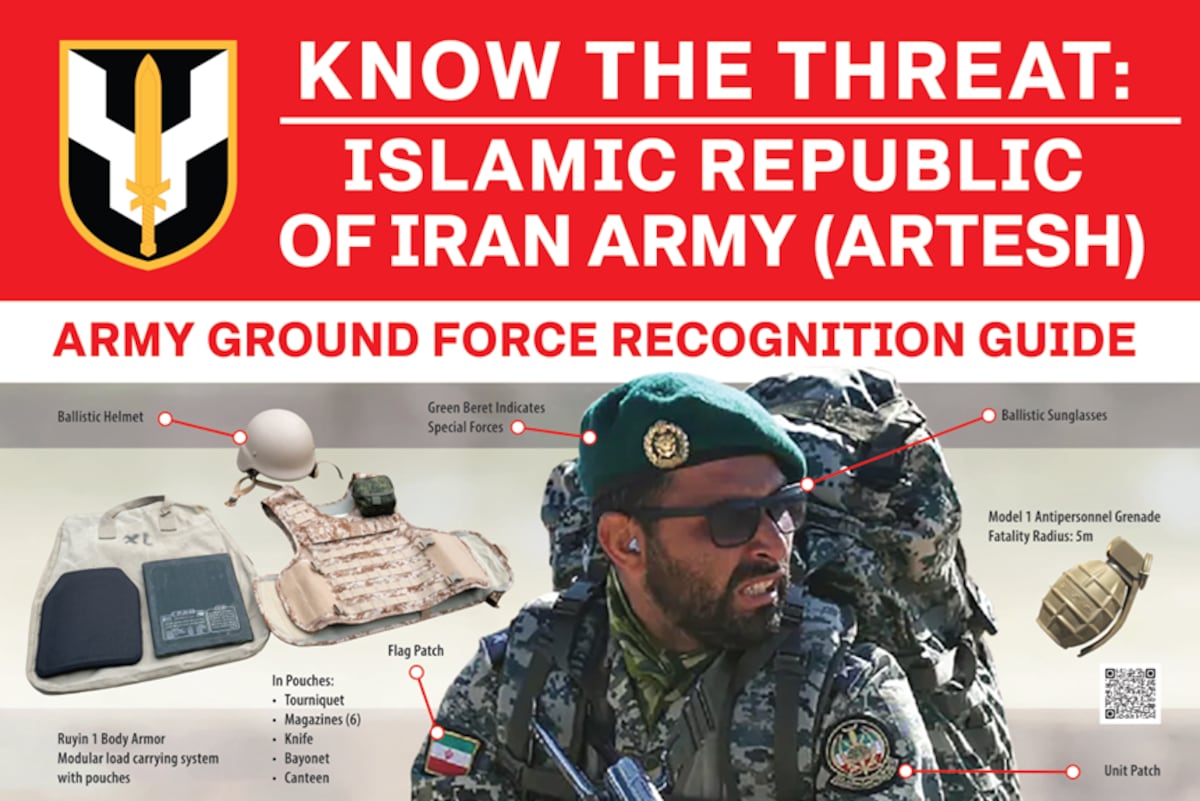
The new U.S. Army poster, published September 24, 2026, is part of a “Know the Threat” series designed to help troops quickly identify enemy combatants. The graphic features a bearded Iranian soldier wearing sunglasses and a beret, with detailed labels identifying the weapons he might carry and the uniforms he might wear.
The Army’s Training and Transformation Command maintains a library of similar recognition guides for foreign militaries around the world, including one for China’s People’s Liberation Army. The existence of a guide for Iranian forces doesn’t confirm any plans to invade Iran — but it does reflect the reality that a ground war with Iran remains a possibility that military planners can’t ignore.
What the Guide Covers — and Why It Focuses on the Artesh
Notably, the new guide does not focus on the Islamic Revolutionary Guard Corps — the powerful, politically loyal force that controls Iran’s ballistic missiles, drone arsenal, and fast-attack naval units. The IRGC tends to dominate media coverage of Iran’s military. Instead, the Army’s poster focuses on the Artesh, the Islamic Republic of Iran Army — the country’s conventional military branch.
According to the research organization the Institute for the Study of War, the Artesh is a predominantly conscript force of approximately 350,000 personnel. It serves as Iran’s regular armed forces and includes armored, infantry, special forces, air defense, aviation, and naval units.
The distinction between the Artesh and the IRGC matters. The IRGC was created specifically to protect the Islamic regime and operates separately from the conventional military — in part because the regime does not fully trust the Artesh, which traces its institutional roots back to the era of the Shah. This dynamic is similar to the split between Iraq’s regular army and Saddam Hussein’s elite Republican Guard, where the regime’s favored force received preferential equipment and resources.
A Force With Known Weaknesses
There have been multiple credible reports of low morale and difficult conditions within Artesh ranks. Soldiers have reportedly suffered from inadequate food and medical care. One draftee who wrote a 2022 essay for the Atlantic Council, a Washington, D.C.-based think tank, described a military culture where most conscripts are assigned menial tasks rather than receiving meaningful combat training.
Despite these structural limitations, American soldiers are being trained to recognize Artesh personnel as a credible threat. The soldier depicted in the Army poster is shown wearing the green beret of Iran’s special forces, equipped with a mix of Soviet-era, Western, and Iranian-made gear. Weapons identified in the guide include the AKM, the Masaf-2, and the Heckler & Koch G3A6 rifle. The soldier can also carry an MG3 machine gun or an RPG-7, along with standard combat equipment such as grenades, body armor, a rucksack, a canteen, and a gas mask.
The poster also illustrates five different camouflage uniform patterns — including khaki and woodland variants — along with three specialized patterns used by Iranian special forces. Officer and enlisted rank insignia are displayed as well, giving U.S. troops the ability to identify not just ordinary soldiers, but unit leadership in the field.
The U.S.-Iran conflict, now in its eighth month, has so far been fought primarily through airstrikes, missile exchanges, and drone operations. However, scenarios involving American ground forces — such as a potential operation to seize Iranian oil infrastructure at Kharg Island — have remained part of the strategic conversation. The Army’s updated recognition materials suggest that military planners are continuing to prepare for contingencies beyond the air and sea domains.
For more military news, visit Army Times. Recent coverage includes: century-old houses getting new life at Fort Bragg, a planned DEERS outage that could affect Tricare beneficiaries, two veterans battling in court over for-profit claims processing, nearly 500,000 veterans set to receive a three-month break from life insurance premiums, and the legacy of the outgoing AAFES director. You can also load more stories from Army Times.
Recent featured video coverage includes: the U.S. Army’s planned livestream of the Fort Hood shooter’s execution, Ukraine’s ‘Army of Robots’ concept and what it means for modern warfare, a retired Green Beret taking on mine-clearing operations in Ukraine, and NORAD’s award of a new warning system contract.