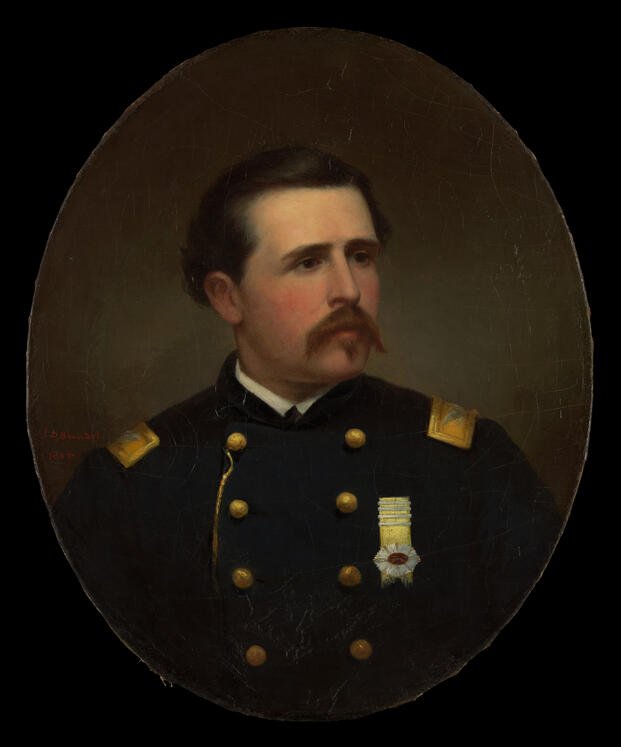
In the midst of the Civil War, one man’s bravery and defiance stood out in the chaos of battle. Col. Luigi Palma di Cesnola, an Italian immigrant, found himself in an unenviable position on June 17, 1863, as he watched his fellow soldiers engage the Confederate forces near Aldie, Virginia. His actions on that day would earn him the Medal of Honor, marking a significant moment in history for Italian-Americans.
An Italian Soldier’s Journey
Luigi Palma di Cesnola, born in Rivarolo Canavese near Turin in 1832, was the second son of a noble family. With the family title set for his elder brother, Cesnola embarked on a military career at the age of 16. His early experiences included fighting in the Battle of Novara in 1849, where his bravery earned him a silver medal and a promotion to second lieutenant. Despite his young age, he displayed remarkable skill and courage.
Cesnola’s military journey continued through various academies in Piedmont and later into the Crimean War, where he served with the British Army. By 1858, his path led him to New York.
From Teacher to Military Leader
Upon arriving in America, Cesnola utilized his linguistic skills to teach Italian and French in New York City. His life took a significant turn when he married Mary Isabel Reid, despite her family’s disapproval. With the onset of the Civil War, Mary encouraged Cesnola to leverage his military background for the Union cause.
In response, Cesnola established a training school for officers, transforming inexperienced men into cavalrymen. His dedication and expertise led to his commission as the colonel of the 4th New York Volunteer Cavalry in 1862, where he equipped his regiment with the finest weapons and horses.
Proving Grounds at Kelly’s Ford
The early years of the Civil War were challenging for Union cavalry, often outperformed by Confederate forces. Cesnola’s European-style training began to make a difference. At the Battle of Kelly’s Ford on March 17, 1863, his regiment took part in a significant Union victory, marking a turning point in cavalry engagements for the North.
At Kelly’s Ford, the Union cavalry clashed with Fitzhugh Lee’s brigade, ultimately forcing a Confederate retreat. This success demonstrated the effectiveness of Cesnola’s rigorous training and aggressive tactics.
The Battle of Aldie and Captivity
During the Battle of Aldie, Cesnola, who was under arrest, could not remain a bystander as his men suffered heavy losses. Braving the battlefield without a weapon, he rallied his troops for another charge, displaying extraordinary courage. This bold action led to his capture and subsequent imprisonment in Libby Prison, a notorious Confederate facility.
His time in captivity was marked by resilience and leadership, as he helped manage the limited resources available to the prisoners, all while maintaining correspondence with his wife, Mary.
A Hero’s Return and Recognition
Upon his release, Cesnola rejoined the war effort, participating in key campaigns alongside General Philip Sheridan. His wartime experiences were later documented in his memoir, “Ten Months in Libby Prison,” offering a vivid account of life as a prisoner of war.
In 1897, Cesnola was awarded the Medal of Honor for his valor at Aldie, becoming the first Italian-American recipient of this prestigious award.
A New Chapter in Archaeology
Post-war, Cesnola’s life took another turn as he became the U.S. Consul to Cyprus, where he developed a passion for archaeology. His efforts in excavating and collecting artifacts led to the Cesnola Collection at the Metropolitan Museum of Art, where he eventually served as the first director.
His contributions to both military history and archaeology left an enduring legacy, inspiring future generations of Italian-Americans and historians alike.