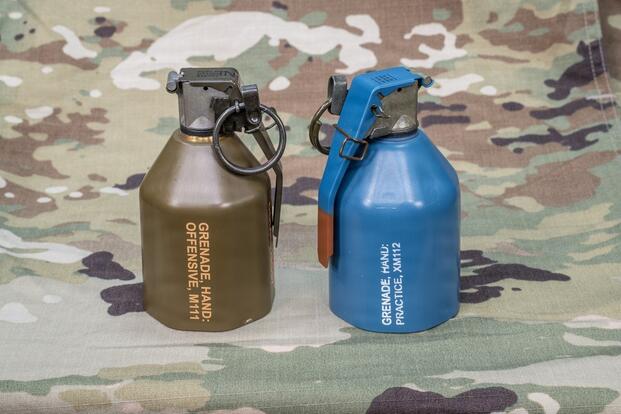
After nearly 60 years, the U.S. Army is making a major change to its standard hand grenade arsenal, introducing a new weapon designed for modern combat scenarios. The M111 Offensive Hand Grenade is set to replace the long-utilized M67 fragmentation grenade, marking the first introduction of a new lethal hand grenade since 1968.
The Army’s New Hand Grenade
Developed at Picatinny Arsenal, N.J., the M111 uses blast overpressure instead of shrapnel to neutralize threats, making it particularly effective in urban environments where traditional grenades pose risks to friendly forces. Unlike the M67, which disperses steel fragments in all directions, the M111’s blast wave permeates through walls and obstacles, reaching targets that might otherwise be shielded.
“One of the key lessons learned from the door-to-door urban fighting in Iraq was that the M67 grenade wasn’t always the right tool for the job,” explained Col. Vince Morris, project manager for Close Combat Systems at the Capabilities Program Executive Ammunition and Energetics. “The risk of fratricide on the other side of the wall was too high.”
The introduction of the M111 is designed to address this issue, with the Army maintaining that the M67 will still be used in open terrain to capitalize on its fragmentary capabilities, providing a dual-option approach for soldiers in the field.
The M67 Hand Grenade
The longstanding M67 grenade, known for its durability and effectiveness, remains in the active inventory, despite the introduction of the M111. Initially developed during the Vietnam War, the M67 has served in conflicts from Southeast Asia to the Middle East.

Featuring a steel body and Composition B explosive, the M67 has a lethal radius of 5 meters and can project fragments up to 230 meters. Its longevity speaks to its reputation as a reliable tool in combat.
The transition to the M111 is structured to integrate seamlessly with existing training, as both grenades share a similar arming process. “By standardizing the arming process and the fuzing, the Army saves taxpayer money without sacrificing lethality on the battlefield,” Morris stated.
Grenades for Two Different Purposes
The concept of having different grenades for various combat scenarios is not new. The Soviet military, for instance, has long utilized a dual grenade system, where the F-1 defensive grenade and RGD-5 offensive grenade were designed for specific tactical uses.

In Afghanistan, Soviet forces faced challenges with grenade deployment, leading to the development of the RGN and RGO grenades, which are still in use today. These innovations highlight the importance of equipping troops with the right tools for varying combat environments, a lesson the U.S. Army is applying with its latest update to its grenade arsenal.