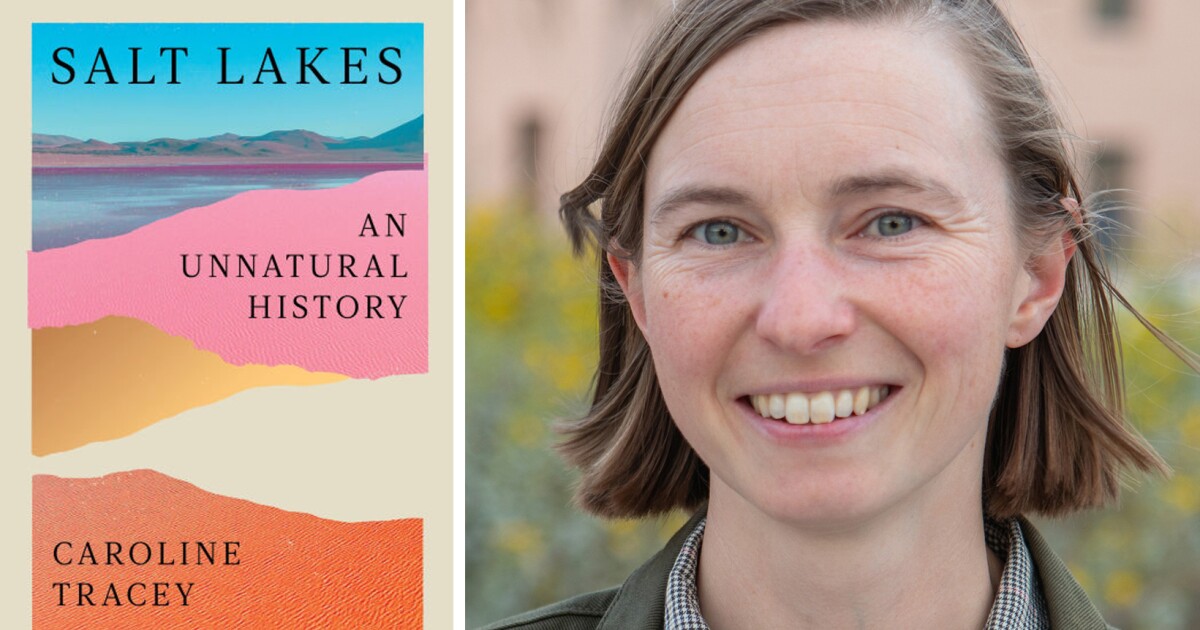
Salt lakes, often seen as harsh and barren landscapes, hold a profound ecological and cultural significance. In her new book, “Salt Lakes: An Unnatural History,” journalist Caroline Tracey embarks on a journey across the American West and beyond, exploring the unique nature of these endorheic basins, from the Great Salt Lake and Salton Sea in the United States to the Aral Sea in Central Asia.
Tracey intertwines her personal narrative of self-discovery with the history of these fascinating bodies of water. During a conversation with The Show, she delved into some of the book’s themes, beginning with a passage that reflects on the unexpected beauty and complexity of seemingly desolate environments.
Lessons from Salt Lakes
CAROLINE TRACEY: “This was the first of Salt Lake’s many lessons. For me, places that seem ugly or desolate are vital and complex in ways that you don’t notice until you give them a chance. Living in the world of my adulthood would require learning to find beauty amidst dust, bad smells and record heat. Not for their own sake, but as a way of working towards something else. Clean air, spectacular views, crisp mornings.”
Tracey highlights the ecological importance of endorheic lakes, which are closed basins with no outflow, relying solely on evaporation to lose water. This process leaves behind salts and minerals, creating the unique environments of salt lakes. She notes that these lakes hold aesthetic, ecological, and spiritual value, often overlooked in favor of utilitarian views that see them as wastelands.
Cultural Connections and Sacredness
Salt lakes have also been imbued with cultural and spiritual significance. Tracey recounts a story involving early Latter-day Saint settlers in Utah, who experienced what they perceived as a miracle when birds from the Great Salt Lake saved their crops from a locust-like plague.
Despite their sacred associations, these lakes have historically been viewed as resources to be exploited. Tracey criticizes this mindset, emphasizing the inherent value of these ecosystems that doesn’t require alteration or exploitation to be appreciated.
Personal Narratives and Broader Perspectives
Tracey’s journey through salt lakes is also a personal one, involving relationships that shaped her understanding of these landscapes. Her time with Dylan in California’s Central Valley and later with Mariana from Mexico City, built on a salt lake, expanded her perception of beauty and ecological importance.
TRACEY: “Dylan brought me to places that I was not familiar with and didn’t really know existed. I grew up in Colorado, and I just had these sort of very aestheticized ideas of California. And a lot of, for instance, the Central Valley is very, very agro-industrial.”
Queer Ecology and New Frameworks
Tracey also introduces the concept of queer ecology, a framework that challenges traditional ecological and biological norms. This perspective embraces the diversity and nonconformity of nature, as seen in species like brine shrimp that exhibit variable reproductive methods.
Queer ecology also encourages viewing landscapes in their altered states, finding value in places impacted by human activity. Tracey aligns this with the idea of salt lakes being seen as wastelands, advocating for their recognition as ecologically valuable spaces.
Finally, Tracey references Cleo Wolfle Hazard’s book “Underflows,” which discusses how queer and trans practices of mourning can inform ecological conservation efforts, particularly in the face of climate change’s impact on ecosystems.
For more insights from Caroline Tracey’s book and her conversation with The Show, visit the full conversation here.