LOS ANGELES — A recent development in a legal battle has led to a federal appeals court halting a 2025 California statute mandating federal immigration officers to visibly carry identification badges.
In a lawsuit initiated in November, the Trump administration contested this legislation, claiming it endangered officers’ safety amidst harassment, doxing, and violence. The administration argued that the regulation unlawfully targeted the federal government, contravening the Constitution.
An injunction was issued by a three-judge panel from the 9th U.S. Circuit Court of Appeals, preventing the law’s execution while an appeal is in progress. Previously, a temporary administrative injunction had also been granted.
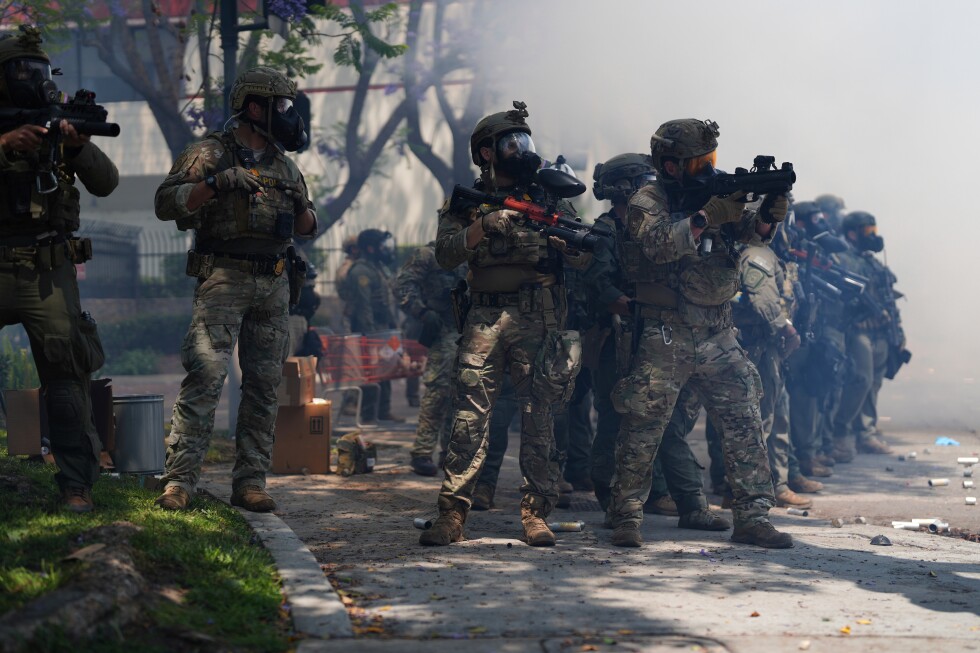
This law was part of a legislative effort introduced last fall to curb federal immigration activities following intensified enforcement in Southern California. Concerns were raised about agents conducting operations without identification.
Another blocked law aimed to prohibit most law enforcement from wearing facial coverings, excluding specific scenarios like undercover work or when using protective gear. A federal judge blocked this law in February, citing discrimination against federal agents.
During a March 3 hearing, the Justice Department emphasized that the identification requirement infringed upon the Supremacy Clause by attempting to govern federal activity. The appeals court supported this view, highlighting that the law “attempts to directly regulate the United States in its performance of governmental functions,” as Judge Mark J. Bennett noted. The panel included Trump appointees Bennett and Daniel P. Collins, and Obama appointee Jacqueline H. Nguyen.
California’s defense argued that the law was impartial, applying uniformly to all law enforcement, and aimed to enhance public safety. They cited the risk of misidentification leading to self-defense attacks on officers and noted an October 2025 FBI report warning against impersonation crimes by false ICE agents.
The court did not address public safety concerns, focusing on constitutional rights, and stated, “all citizens have a stake in upholding the Constitution.” This decision may impact other states with similar legislative attempts to regulate immigration enforcement.
After the mask ban was nullified, a new bill is being considered to extend mask restrictions to state troopers, potentially aligning with judicial recommendations for broader applicability.
The appeals court’s stance indicates a cautious approach to state regulation of federal personnel, emphasizing, “The Supremacy Clause prohibits States from enacting a law that directly regulates federal operations even if the law regulates state operations in the same manner.”
First Assistant U.S. Attorney Bill Essayli described the ruling as a “huge legal victory” via a social media post. Meanwhile, California Attorney General Rob Bonta’s office is currently reviewing the court’s decision, reiterating the importance of “Transparency and accountability” in law enforcement. They criticized the Trump administration’s use of masked and unmarked agents, citing public safety and civil liberties concerns.