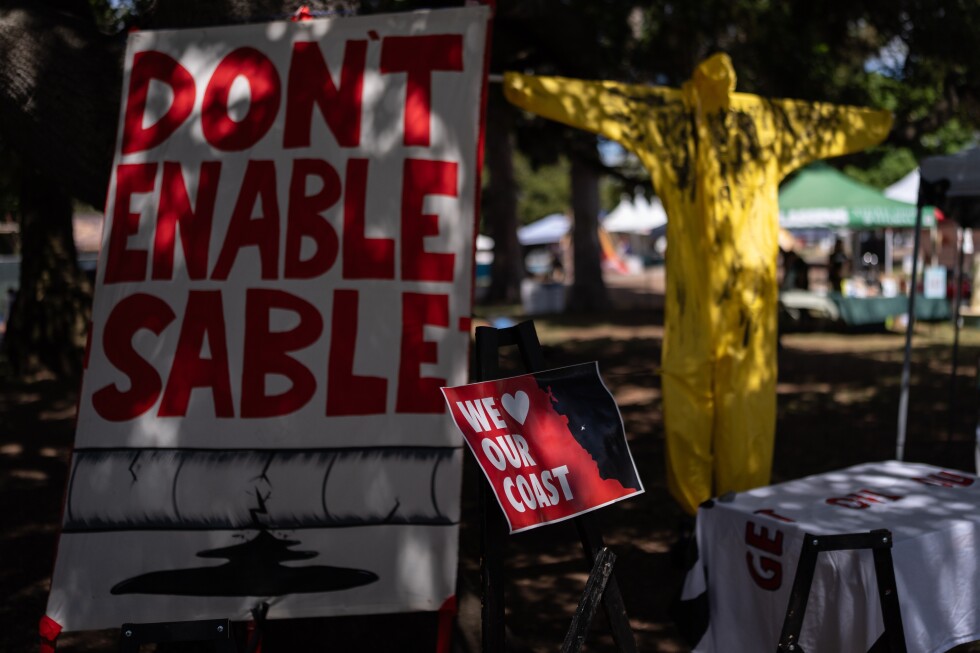
After more than a decade of dormancy, a contentious pipeline that traverses California’s state park land has resumed transporting oil from the Pacific Ocean. This development follows the Trump administration’s decision to bypass state opposition, citing the necessity of offshore drilling off Santa Barbara for national security.
California state officials are contesting this move, labeling it as trespassing. They are seeking an injunction from a federal judge to compel Sable Offshore Corp. to cease pipeline operations and dismantle the infrastructure crossing Gaviota State Park.
The pipeline in question, owned by a Texas-based company, had been inactive since a 2015 rupture resulted in one of California’s most severe oil spills, affecting 150 miles of coastline from Santa Barbara to Los Angeles and causing significant ecological and economic damage.
National Security vs. State Rights
Energy Secretary Chris Wright invoked a provision from the Cold War era to direct Sable to resume production, arguing that increasing domestic oil supplies is critical amid global tensions and the ongoing Iran conflict. He emphasized the vulnerability of California’s reliance on foreign oil, particularly shipments through the volatile Strait of Hormuz.
This federal directive has sparked a legal battle between state and federal authorities, challenging the extent of state power in opposing federal mandates, especially during wartime. State officials argue that their regulatory and property rights are being overridden without consent.
Environmental and Legal Concerns
Opposition to the pipeline’s reactivation is strong in Santa Barbara, a region with a history of environmental advocacy following the 1969 oil spill. Local activists and organizations, such as the Environmental Defense Center, have criticized Sable Offshore Corp. for allegedly operating outside legal boundaries.
Despite state-imposed injunctions and fines, Sable maintains that its permits are valid and asserts the federal directive takes precedence. The U.S. Energy Department claims that Sable’s operations could increase California’s oil production by 15%, reducing dependency on foreign crude.
However, experts like Paasha Mahdavi from UC Santa Barbara argue that the heavy crude extracted is costly to refine and insufficient to impact domestic gas prices significantly.
Use of the Defense Production Act
The administration’s use of the Defense Production Act to restart drilling is unprecedented in its direct challenge to state regulations. Historically, the Act was used to mobilize resources during crises, such as energy shortages or to support renewable energy initiatives.
Legal scholars like Deborah Sivas of Stanford Law School express concerns over the federal government’s expansive use of this Act, potentially setting a precedent for overriding state laws in favor of federal objectives.
California’s Response
California officials are contesting the pipeline’s legality on state land, asserting their jurisdiction over operations within state boundaries. The ongoing litigation underscores the tension between state sovereignty and federal authority, particularly in environmental regulation.
While the Trump administration has also moved to exempt oil and gas drilling in the Gulf of Mexico from certain environmental protections, California continues to resist, arguing for its right to enforce state-specific regulatory standards.