Michigan Supreme Court Hears Arguments on Legislative Power Over Bill Delivery to Governor
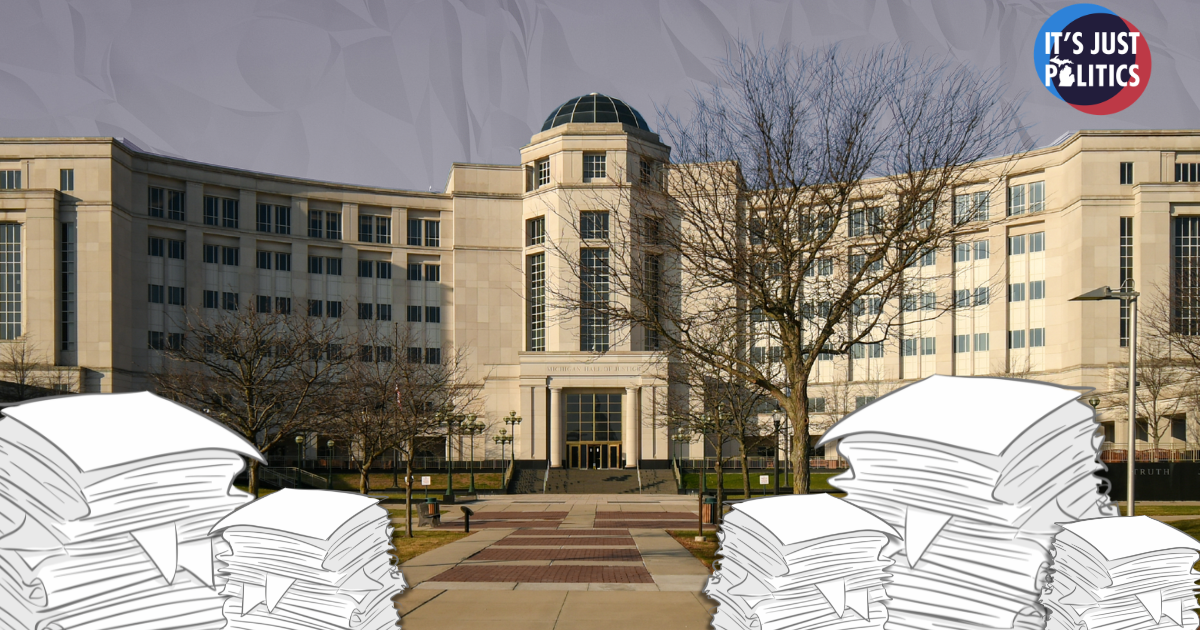
This week, the Michigan Supreme Court listened to oral arguments regarding a crucial constitutional issue – whether legislative leaders possess the authority to determine which bills reach the governor’s desk after passing through the House and Senate.
The case under consideration involves nine bills that were approved by both chambers but were held back by House Speaker Matt Hall (R-Richland Township) when Republicans gained control of the House in January 2025. These bills cover a range of issues like public employer health insurance costs, public assistance payment exemptions from debt collection, changes in the Michigan State Police pension system, and enabling Detroit historical museums to seek millage.
Senate Democrats are pushing for the Supreme Court to mandate the submission of these bills to Governor Gretchen Whitmer. The core debate revolves around whether the Supreme Court should intervene to decide the case, potentially leading to further arguments, or uphold the appeals court ruling.
Mark Brewer, the attorney representing Senate Democrats, emphasized the potential consequences of allowing the House’s actions to stand, stating, “It will unilaterally and drastically change Michigan’s bicameral legislature, its separation of powers, our checks and balances, and the majoritarian principles which underlie everything we do in state and local government in this state.”
In contrast, Kyle Asher, the attorney representing House Republicans, argued that the broad discretion granted to legislative leaders by the Michigan Constitution allows them to hold back bills even if this power has not been used previously. He highlighted that the Constitution does not explicitly mandate the presentation of every bill to the governor.
Lower courts have ruled against the House Republicans, declaring their actions unconstitutional for withholding the bills from Governor Whitmer. The Senate Democrats are seeking a Supreme Court directive to compel the House to comply with this ruling.
As the Supreme Court deliberates on this issue, it faces limitations in enforcing its decisions due to the absence of law enforcement and budgetary powers. The court’s authority relies on the goodwill of other branches and public trust in upholding judicial decisions.
Previously, a Court of Claims judge ruled in favor of sending the bills to the governor but refrained from issuing an enforcement order. The Court of Appeals reinforced this decision, instructing the judge to enforce the directive. The current focus remains on how the Supreme Court will navigate this complex scenario.
What’s Happening in Michigan Politics
In a closely watched special election for Michigan’s 35th Senate district, Democrat Chedrick Greene secured victory, ensuring that Democrats maintain their majority in the Senate. This victory comes after a prolonged vacancy in the district, with former state senator Kristen McDonald Rivet leaving the seat in January 2025 to join Congress. Governor Gretchen Whitmer’s delayed scheduling of the special election drew criticism from Republicans, who viewed it as politically motivated. Democrats now retain a narrow majority in the Michigan Senate following Greene’s win.
In a recent special state Senate election in mid-Michigan, a Democrat emerged victorious, securing a crucial win that could have shifted the balance of power in the Legislature. If Republican Jason Tunney had won, the upper chamber would have been deadlocked, but Democrat Greene managed to secure a significant lead, potentially setting the tone for the upcoming mid-term elections in Michigan. This victory is seen as a significant indicator of the political landscape, especially in a district that showed support for both Republican and Democratic candidates in previous elections.
Meanwhile, in a separate development, the Michigan Attorney General has charged Fay Beydoun, a politically connected metro-Detroit businesswoman, with misusing state funds related to a $20 million taxpayer-funded grant. Beydoun, a Democratic former appointee and fundraiser for Gov. Gretchen Whitmer, faces charges including larceny by conversion and conducting a criminal enterprise. The ongoing investigation suggests that further charges could be forthcoming, highlighting the importance of accountability in public spending.
In another political endorsement, former Michigan Senator Debbie Stabenow has decided to endorse U.S. Representative Haley Stevens in the Democratic primary for the state’s open U.S. Senate seat. Stabenow believes that Stevens is the candidate best positioned to defeat Republican Mike Rogers and retain the seat for Democrats. The primary race, which also includes state Sen. Mallory McMorrow and physician Abdul El-Sayed, is expected to be fiercely contested, with national implications as Republicans target the seat as a key opportunity for a pick-up in the November general election.
These political developments underscore the dynamic and competitive nature of Michigan’s political landscape, with key races and endorsements shaping the future direction of the state’s representation in government. As candidates and officials navigate the complexities of campaigning and governance, the outcomes of these events will undoubtedly influence the state’s political trajectory in the months and years to come.