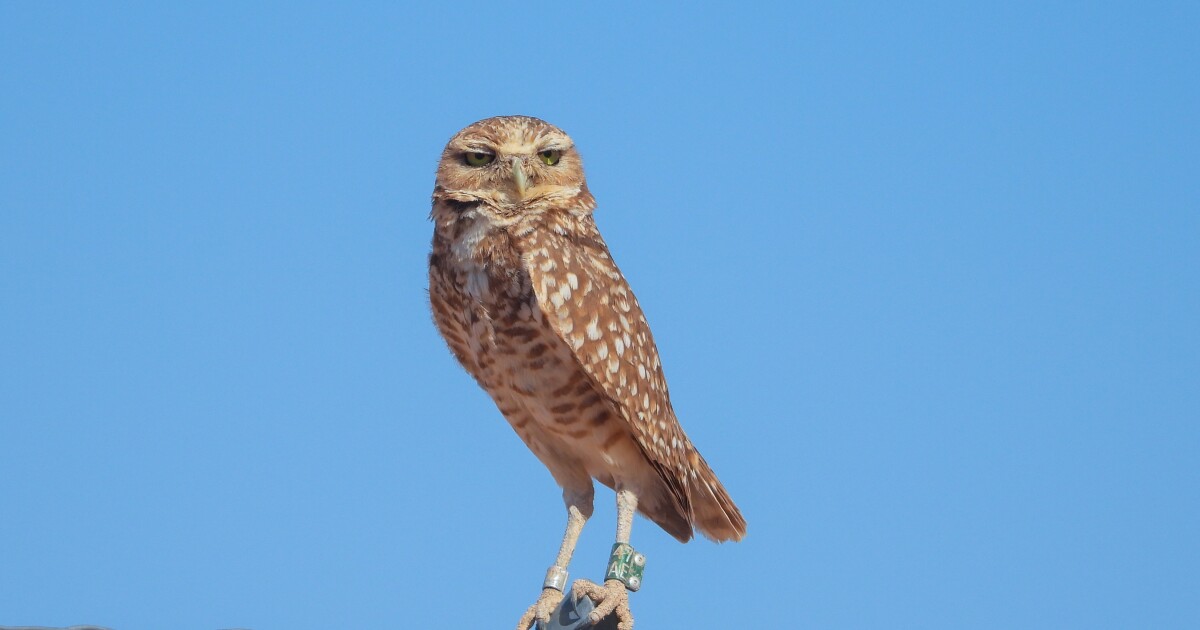
Amidst the sprawling solar panels of the Sun Streams solar farm, a unique coexistence occurs. In the midst of energy generation, burrowing owls have found a new habitat, showcasing a harmonious blend of technological advancement and wildlife conservation.
A New Home for Burrowing Owls
Situated 17 miles west of Buckeye, the solar farm primarily focuses on harnessing solar energy. However, it also serves as a sanctuary for one of Arizona’s iconic avian species. Last year, Longroad Energy collaborated with the nonprofit Wild at Heart to create a habitat for burrowing owls displaced by urban development. This initiative offers researchers a unique perspective on how these birds adapt to life adjacent to a large-scale solar facility.
Samad Khan
/
Cronkite News
“We’re still figuring it out,” said Deron Lawrence, Longroad’s vice president of environment. “Part of the research we’re undertaking is figuring out what that effect is and how the owls are affected.”
In March 2025, Wild at Heart relocated nine pairs of burrowing owls and a solitary male from a housing project about 50 miles away. With the help of motion-activated cameras, researchers now keep a close watch on the colony’s 30 artificial burrows, documenting the owls’ adaptation and survival.
Decades of Dedication
Greg Clark, who coordinates the burrowing owl habitat for Wild at Heart, has been dedicated to this cause for over a quarter of a century. “When we started investigating burrowing owls in 1999 and 2000, it was clear they were in trouble,” Clark said. “We decided in 2000 that we were going to do something about it.”

Samad Khan
/
Cronkite News
Clark believes that the open landscape of the solar site may actually benefit the burrowing owls. Unlike dense vegetation that can conceal predators, the open area allows the owls to spot threats from a distance. “Solar panels don’t block the owl’s visibility,” Clark said. “The panels may even attract insects the owls can feed on. Though we’re still learning.”
Clark is drawn to the owls for their human-like behaviors. “They chase each other around. They’ll stand up to dogs and coyotes,” Clark explained. “The juveniles pick fights with each other. The males interact with female owls. The owls almost act like tiny little people.”
Fostering a Thriving Ecosystem
Nearby, at the Mesquite Wildlife Oasis, Clark oversees an irrigation system designed to cultivate an environment rich in butterflies, moths, and grasshoppers—key food sources for the owls. Every few weeks, he reviews the state of the habitat, ensuring it continues to support the 40 owls residing there.

Samad Khan
/
Cronkite News
The oasis also serves as a learning hub for horticulture students, illustrating how reestablishing native flora can rejuvenate an entire ecosystem. Though Clark acknowledges the challenges and time involved, he remains optimistic. “Development and wildlife conservation can coexist,” Clark stated. “If you build conservation into a project from the beginning, you can create places where wildlife still has a chance.”
This article first appeared on Cronkite News and is republished here under a Creative Commons Attribution-NoDerivatives 4.0 International License.