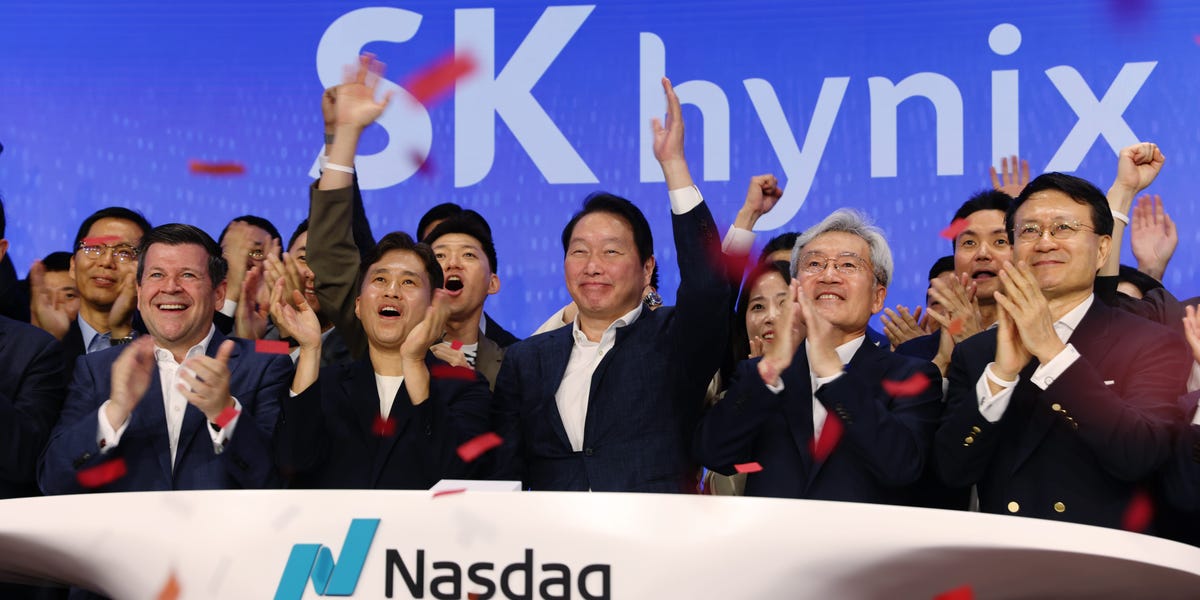
SK Hynix Experiences Record Plunge Following Nasdaq Debut
In the wake of its spectacular Nasdaq debut, SK Hynix faced a significant setback on the South Korean stock market. The company, known for its dominance in the memory chip sector, saw its shares on the Korea Exchange plummet by 15.4% on Monday. This marked the company’s steepest decline ever as investors quickly moved to secure profits after a prolonged rally and the closely monitored listing of its US American depositary receipts (ADRs).
The Nasdaq debut was a success, with SK Hynix’s ADRs opening at $170, about 14% higher than the reference price of $149, and closing the session up by 12.8%. The IPO raised an impressive $26.5 billion, surpassing the previous record set by Alibaba’s Initial Public Offering over a decade ago.
Meanwhile, the downturn was not limited to SK Hynix. Rival Samsung Electronics also experienced a decline, losing more than 10%. The combined losses of these heavyweight companies triggered a sharp fall in the Kospi index, which dropped nearly 9% after a 20-minute trading halt due to the activation of a circuit breaker, marking the seventh occurrence this year.
The ripple effect of SK Hynix’s plunge was felt beyond South Korean borders, with US-listed chipmakers Nvidia, AMD, and Intel all seeing declines in premarket trading. Additionally, the broader Asian markets retreated, influenced by escalating tensions in the Middle East and doubts about whether the AI-driven rally was sustainable.
In Japan, the Nikkei 225 index fell by around 2%, while Kioxia, a hot memory chip stock, dropped nearly 13%. The US stock futures also showed a downward trend early Monday, with the tech-heavy Nasdaq down by 1%, and the S&P 500 and Dow Jones experiencing smaller losses of 0.3% and 0.03%, respectively.
Despite the dramatic pullback in SK Hynix’s stock, analysts maintain a positive outlook on the company. Its Korea-listed shares have nearly doubled in value this year. Morningstar has valued the company’s ADRs at $160 and its Korean shares at 2.4 million won each, suggesting that the stock is fairly valued.
“The current memory upcycle is tracking substantially stronger than expected, but our base case continues to assume normalization in cycle dynamics, limiting upside at current levels,” stated Morningstar analyst Lorraine Tan in a note on Friday.
Notably, SK Hynix’s ADRs in the US are trading at a 37% premium compared to its Korean stock, a valuation gap that analysts are monitoring closely. James Ooi, a market strategist at Tiger Brokers, noted, “Companies with both US and home-market listings often trade at a premium in the US, benefiting from broader investor access, deeper liquidity and stronger valuation support, as seen with TSMC.”