
Imagine receiving a call from a distressed family member claiming they need urgent financial assistance due to an accident. The voice is familiar, but it’s not who you think it is. It’s actually a sophisticated scam using AI technology to mimic your loved one, orchestrated by a stranger targeting unsuspecting individuals.
While AI-related cybersecurity warnings have traditionally centered around corporate and government networks, recent trends show a troubling shift. According to the FBI’s fraud data, significant amounts of money are being siphoned off directly from household accounts.
In its 2025 annual report, the FBI’s Internet Crime Complaint Center began documenting AI-related fraud cases for the first time. Over 22,000 cases were reported by Americans, with total losses approximating US$893 million. Investment scams were the primary contributor, causing $632 million in losses, while individuals over 60 suffered $352 million in losses.
These figures only account for incidents reported to the FBI and where AI’s role could be confirmed. Deloitte anticipates that the true impact of AI-driven fraud will be much greater, projecting U.S. fraud losses to soar to $40 billion by 2027 from $12.3 billion in 2023.
As a finance professor focusing on household finance and AI in financial decisions, I see the most pressing AI security issue unfolding not in corporate environments but in everyday homes.
Old Tricks, New Tech
AI hasn’t invented new scams; it’s merely refined existing ones. The ease and affordability of cloning a voice have made cons more believable. Research shows listeners can only identify AI-generated voices accurately about 60% of the time. Video manipulation follows suit, as seen in a 2024 incident where a finance employee at Arup sent $25 million to fraudsters after being deceived by deepfake videos of company executives.
Phishing emails, once easily spotted by awkward language and formatting, are now crafted with precision by language models that personalize messages using data scraped from social networks. Deepfake videos feature well-known business leaders endorsing fake trading platforms.
Businesses have also faced growing pressures, with Resilience’s data showing that over 85% of cyber losses in the first half of 2026 were due to human-targeted attacks rather than system breaches.
Understanding Victim Vulnerability
Contrary to common belief, not only careless individuals fall prey to scams. Behavioral finance research indicates that these cons exploit fear and urgency, causing stress that narrows focus and leads to impulsive decisions, precisely when careful deliberation is needed. The illusion of authority, whether it’s a familiar face or an official letterhead, often gains unmerited trust.
The seamlessness of AI-generated content plays a role too. My research shows that fluency in communication fosters trust. Messages free of errors and delivered in a convincing voice bypass defenses that would catch clumsier attempts.
Scammers thrive on panic-induced decision-making, which is why they cultivate a sense of urgency.
Silent Threats
AI-facilitated theft doesn’t always involve direct interaction with the victim. Personal data, often sold for mere dollars on the dark web, is used by AI agents to continuously probe financial systems for vulnerabilities. Last year, an espionage campaign was halted by Anthropic after an AI agent handled 80% to 90% of the infiltration work against financial institutions.
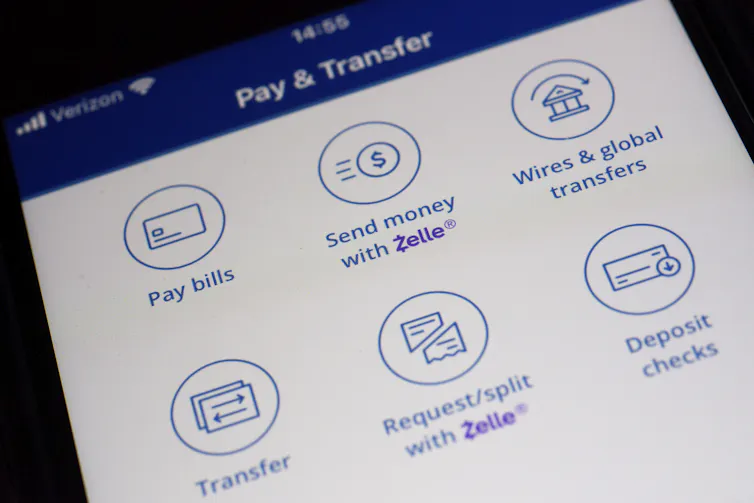
Once a customer’s account is compromised, the theft can occur in minutes through rapid payment platforms like Zelle, which prioritize speed and convenience. Retrieving the stolen funds is nearly impossible.
Protective Measures
Households can adopt banking security practices to safeguard against scams.
Verify by Callback. If you receive a suspicious call, hang up and call a trusted number, like your bank’s fraud hotline, not the number provided by the caller. A cloned voice cannot answer the real phone of your family member.
Use a Code Word. Establish a family code word for emergencies. Treat any money request without it as fraudulent. Ensure major financial decisions involve more than one person, and impose a 24-hour delay on large transactions to counteract urgency.
Enhance Account Security. Enable two-factor authentication and never share verification codes. Set up transaction alerts and consider a credit freeze to prevent unauthorized account openings.
Support Older Adults. Given that $352 million of AI-related losses involved individuals over 60, discuss security measures with older family members. Suggest adding a trusted contact to their financial accounts for added protection.
If a scam has already occurred, contact your bank immediately for assistance in recovery, and report the incident to the Federal Trade Commission.
Regulatory and Legal Considerations
While good habits can deter scams, regulatory measures are necessary to address these emerging threats. U.S. law is designed to protect consumers from unauthorized transactions, but victims of instant-payment scams often face challenges in recovering their losses. Banks may label losses as “authorized” even when the customer was misled.
In late 2024, the Consumer Financial Protection Bureau sued Zelle and major banks over their handling of fraud, but the case was dropped in March 2025. However, New York’s attorney general filed a subsequent lawsuit, which was allowed to proceed.
AP Photo/Patrick Sison
The U.K. offers a contrasting approach. Since late 2024, U.K. banks must reimburse most scam victims up to £85,000 ($115,000), with costs shared between sending and receiving banks. This policy incentivizes banks to enhance fraud prevention, as shown by an 88% return rate for eligible scams and a 20% reduction in losses during the first year.
American regulators and legislators might do well to examine this model closely. In an era of instant, irreversible payments, the burden of risk should not rest primarily on the consumer, who is often the least prepared to combat these sophisticated threats.