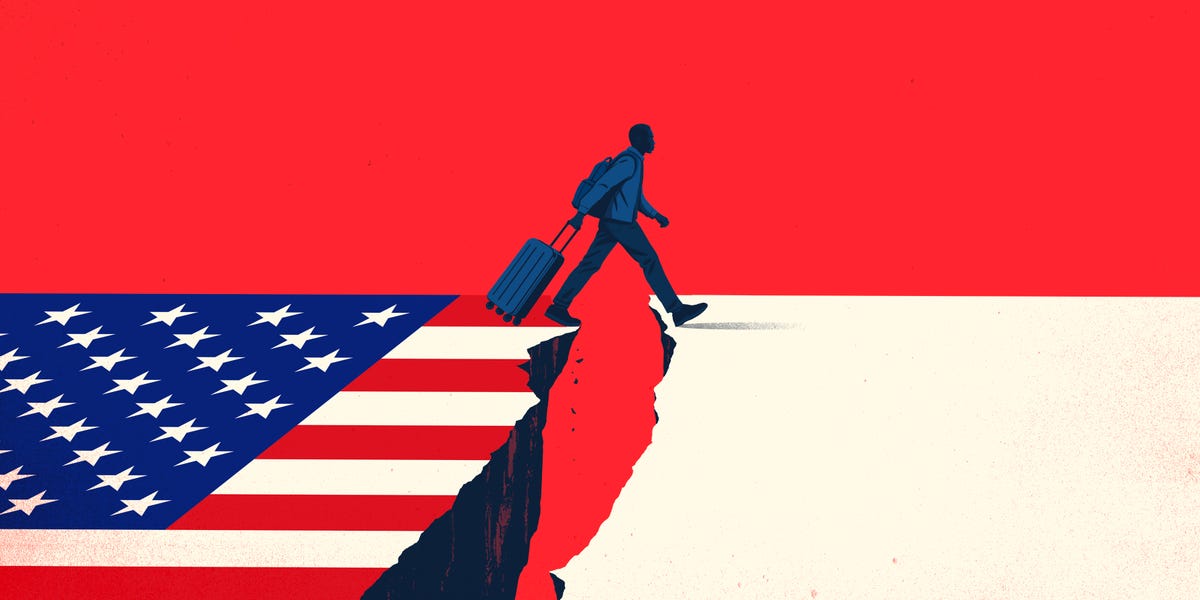
After making a life in Chicago, Ananya Joshi was faced with an unexpected challenge when her US work authorization neared its expiration, forcing her to make a life-altering decision. The scientist, who was thriving in her role at a lab-grown meat startup, had to leave the US due to visa sponsorship issues.
Joshi, an Indian national, initially moved to the US to pursue a master’s degree in biotechnology at Northwestern University. After graduation, she secured a $75,000-a-year position at a startup, enjoying a fulfilling job, an affordable apartment, and frequent road trips with friends. However, her company was unable to sponsor her for an H-1B visa, and her Optional Practical Training (OPT) was set to expire in July 2025.
Faced with limited options, Joshi accepted a job offer in Germany, despite leaving behind a life she loved. “Having gone through so much turbulence, I really needed the stability to calm down,” she told Business Insider.
This scenario highlights a growing uncertainty for international graduates and foreign workers in the US trying to navigate complex immigration policies. The H-1B visa, a pathway to better opportunities since 1990, is highly sought after, with only 85,000 new visas issued annually. For fiscal year 2026, there were nearly 344,000 eligible registrations for H-1B visas.
The Trump administration’s crackdown on H-1B visas has added further complexity to the process. Joshi is one of many who faced career uncertainty due to these policy changes.
A Year of Immigration Chaos
Sonu, a software engineer from Silicon Valley, experienced a similar disruption. During a planned trip to Asia, he was informed about an executive order requiring a $100,000 fee for H-1B applications, which nearly prevented his return to the US.
“But I was with my family, and I couldn’t risk it,” Sonu said. He spent over $7,000 on tickets for an immediate return. The White House later clarified that the fee would apply only to new applicants.
“I was with my family, and I couldn’t risk it.”Sonu, a software engineer on the H-1B visa
Nine months later, a federal judge blocked the fee, but the episode left many questioning the reliability of US immigration policies.
Jeanne Batalova from the Migration Policy Institute noted that the US’s current outflow of foreign talent is unprecedented, attributing it to administrative actions restricting pathways for international students and workers.
America’s Got Talent, But Other Countries Want It, Too
As the US tightens its immigration policies, some international students and workers are exploring opportunities in other countries. Sunjana Ramana, unable to secure an H-1B visa after three attempts, moved to the UK where she launched an AI business.
“I want to go back and tell my younger self not to associate the ‘dream’ with America.”Sunjana Ramana, London-based product manager at Wise
Countries like Germany, the UK, and Canada are actively courting these skilled workers with simpler immigration processes and faster routes to permanent residency.
For Some Workers, Home is Calling
India and China are seeing a return of their nationals due to the US’s unpredictable visa policies. In 2025, workers from India made up 70% of H-1B beneficiaries, with China’s share at 12%.
Vivienne Yang, a former H-1B worker, returned to Taiwan after a layoff, where she now enjoys the freedom of working without visa constraints.
“It’s so weird not having to worry about a visa. Now I can get any random gig without worrying.”Vivienne Yang, a former H-1B worker who returned to Taiwan after a layoff
The demand for H-1B visas remains high, yet the uncertainty around sponsorship may affect America’s competitive edge in attracting global talent. Foreign-born workers are integral to the US STEM workforce, and policy changes could disrupt this dynamic.
David Brown from Hays emphasized that the real risk is losing a small number of highly valuable individuals in fields where talent is scarce. The US must provide clear and consistent immigration policies to maintain its position as a leading destination for top-tier professionals.
“The bigger risk for US employers is not a mass departure. It is losing a relatively small number of highly valuable people.”David Brown, Americas CEO of global recruitment firm Hays
Joshi, after moving to Germany, remains hopeful about new career paths but reflects on her time in the US with some regret. “I regret moving to the US because I’ve seen what that country offers, and nothing else will be enough,” she said.