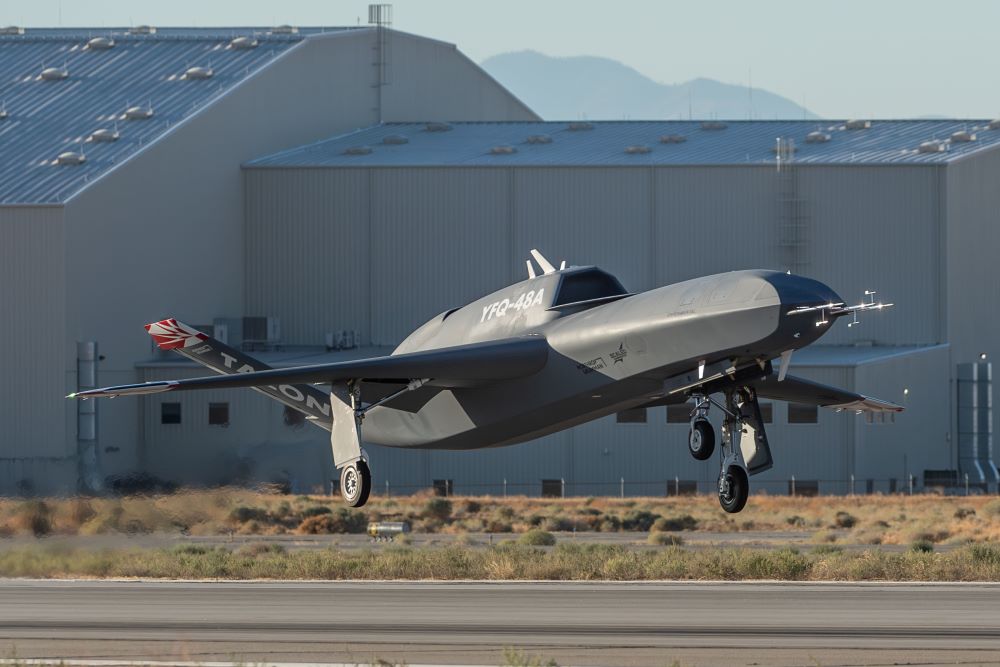
A military aircraft that can taxi, take off, fly complex maneuvers, and land — all without a single human at the controls — just moved from concept to reality. Northrop Grumman’s YFQ-48A Talon Blue has completed its first fully autonomous flight, marking a significant step forward in the U.S. military’s push to field a new generation of unmanned combat aircraft.
The test flight took place in Mojave, California, where the Talon Blue successfully completed a full autonomous sequence — taxi, takeoff, in-flight maneuvers, and landing — with no human pilot onboard or in direct control. Northrop Grumman confirmed the milestone in a recent company release.
Built for Speed and Affordability
The Talon Blue is part of Northrop Grumman’s internally funded Project Talon portfolio, which focuses on developing Collaborative Combat Aircraft (CCA) — autonomous jets designed to fly alongside and support crewed fighters. The program’s design philosophy centers on making autonomous aircraft faster and cheaper to produce without cutting corners on performance.
Engineering upgrades reduced the aircraft’s total part count and overall weight, which in turn lowered manufacturing costs and shortened production timelines. The goal is to make autonomous systems available at scale, meeting what the U.S. military sees as an urgent and growing need.
Craig Woolston, vice president and general manager of research and advanced design at Northrop Grumman, framed it in straightforward terms.
“Our customers made it clear they need autonomous systems that can be fielded faster and more affordably without sacrificing mission effectiveness. We listened,”
Woolston said.
He added:
“Talon Blue’s first flight is one step toward a new generation of autonomous capabilities. Every flight and lesson strengthens our broader autonomy work and sharpens what comes next.”
The Air Force’s Bigger Picture
The Talon Blue’s milestone comes at a critical moment for the Air Force’s autonomous aircraft ambitions. Just weeks before Northrop’s announcement, Air Force officials stated their intention to have 500 autonomous aircraft in service by 2032 — an aggressive timeline that is driving competition among defense contractors.
Secretary of the Air Force Troy Meink has already named two aircraft selected for production: Anduril’s FQ-44A, dubbed “Fury,” and General Atomics’s FQ-42A, called “Vengeance.” Production contracts for both companies were awarded in June. The following month, Anduril completed the program’s first-ever live-fire test, and General Atomics has indicated it plans to conduct its own live-fire testing this fall.
Northrop Grumman has not yet received a production contract for its CCA, but the company is not out of the running. It has been included in the Air Force’s baseline contract pool for mission autonomy software production — the software layer that will govern how all CCAs think and operate in the field.
In June, the Air Force selected six vendors to compete in a performance-based competition for Increment 1 of the autonomy software contract. The service plans to narrow that field down to a single winner by summer 2027. For Northrop Grumman, the Talon Blue’s successful autonomous flight is a strong data point to carry into that competition — and a demonstration that its technology is advancing on pace with the military’s ambitious goals.
For more on the rapidly expanding world of military autonomous systems and defense technology, explore the latest coverage at Air Force Times MilTech, including recent stories on the Air Force’s certification of Skydio X10D drone operators, a new $2.38 billion F-15EX contract awarded to Boeing, and questions about whether the Pentagon has stepped back from AI-based loyalty analysis.