High-altitude balloons floating silently miles above the Earth may not seem like a pressing concern for American voters — but when the U.S. military develops powerful new surveillance and weapons capabilities with limited public debate, democratic oversight becomes a very real question. The Army’s expanding stratospheric balloon program is now being tested across three continents, and the public deserves to understand what’s being developed in their name.
At the Association of the United States Army’s annual meeting this week, senior Army officials pulled back the curtain — at least partially — on an ambitious effort to dominate a zone of the atmosphere that sits between conventional airspace and outer space. The program raises legitimate questions about transparency, congressional oversight, and how new military technologies are developed and deployed without broader public awareness.
What the Army Is Building — and Why It Matters
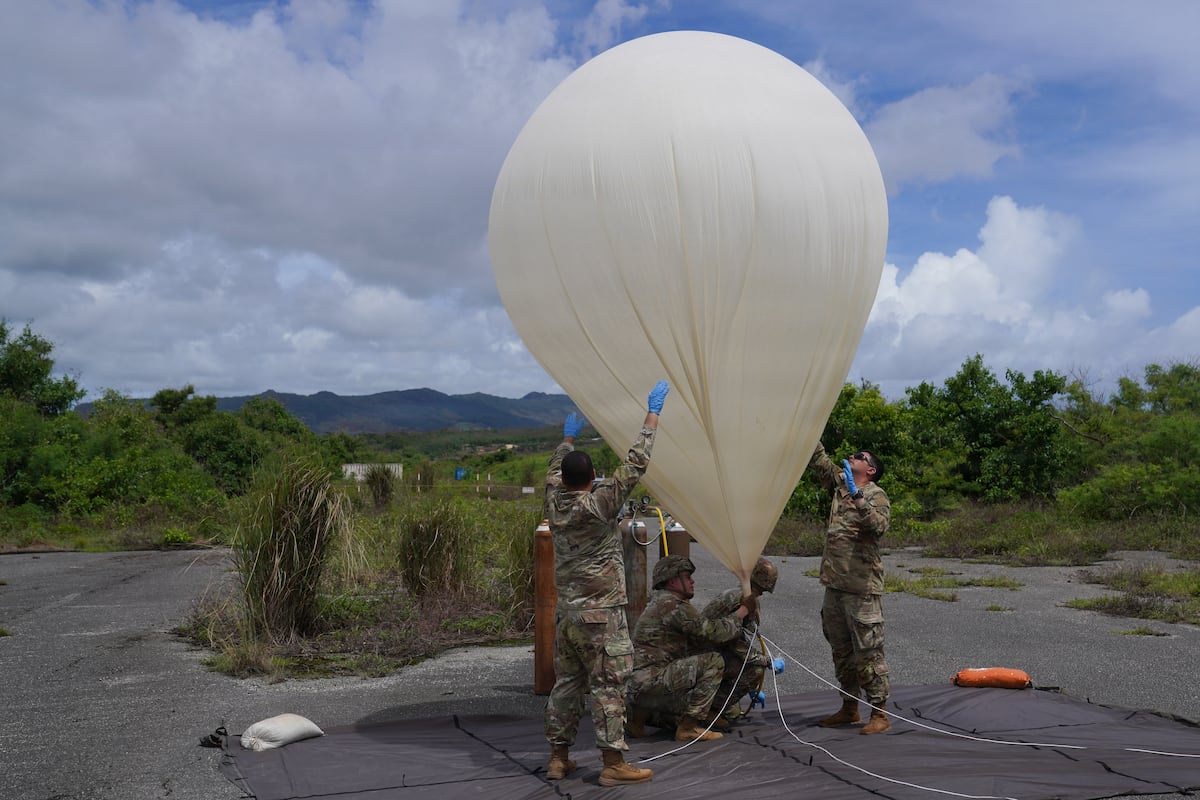
Col. Joseph Mroszczyk, director of the Army Space and Missile Defense Command’s Transformation Integration Directorate – Space Superiority, described an effort to develop what he called “a family of stratospheric systems” — high-altitude balloons of varying sizes capable of carrying a wide range of payloads. The Army defines the stratosphere as the band between roughly 60,000 and 100,000 feet — 11 to 19 miles above Earth — and Mroszczyk used the term “space littorals” to describe it, borrowing naval language for shallow coastal waters.
In his briefing, Mroszczyk explained the strategic logic:
“What that enables us to do is provide space-like capabilities, really exploiting a transition point between what is normally considered the aerial layer and the space domain.”
He went further, describing the ability to use natural wind currents to position balloons, and to deliver sensing, communications, and weapons capabilities from that altitude:
“That operational space allows some persistence and broad coverage in an area where you can deliver space-like capabilities in terms of payloads, but then also take advantage of the deep access that you get from the stratosphere … being able to go and take advantage of winds that are pushing you where you want to go already, to be able to get either launched effects or other types of payloads for sensing and communication and extension of your launched effects portfolio.”
Armed Balloons: An Option on the Table
Perhaps most notably, officials did not rule out using balloons as weapons platforms. Ukraine has reportedly already moved in this direction — as Ukraine has reportedly done with its own stratospheric balloon program — and the U.S. Army is watching closely. When asked whether armed or “kinetic” balloon applications were being considered, Mroszczyk was direct:
“I wouldn’t say that we’re going to hold back from opportunities and options that would include something that could be kinetic in nature. But right now, we’re doing experiments across the board with all types of different payloads.”
That candid acknowledgment — that the Army is actively experimenting with the possibility of weaponized balloons — underscores why public awareness of this program matters. New military capabilities, especially ones with potential offensive applications, warrant scrutiny from lawmakers and citizens alike.
A Program Already Deployed Globally
Lt. Gen. John Rafferty, commander of U.S. Army Space and Missile Defense Command, confirmed that balloon systems have already been deployed for testing and demonstration in Europe, the Pacific, and Morocco. Breaking Defense also reported on deployments in the Middle East, where small swarms of a few dozen drones were sent to the region for testing after a larger Pacific demonstration was scrapped.
Col. Wade Germann, commander of the Army’s 3rd Multi-Domain Task Force, offered the clearest picture yet of how these systems would actually be used in practice. He described a “constellation approach” that combines high-end platforms with mass-produced disposable ones:
“We work them in a format called constellation approach, where we’ll put a couple of the high, high-end, really exclusive ones up there with different payloads and systems on them. And then we’ll work in a different venue where we’ll look at cheap, very expendable, rapidly employable, in that you can put up hundreds at a time and create multiple dilemmas for the enemy on.”
Germann added that the Army is working with industry partners to determine the right payloads, lifting gases, and launch methods, calling it a collaborative, real-time feedback process:
“That’s the way that we’re working with our partners out in the field to gain that real-time feedback and make these things happen.”
Not a New Concept, But an Unprecedented Push
Military balloons are not a new idea. The concept gained public attention in February 2023 when a Chinese balloon drifted into U.S. airspace, triggering national security alarms and revealing that previous incursions had gone undetected. That episode prompted serious questions about American preparedness and the adequacy of existing monitoring systems.
The military value of high-altitude balloons had already been articulated years earlier. In a 2019 Army University Press article, Lt. Col. Anthony Tingle wrote:
“Intuitively, balloons at such heights could perform missions such as intelligence, surveillance and reconnaissance, communications, missile warning, and precision navigation and timing. As the space domain becomes increasingly precarious, balloons offer resilience and redundancy against overhead capability shortfalls.”
What is unprecedented now is the scale and seriousness of the Army’s investment. Rafferty described himself as a convert to the program’s potential:
“Every time they are demonstrated in the Pacific or in Europe, there are more and more; they gain more and more support. So we’re, I think, really excited about this next year, about what we’re going to do to further the program.”
The Army plans multiple balloon experiments over the coming year, all aimed at finding the best ways to, in Mroszczyk’s words, “exploit the stratosphere.” As this program grows, the American public — and their elected representatives — have a responsibility to ask questions about how these technologies will be governed, what legal frameworks apply to their use, and how oversight will be maintained over a capability that spans continents and operates in largely unregulated airspace.
Related Coverage
- US Army to address parents’ blocked access to teen medical records
- Here’s the 2027 cost-of-living increase for retirees, veterans
- Voting by absentee ballot? It’s time.
- Century-old houses getting new life at Fort Bragg
- Planned DEERS outage could affect Tricare beneficiaries, DOD says
- Load more Army Times coverage