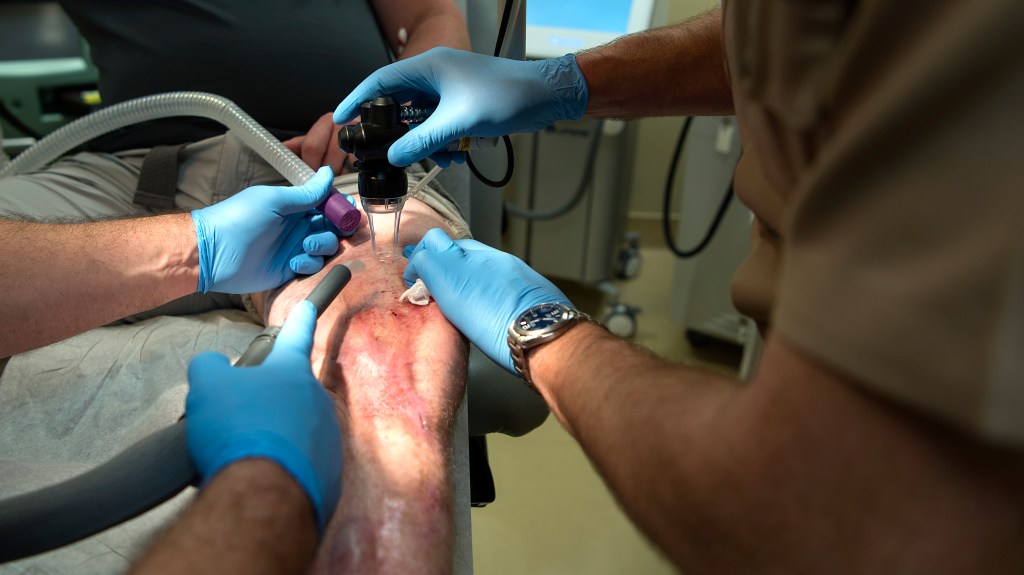
For hundreds of thousands of veterans living with painful scars from combat wounds, burns, and surgeries, the VA’s disability compensation system is a lifeline — but a new federal watchdog report reveals that the system handling those claims is riddled with errors. Those mistakes have already cost taxpayers millions of dollars, and without intervention, the tab will keep growing.
The VA Office of Inspector General found that the Veterans Benefits Administration made at least one processing error in roughly 38% of disability decisions related to painful scars during a review period spanning June 2024 through May 2025. That translates to an estimated 17,900 flawed decisions — and approximately $5.6 million in overpayments to veterans.
What Went Wrong
At the heart of the problem is the Disability Benefits Questionnaire, the form used to evaluate veterans’ scar-related disability claims. According to the OIG, the form
“does not clearly define objective versus subjective evidence.”
That ambiguity left claims processors without a clear standard, and as a result, many evaluations were approved without the objective medical evidence required to support them.
For service-connected painful scars — which can result from burns, surgeries, shrapnel, or gunshot wounds — VA policy requires a physical examination to back up a veteran’s claim. But when that line between what a veteran reports and what can be clinically verified gets blurred in the paperwork, the system breaks down. The OIG concluded that claims processors
“sometimes provided evaluations for painful scars without objective evidence to support the evaluations, which led to overpayments in disability compensation.”
A second issue compounded the problem. The report found that physical aspects of scar-related disabilities were frequently evaluated under two separate diagnostic codes simultaneously — a practice known as “pyramiding” — leading to inflated compensation payments that veterans may not have been entitled to receive.
The OIG reviewed a random sample of 70 decisions drawn from a population of 47,300, then briefed the VBA on its findings in February 2026. A follow-up review of 30 additional decisions from January 2026 found an even higher error rate — 43 percent.
The VA’s Response
The VBA agreed with several of the OIG’s core recommendations, including revising the “Scars/Disfigurement” section of the Disability Benefits Questionnaire, improving employee training on how to accurately evaluate painful scar claims, and correcting the specific processing errors the OIG identified.
However, the agency pushed back on how the OIG characterized the scale of the problem. In its official comments included in the report, the VA argued that the projected error figures overstate the actual impact:
“The OIG examined 130 decisions, representing approximately 0.27 percent of the total review population of about 47,300 decisions, and identified 60 errors, which form the basis for the projected 17,900 errors referenced throughout the report.”
The VA further noted that the majority of those errors did not result in financial consequences:
“Importantly, only seven of the 60 errors OIG found resulted in improper payments, which represents about 5.4 percent of the sample, and when viewed across the full review population, only about 0.015 percent of all decisions reviewed. The remaining 53 errors, more than 88 percent of the sample, were technical or procedural issues that did not result in improper payments.”
The department has committed to implementing all of the OIG’s recommendations by February 2027. More than half a million veterans currently receive VA disability benefits for painful scarring caused or worsened by military service, meaning the accuracy of these evaluations has broad implications for both veterans and federal spending.
For more coverage of veterans policy and defense issues, visit the Pentagon & Congress section at Army Times, where recent stories include a 10-year deal between the Pentagon and Lockheed for 850 F-35 jets, the Pentagon’s push for ketamine wafers as a battlefield medicine option, a Marines’ lawsuit alleging the Pentagon ignored cybersecurity flaws before a data breach, and a GAO report finding the Pentagon’s AI oversight office is struggling to keep pace.