American and Colombian soldiers are deep in jungle terrain this week, training together on some of the most demanding military skills in the modern arsenal. The joint exercise underscores a deliberate shift in how the United States is approaching security across the Western Hemisphere — and why that region is now front and center in Pentagon planning.
Exercise Southern Vanguard 2027 launched Monday, bringing together roughly 350 U.S. military personnel and more than 400 Colombian soldiers for the 41st edition of this annual event. The exercise runs through mid-November and is hosted by the Colombian Army, with the U.S. Army Western Hemisphere Command leading the American side. The Army announced the launch this week.
Training priorities include jungle warfare, counter-IED techniques, command post operations, maritime interdiction, cyber skills, and ground security. According to a separate military release, troops will also conduct medical evacuation drills running from Colombia’s Tolemaida military base to its Cavalry School in Bogotá.
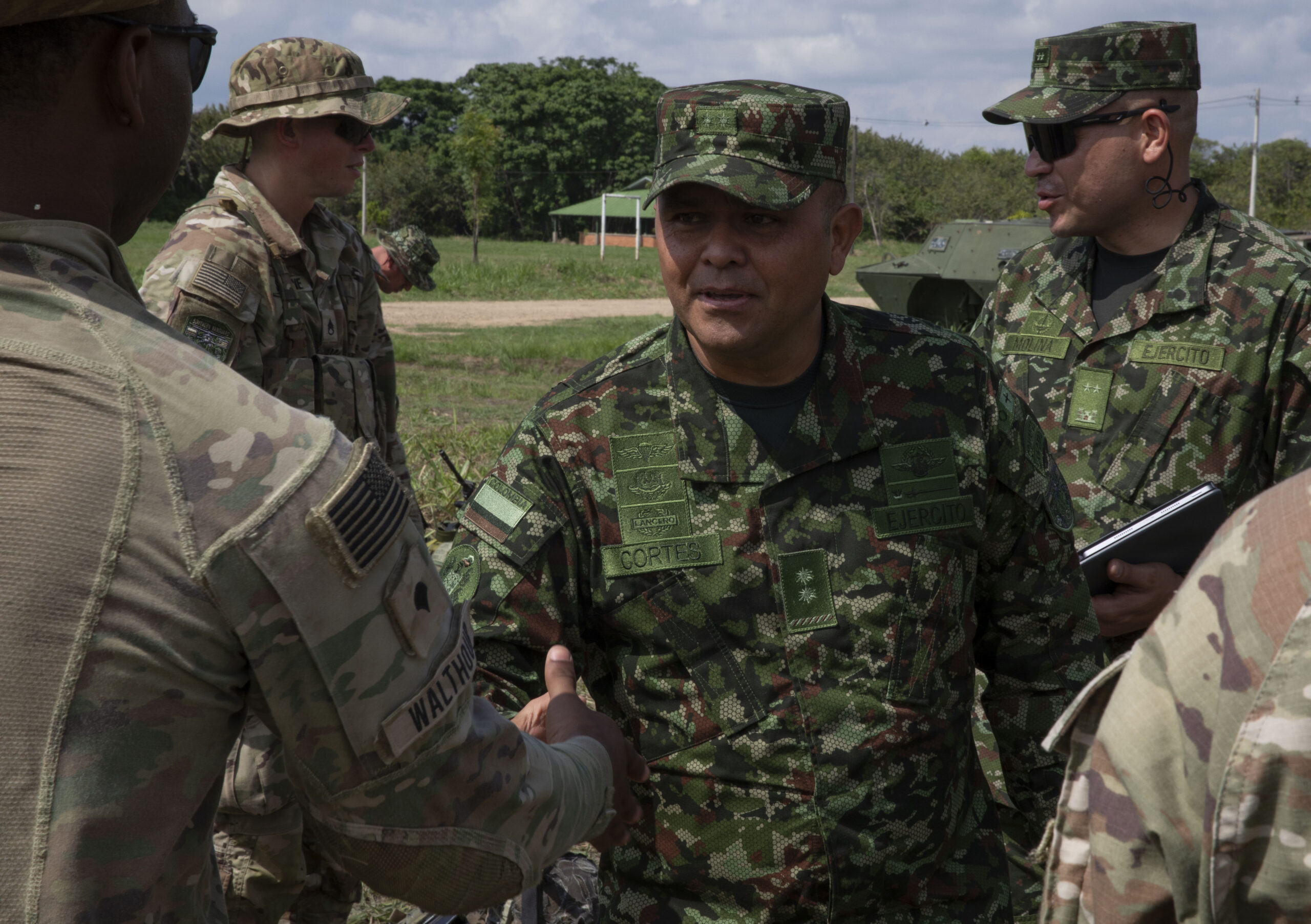
Colombian Army Brig. Gen. Edilberto Cortés, Chief of the Force Generation Staff, welcomed international participants at the opening ceremony.
“This presence demonstrates the shared commitment of our nations to strengthen collective readiness and consolidate the ties of cooperation that support our strategic and historical relationship,” he said.
A Command Built for a New Strategic Era
The exercise arrives as the U.S. Army completes a significant organizational overhaul. The Western Hemisphere Command, stood up in late 2025, reflects a broader reordering of Pentagon priorities embedded in the 2026 National Defense Strategy — one that elevates defense of the U.S. homeland and the Western Hemisphere above even the longstanding focus on countering China abroad.
The economic dimension of that strategy came into sharp relief at an Army conference last October. Rather than framing the hemisphere purely in military terms, Gen. Joseph Ryan, the commander of U.S. Army Western Hemisphere Command, cast the stakes in bluntly economic terms:
“The end state is economic supremacy for the United States,”
he said during a panel discussion. He went on to warn:
“we have ceded control of that economic terrain in this hemisphere to the People’s Republic of China over at least the last two decades, and that is a major threat to our national security.”
Jungle Training Gets a Renewed Focus
The Pentagon has been investing heavily in jungle warfare capabilities in recent years. A reinvigorated jungle school is now operating in Panama in partnership with Panamanian armed forces, and U.S. troops have been deployed globally to study and shape jungle warfare doctrine. As of September, Colombian soldiers were reported to be cycling through the reestablished “Green Hell” course — a notoriously grueling jungle training program.
The United States and Colombia have a long record of military cooperation. The U.S. has partnered with Colombia’s Lancero course, a program comparable to the Army’s Ranger School. Colombia also recently took part in PANAMAZ, a multinational exercise that simulated the defense of the Panama Canal. Both nations are members of the Counter Cartel Coalition, which is chaired by the United States.
This year’s exercise follows Exercise Southern Vanguard 2026, which included field training in Sauce, Peru, and gathered approximately 400 soldiers for jungle operations — a signal that this series of drills is growing in scale and strategic importance, as Army Times has reported.