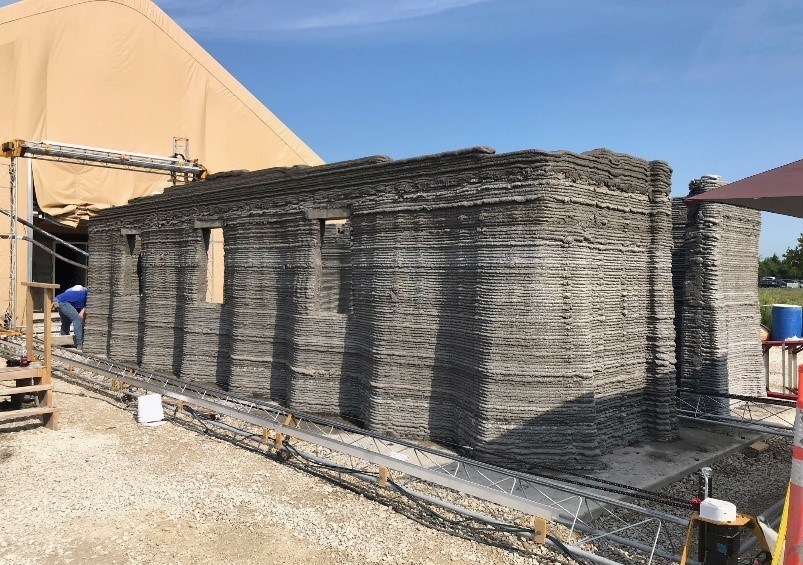
When Iranian forces struck U.S. military installations across the Middle East, the damage exposed a glaring vulnerability: American airmen were often sheltered in structures never built to withstand modern missile and drone attacks. Now, the U.S. Air Force is turning to an emerging technology — mobile 3D concrete printing — to change that reality on the battlefield.
The Air Force has issued a Small Business Innovation Research (SBIR) solicitation seeking companies to develop portable concrete printers capable of rapidly constructing protective military buildings in combat zones. The solicitation closes in January 2027 and is structured as a direct-to-Phase II project, signaling that the military wants this capability sooner rather than later.
The urgency stems from a harsh reality the Air Force openly acknowledged in its own solicitation:
“Put bluntly, the Air Force has spent decades building exquisite kill chains while too often housing the airmen who sustain them in tents, trailers, and flat-walled structures that were never designed for the threat environment now arriving overhead.”
The Threat That Exposed the Gap
A September 2026 report from the Department of Defense Office of the Inspector General found that hundreds of U.S. military buildings across eight Middle Eastern countries were damaged by Iranian attacks. Those strikes made clear that the existing infrastructure housing American service members was dangerously ill-suited for today’s threat environment, particularly as missile and drone technology continues to advance.
The Air Force’s response is to rethink how protective structures are built in the field — faster, smarter, and with materials that can actually absorb the punishment of modern warfare.
What 3D Concrete Printing Can Do
Concrete printing works by depositing layer upon layer of cement-like material to form complete structures, much the same way a desktop printer builds up ink — only on a vastly larger scale. The technology has already found a foothold in commercial construction and has even been tested by the military. In 2023, the Air Force used 3D printing to help rebuild hurricane-damaged Tyndall Air Force Base in Florida. Separately, a Maryland Air National Guard civil engineer squadron is already working on its own mobile concrete printer.
But those efforts, while promising, have yet to solve the specific challenges of a combat environment. According to the SBIR,
“the existing state of the art has not yet fully addressed the combined problem that matters most for combat survivability: printable expeditionary materials, field-executable operator workflows, and structure geometry deliberately optimized to mitigate blast-wave behavior and fragmentation effects.”
What the Military Needs
The Air Force’s program targets several technical challenges at once. Researchers will evaluate cement-like materials for strength, adhesion, and the availability of local components — meaning the military wants to use materials found near the construction site rather than hauling supplies across a war zone.
The project will also focus on designing new structural shapes that go beyond the standard flat walls found in most military buildings. The goal is to develop construction geometries that
“improve survivability beyond conventional flat-wall construction, including shapes intended to reduce blast reflection, limit pressure amplification, interrupt fragmentation paths, and improve internal occupant protection.”
Critically, the system must be operable in tough conditions by personnel who aren’t construction specialists. The Air Force wants a mobile printer that can be deployed and run
“in austere conditions by lightly trained military personnel.”
The service summed up the ambition clearly: the aim is to
“transition the capability from ‘we can print something interesting’ to ‘a civil engineer unit can deploy, set up, print, inspect, and use protective infrastructure fast enough to matter.'”
Beyond the battlefield, the Air Force sees broad potential for the technology. Officials noted
“substantial”
dual-use applications in areas like critical infrastructure repair and humanitarian disaster relief — though the SBIR acknowledges that wider commercial use will require navigating building codes and other regulatory approvals.