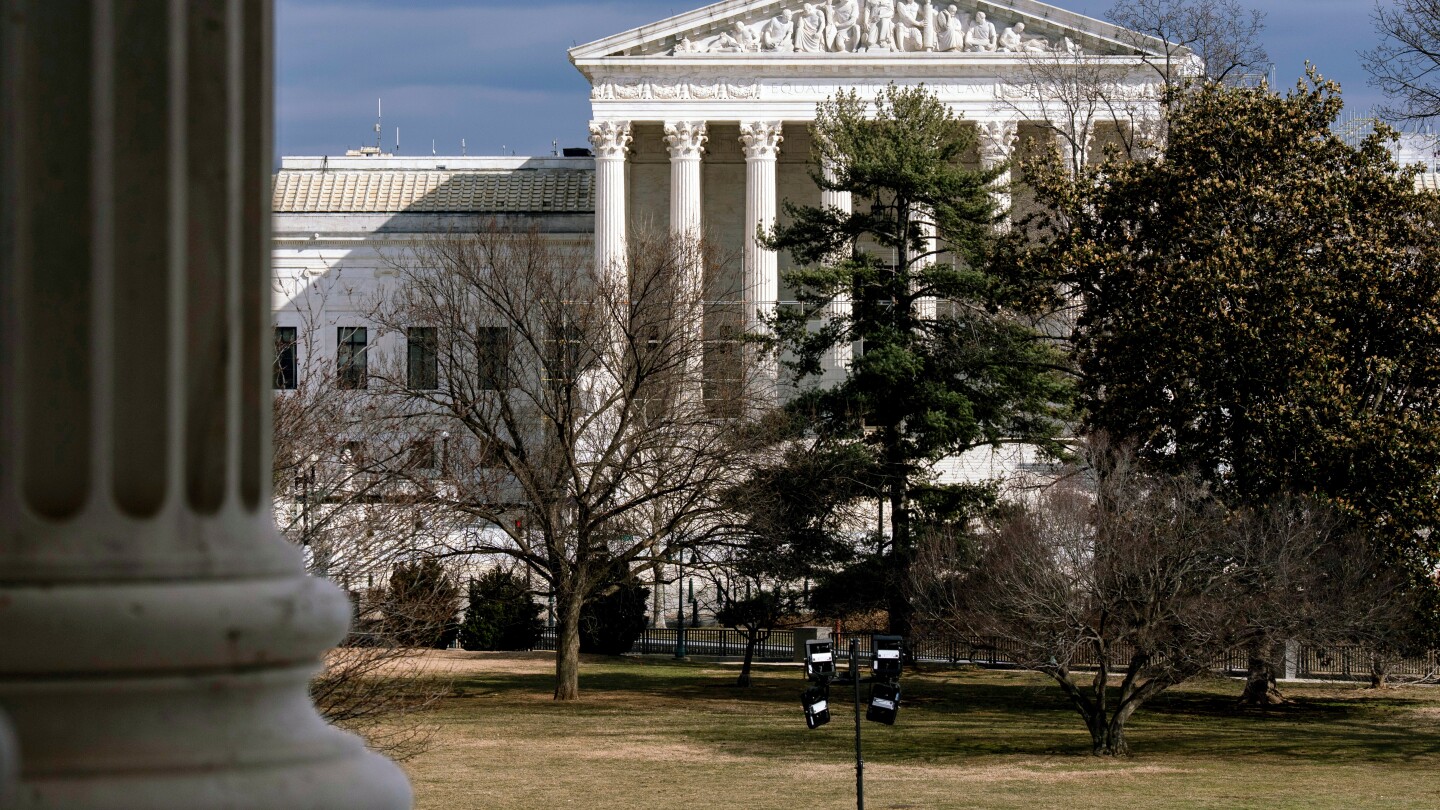
WASHINGTON (AP) — A pivotal legal battle is unfolding at the Supreme Court, with a Republican-backed challenge aiming to significantly alter the Voting Rights Act. Central to this litigation is a potential dismantling of a crucial segment of the law that forbids racial bias in the redrawing of district lines.
The justices are revisiting arguments concerning Louisiana’s congressional district map, which currently includes two districts with majority Black populations. A decision favoring Louisiana could pave the way for southern states to reconfigure their congressional maps, potentially enhancing Republican election outcomes by reducing districts that predominantly support Democrats.
The national struggle over redistricting has intensified, especially after former President Donald Trump’s encouragement for states like Texas to adjust their district boundaries to strengthen the GOP’s slim majority in the House of Representatives. This mid-decade redistricting conflict reflects ongoing political maneuvering.
The Supreme Court’s conservative majority has shown reluctance to factor in race, as evidenced by their recent termination of affirmative action in college admissions. Twelve years ago, the court nullified another critical portion of the voting law that mandated states with histories of racial discrimination to obtain federal approval before making electoral changes.
Currently, state legislatures have significant leeway to engage in gerrymandering for political gains, subject mainly to state supreme court oversight. Should Section 2 of the Voting Rights Act be weakened or removed, states might face no federal restrictions in delineating electoral districts, which could result in aggressive gerrymandering favoring the dominant political party.
In a notable 5-4 decision just two years back, the court upheld a ruling that identified a probable infringement of the Voting Rights Act in Alabama’s districting map. Chief Justice John Roberts and Justice Brett Kavanaugh aligned with the court’s liberal justices in this ruling.
This ruling facilitated the creation of new districts in both Alabama and Louisiana, leading to the election of two additional Black Democrats to Congress. Presently, the court seeks to address whether establishing a second majority-minority district contravenes the Fourteenth or Fifteenth Amendments.
During the initial hearings in March regarding the Louisiana case, Chief Justice Roberts expressed skepticism about the feasibility of a second majority Black district. He described it as a “snake” that spans over 200 miles to connect disparate regions of the state.
The legal contention over Louisiana’s districting has persisted for three years, with the Republican-led legislature crafting a new map in 2022 based on the 2020 census data. This map essentially preserved the existing distribution of five Republican-majority white districts and one Democratic-majority Black district.
Civil rights groups achieved a lower court victory, which determined that the proposed districts likely disadvantaged Black voters. Subsequently, the state was compelled to draft a new map to align with the court’s mandate while safeguarding its influential Republican figures, including House Speaker Mike Johnson. However, a separate lawsuit from white Louisiana voters argued that race predominantly influenced the redistricting process, a claim upheld by a three-judge panel, leading to the current Supreme Court case.
___
Stay updated with the AP’s coverage of the U.S. Supreme Court at https://apnews.com/hub/us-supreme-court.