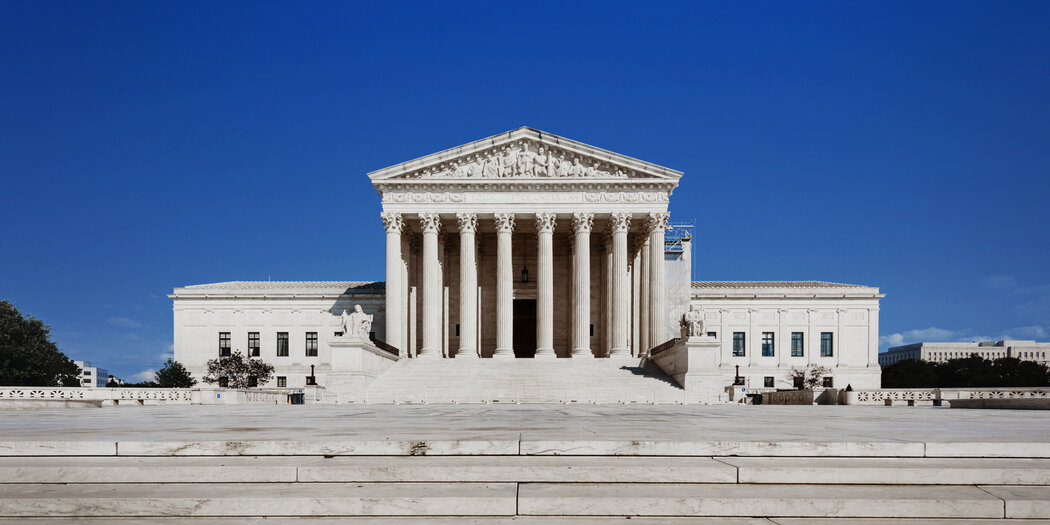
The Voting Rights Act, a pivotal piece of legislation from the civil rights era, continues to face significant challenges. On Wednesday, the Supreme Court deliberated a case that could potentially alter the enforcement of this landmark law, which was originally created to ensure voting rights for all Americans, irrespective of race.
The roots of the Voting Rights Act trace back to March 1965 in Selma, Alabama, where peaceful demonstrators crossed the Edmund Pettus Bridge and were met with violent resistance from state police. This incident, broadcasted nationwide, spurred President Lyndon Johnson and Congress to pass the Act with bipartisan support. Its primary aim was to eliminate racial discrimination in voting, prohibiting both intentional and resultant discriminatory practices.
This legislation, part of what was known as the “Second Reconstruction,” sought to fulfill the promises of the 14th and 15th Amendments. It dramatically reshaped political landscapes from local jurisdictions to federal levels, expanding the electorate and offering protections against discriminatory voting laws. The Act enabled voters of color to contest rules that hindered their ability to elect representatives of their choice, and it has been consistently reauthorized by both Republican and Democratic administrations, most recently in 2006.
However, the Voting Rights Act has not been immune to challenges. The Supreme Court has weakened it over the years, notably in the 2013 Shelby County v. Holder decision, which nullified Section 5. This section required certain states, mainly in the South, to obtain federal approval before changing voting regulations. Justice Ruth Bader Ginsburg, dissenting, famously compared this to “throwing away your umbrella in a rainstorm because you are not getting wet.”
This decision has led to a surge in laws that make voting more challenging. A study by the Brennan Center (report) highlights a growing racial turnout gap, which was 18 percentage points in the 2022 midterm elections, particularly in areas formerly covered by Section 5.
Despite the removal of Section 5, the Supreme Court maintained that Section 2 was still a viable means to enforce the Act. However, the current case of Louisiana v. Callais questions the constitutionality of Section 2 itself. The outcome could decide whether decades of voting rights progress will endure or be dismantled.
The dispute focuses on Louisiana’s congressional map, drawn in 2020 by Republicans, which diluted the influence of Black voters. Although Black residents make up a third of the population, they had significant representation in only one of six districts. Black voters challenged this under Section 2, leading to a court ruling against the map. However, the state produced another map that was then contested by white voters, claiming it violated the 14th Amendment’s Equal Protection Clause.
Previously, the Supreme Court postponed its decision on this issue, inviting debate on whether Section 2 should stand. Louisiana contends that states shouldn’t consider race in map-drawing, arguing for a reinterpretation of the 14th Amendment that might undo protections against discriminatory practices.
Racial discrimination in voting remains a pressing issue. In Louisiana and other states, courts have found both deliberate discrimination and vote dilution, which have widened racial disparities in political participation. During Wednesday’s Supreme Court arguments (arguments Wednesday), some justices seemed open to limiting or even discarding Section 2. Eliminating it could, as noted in a friend-of-the-court brief, disrupt redistricting processes nationwide just before a major election.
Regardless of the Supreme Court’s decision, it is crucial for Americans to champion the fundamental right to vote. The courage of the 1965 Selma marchers paved the way for progress, and today, collective engagement at all government levels is necessary to uphold constitutional principles.