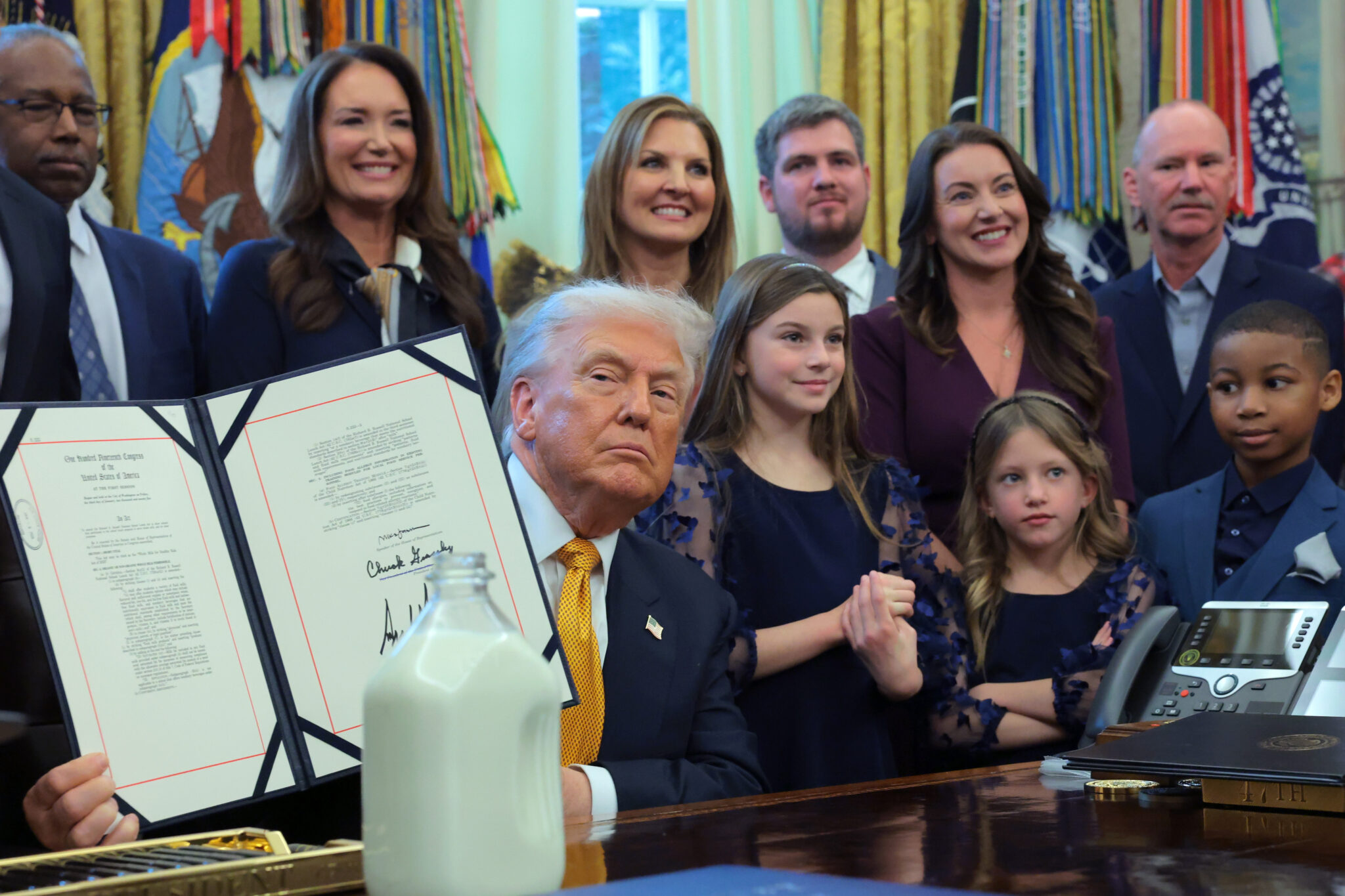
In a significant shift for U.S. school nutrition programs, President Donald Trump has signed into law a measure bringing whole milk back to federally subsidized school lunches. This move marks the return of whole milk to school cafeterias after over a decade of absence, aimed at addressing childhood obesity concerns.
During a ceremony in the Oval Office, President Trump highlighted the Whole Milk for Healthy Kids Act, emphasizing its role in ensuring that millions of schoolchildren have access to what he described as “high-quality milk.” The President noted this as a win for both students and the American dairy industry, acknowledging the support he received from dairy farmers.
White House Ceremony
Accompanying the President at the signing event were Agriculture Secretary Brooke Rollins and Health and Human Services Secretary Robert F. Kennedy Jr., both praising the legislation. Rollins announced that her department would initiate the necessary rulemaking to reintegrate whole milk into school lunches, while Kennedy Jr. called the policy change a needed correction to prioritize children’s health.
Notable attendees at the ceremony included Dr. Ben Carson, USDA’s national advisor for nutrition, alongside a bipartisan group of senators and representatives such as Democratic Sen. Peter Welch of Vermont and GOP Sens. John Boozman, Mike Crapo, and Roger Marshall. They were joined by Commerce Secretary Howard Lutnick and several advocates who supported the initiative.
The Whole Milk for Healthy Kids Act had seen smooth legislative progress, with the U.S. House passing the bill in December following its unanimous Senate approval in November. Key figures in introducing the measure were Sens. Welch, Marshall, Dave McCormick, and John Fetterman, alongside Reps. Glenn “GT” Thompson and Kim Schrier.
Details of the New Legislation
The newly signed law allows schools participating in the USDA’s National School Lunch Program to offer a variety of milk options, including flavored and unflavored whole, reduced-fat, low-fat, and fat-free milk variants. The program, which serves approximately 29.4 million children daily, also accommodates nondairy beverages that meet nutritional standards set by the Agriculture Secretary.
Importantly, the legislation exempts milk fat from being categorized as saturated fat concerning schools’ meal planning guidelines. Additionally, it permits parents, guardians, and physicians to provide written requests for nondairy milk substitutes for students.
Michael Dykes, president and CEO of the International Dairy Foods Association, welcomed the enactment of the law, describing it as a victory for children, parents, and school nutrition leaders. He highlighted the flexibility it offers schools in providing diverse milk options catering to students’ preferences.
This legislative change follows another significant policy update: the release of the 2025-2030 Dietary Guidelines for Americans by the USDA and HHS, which encourages increased consumption of full-fat dairy and protein.