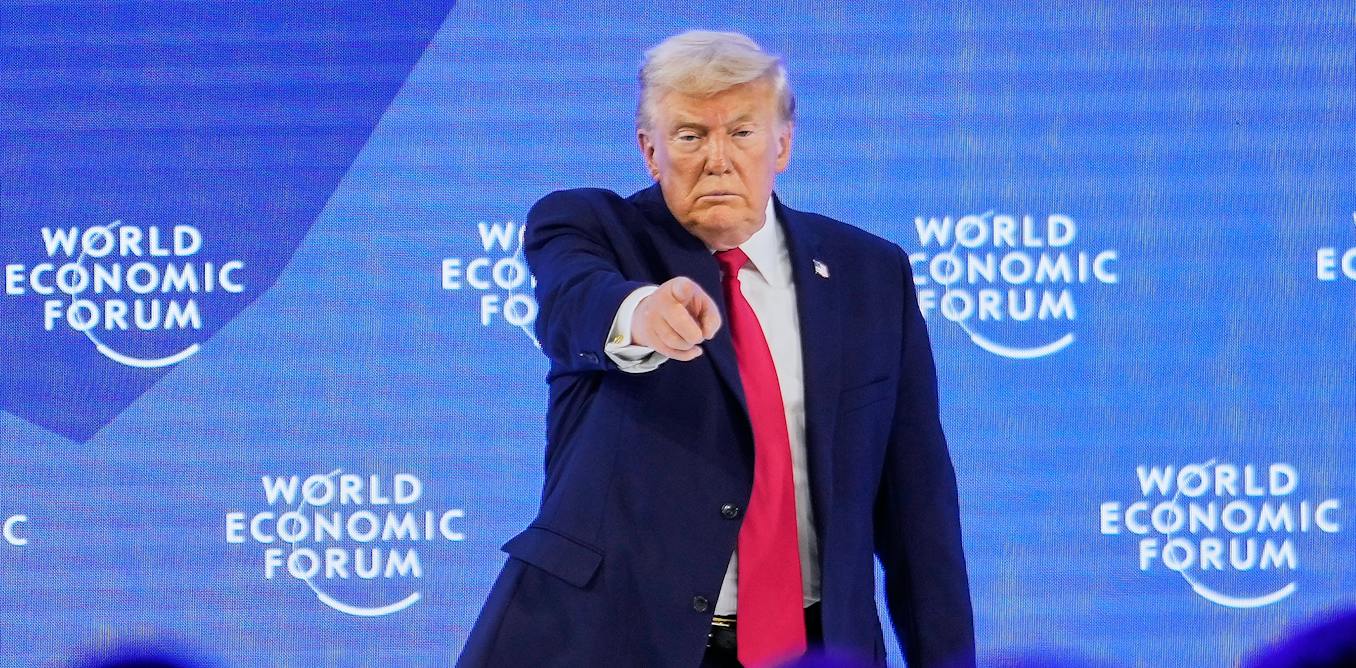
In an unexpected declaration in January 2026, President Donald Trump articulated a bold stance at a conference in Davos, Switzerland. Speaking to a gathering of business and political leaders, he emphasized that the United States required the “right, title and ownership” of Greenland, asserting that ownership was essential for defense.
Greenland, with its small population of approximately 57,000 people, is seen by Trump as a strategic asset to be acquired rather than leased.
Trump’s approach during his second term has sparked numerous interpretations, from the “flooding the zone” strategy, which overwhelms media and judicial systems, to psychological analyses labeling him as narcissistic. Some view his actions through lenses of authoritarianism or demagoguery.
However, an alternative perspective suggests something simpler. Trump’s five-decade career in commercial real estate continues to influence his reasoning. This framework, termed portfolio reasoning, offers insight into his governance style.
As an academic who studies the impact of reasoning on political arguments, I observe that Trump employs a business-like approach in his political discourse, focusing on portfolio reasoning.
Portfolio Theory
Portfolio reasoning, rooted in financial theory, involves managing and reassessing a collection of holdings—property, money, relationships—aimed at maximizing value.
Questions such as “What do I have?” “What should be retained, acquired, or disposed of?” and “How can I ensure flexibility?” are central to this approach.
Originating from economist Harry Markowitz in the 1950s, portfolio theory addresses financial risk management. Its principles have extended beyond finance into broader economic thinking.
Consider a college sophomore navigating stock decisions on Robinhood, adjusting a fantasy football roster, and engaging in prediction markets. These activities reflect a consistent habit of managing fluctuating positions.
The US as a Flagship Holding
Trump’s second term aligns with portfolio reasoning, viewing the nation as a valuable asset to enhance.
Under this model, a thriving stock market, foreign investment, and tariff revenue underscore the increased value of the United States. Previous leaders, according to Trump, were ineffective negotiators, leaving untapped potential.
Treaties and alliances transform into assets requiring continuous evaluation, while dissenting states face potential divestment.
Trump’s rhetoric frequently portrays the U.S. as a “flagship holding,” with his State of the Union address boasting of economic achievements akin to an investment report.
At a Las Vegas rally, he emphasized the influx of capital, likening the nation’s revival to a distressed property’s turnaround.
Continuous Reassessment of Holdings
Trump reassesses existing holdings, repricing those deemed underperforming.
In his State of the Union, he highlighted NATO’s increased defense spending and the U.S. no longer subsidizing others’ security.
Canada faced a similar reassessment when seeking missile defense coverage, with Trump proposing a $71 billion price tag or an alternative path to becoming the 51st state.
Acquiring New Positions
Portfolio growth involves acquisition, as seen in Trump’s interest in Greenland and Venezuela. Following political changes in Venezuela, Trump announced plans for oil transfers and U.S. company involvement, treating the nation as an asset to enhance.
The federal government has also acquired stakes in numerous companies since 2025, including a 9.9% share in Intel.
Portfolio Reasoning and Democratic Limits
This approach raises questions about its alignment with traditional presidential roles.
While Trump’s team, represented by Stephen Miller, frames the global environment as one of strength and negotiation, portfolio reasoning challenges democratic norms by privileging flexible commitments over lasting agreements.
This logic applies to political commitments and the public, assessing value but lacking a moral framework to prioritize democratic values over financial calculations.