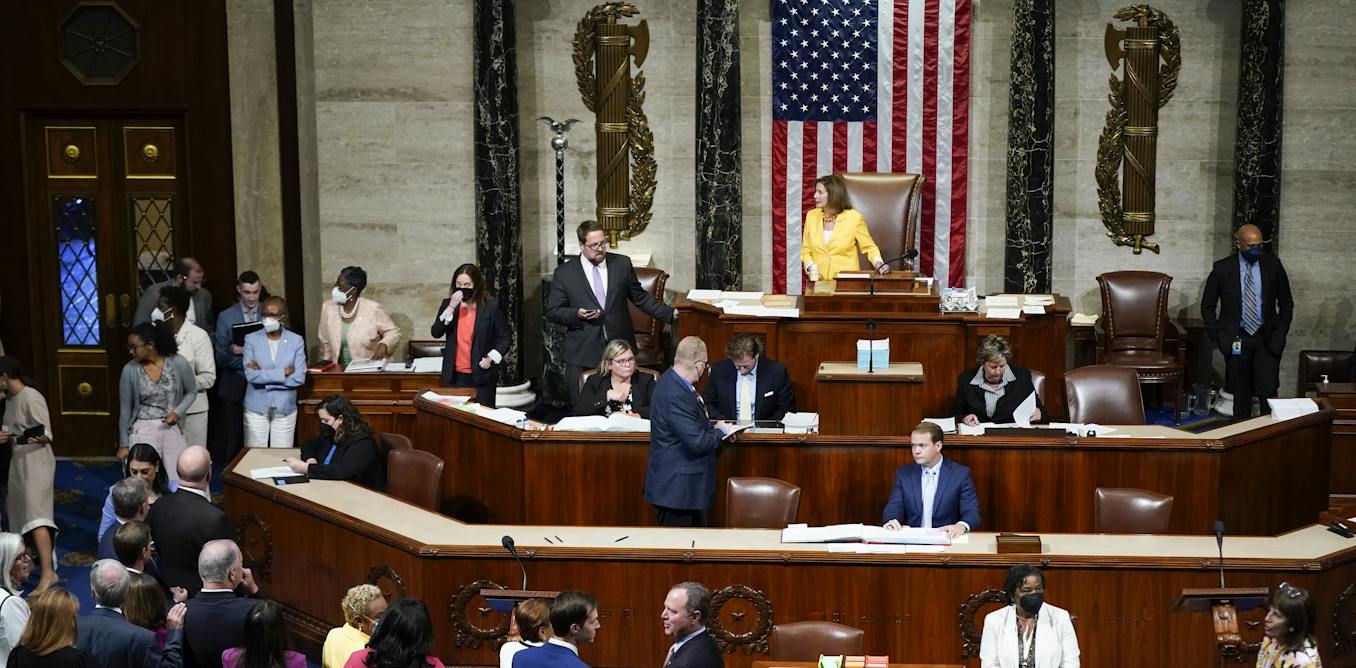
The Inflation Reduction Act of 2022, a significant U.S. federal initiative aimed at addressing climate change, was passed without Republican support. Yet, the financial advantages it offered were felt across party lines, benefiting both Republican and Democratic politicians who were already serving in the House of Representatives. This finding emerges from a detailed analysis conducted by a team of researchers, indicating that the flow of federal funds to districts can boost electoral prospects even for those who opposed the legislation.
The legislation was passed thanks to a decisive vote by Vice President Kamala Harris, authorizing $370 billion to fight climate change and reduce greenhouse gas emissions. This funding primarily came through subsidies, including a tax credit of up to $7,500 for electric vehicle purchases and incentives for enhancing the energy efficiency of commercial buildings, rather than through new taxes or fees.
As the 2024 elections approached, more than $204 billion had been invested in clean energy projects nationwide, fueled by both private investment and federal incentives. Despite initial opposition, a substantial portion of the investment, approximately 79%, was directed to Republican congressional districts.
Interestingly, although Republicans at the national level opposed the bill, many supported clean energy investments at the state and local levels. These investments, often well-suited to the larger, rural Republican districts, were seen as beneficial for local economic development.
Federal Spending and Political Gain
The practice of directing federal funding into local districts, often criticized as “pork barrel politics,” can enhance job creation and economic growth, making it favorable among voters. Despite their initial dissent, some Republican lawmakers began to defend aspects of the Inflation Reduction Act as the funds started benefiting their districts. In August 2024, 18 Republican House members advocated for the preservation of the law’s clean energy tax credits, citing job creation benefits.
This backing was evident again in March 2025 when Republican leaders, while considering cuts to the law’s programs, faced pressure from within the party to maintain clean energy tax credits. These credits were crucial for ongoing projects, such as wind energy developments and battery factories, which risked losing out if the credits were revoked.

Logan Cyrus/AFP via Getty Images
Impact on the 2024 Election
The analysis reveals that the funding from the Inflation Reduction Act provided a significant boost to incumbent House members from both parties in the 2024 elections. During their campaigns, Republicans often referred to the act’s benefits as “economic development opportunities,” whereas Democrats mentioned the act by name.
Funding was unevenly distributed, with some districts receiving as much as $8 billion. Notable investments were made in Republican-controlled areas like North Carolina and Georgia to expand electric vehicle production facilities. These companies benefited from corporate tax breaks and anticipated increased electric vehicle sales due to consumer tax credits.
In Mississippi’s 2nd Congressional District, which received $588 million, Democratic Rep. Bennie Thompson secured 61.8% of the vote in 2024, an increase from 60% in 2022. Similarly, in Michigan’s 5th District, Republican Rep. Tim Walberg saw his vote share rise to 65.7% in 2024 from 62% in the previous election cycle.
Statistical analysis confirmed that greater financial inflows from the Inflation Reduction Act correlated with improved electoral performance for incumbents. Doubling the district’s federal investment was associated with a 0.9 percentage-point increase in the incumbent’s vote share relative to 2022.
Despite the lack of evidence for direct economic improvement, incumbents appeared to gain electoral benefits by crediting these investments during their campaigns. This suggests that voter preferences are more influenced by visible investments than the broader intentions behind them.

Samuel Corum/Getty Images
Policy Revisions Under the Trump Administration
With the onset of President Trump’s administration in 2025, significant climate-related provisions of the Inflation Reduction Act were rolled back by the newly Republican-controlled House. The “One Big Beautiful Bill Act” eliminated tax credits for energy efficiency and electric vehicle purchases.
The Trump administration also aimed at increasing fossil fuel production on federal lands, highlighting how presidential priorities can overshadow local benefits in polarized issues. Nevertheless, the retention of some climate-related tax credits suggests that economic development initiatives may still hold sway within Republican strategies.
Despite the contentious nature of climate change policies, the direct financial benefits of the Inflation Reduction Act have demonstrated that investments can yield political advantages, reflecting a complex dynamic between policy benefits and political alignment.
This article is based on research conducted with Nives Dolsak, Inhwan Ko, and Aseem Prakash.