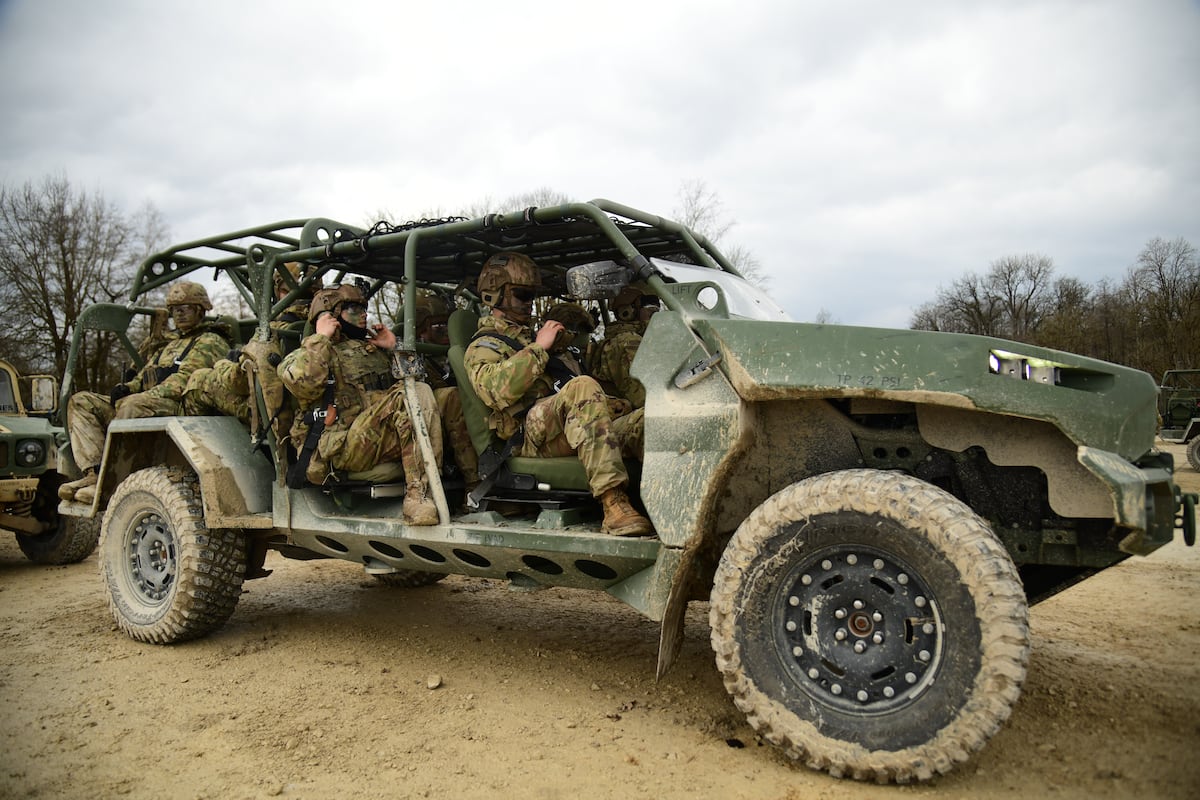
In a significant move to bolster its military fleet, the Army is massively increasing its orders for the Infantry Squad Vehicle (ISV). GM Defense, the manufacturer of the ISV, announced at the Association of the United States Army’s annual exposition that the Army’s request has jumped from an initial 649 vehicles to nearly 12,000.
This expansion signifies a dramatic 1,750% increase in the Army’s ISV fleet, reflecting the military’s commitment to modernizing its capabilities. Steve duMont, President of GM Defense, highlighted the company’s swift adaptability to the Army’s evolving demands, emphasizing their focus on “advanced capability, rapid fielding and sustainable scale.”
DuMont stated, “By transferring GM’s world-class engineering, supply chain and manufacturing scale directly to the service member, we are transforming customer needs into mission-ready capability faster than ever before.” This statement underscores GM Defense’s commitment to providing cutting-edge solutions for military needs.
To demonstrate its rapid operational capabilities, GM Defense pointed to its delivery of PAC-3 Missile Segment Enhancement housing components to Lockheed Martin in a mere 22 days. This achievement shows how quickly GM can scale its production to meet urgent demands.
The development of the ISV came after GM Defense identified a critical operational gap in collaboration with the Army. The company proactively funded the development of an ISV-Utility prototype and provided seven prototypes of a versatile five-soldier variant for free, allowing the Army to conduct unit-level assessments.
These variants are set to be deployed across 39 active-duty and National Guard mobile brigades. Unlike conventional combat vehicles, the ISV is designed without armor, doors, or windows, making it distinct from traditional military transport.
The design of the ISV and its heavier counterpart, the ISV-Heavy, is inspired by GM’s Chevrolet Colorado ZR2 and Chevrolet Silverado HD 3500 ZR2. This design approach allows adaptability to battlefield conditions rather than fixed mission scenarios.
Drawing from lessons learned from Ukraine, the Army plans to use the ISV as a key component of its new Mobile Brigade Combat Teams (MBCTs), which are designed to swiftly address emerging threats and large-scale combat operations.
In addition to the ISV announcement, GM Defense introduced concepts for an unmanned ground vehicle (UGV) and an expeditionary energy storage system at AUSA. The UGV, based on the “Chevrolet Silverado 3500HD dual-rear-wheel skateboard architecture,” is intended for tasks such as “silent logistics and casualty evacuation,” with testing slated for 2027.
Furthermore, GM Defense showcased the EPIQ Hybrid prototype of an energy storage system, inspired by military needs. This system, with a capacity of 60 kilowatts and 100 kilowatt-hours, features an onboard generator that minimizes thermal and noise outputs.
Daniel Terrill is a contributor to Military Times. He’s been reporting on military issues, the gun industry, and the outdoors for nearly two decades. Although writing is his passion, he’s been a Marine, police officer, and, perhaps the most dangerous job of his career, a substitute teacher.