For the first time in two decades, the U.S. Army is on the verge of replacing one of its most widely used artillery systems — and the clock is moving faster than many expected. Less than a year after the Army issued its initial request for proposals, the first prototype of a next-generation mobile cannon has already arrived in American hands.
Army officials confirmed Thursday that the service has taken delivery of its first Mobile Tactical Cannon, a self-propelled 155mm howitzer built by Hanwha Defense USA. The announcement came ahead of the Association of the United States Army’s annual meeting, where senior officials spoke to reporters about the state of the Army’s artillery modernization push.
The cannon was also on display earlier this month at an “Army Modernization Day” event on Capitol Hill — the first of its kind — giving lawmakers and the public an early look at the hardware.
What the New Cannon Replaces
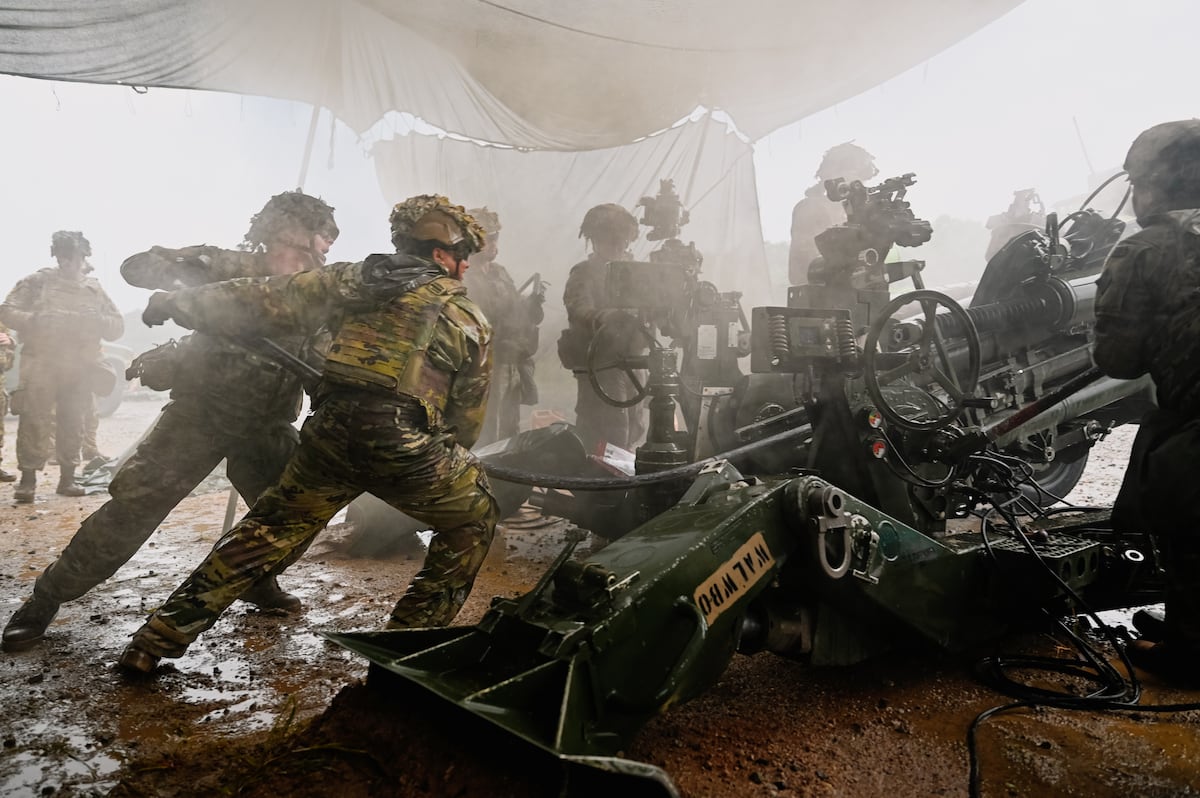
The Mobile Tactical Cannon is designed to succeed the M777 155mm howitzers, which have been in service since 2005. While the M777 has proven reliable over two decades of use, its range limitations have become a growing concern. The system has an effective range of under 24 kilometers — roughly 15 miles — and can reach up to 40 kilometers, or about 25 miles, when firing the extended-range Excalibur round.
The new Mobile Tactical Cannon, based on Hanwha’s K9 platform, offers a significant leap forward. The K9 is a 52-caliber system capable of reaching targets more than 60 kilometers away — nearly 37 miles. The K9 has been a mainstay of the South Korean military since 1999 and is now operated by 11 countries in various configurations, accounting for more than half of all self-propelled howitzers in service worldwide.
Speed of Acquisition
The pace of this procurement has drawn attention within defense circles. The Army awarded a prototyping contract to Hanwha in August 2026 — a four-year agreement worth up to nearly $263 million. That contract covers the procurement of up to 18 prototype systems for testing and soldier experimentation, with an initial requirement for six systems to be delivered on an accelerated timeline, and options for up to 12 more.
The contract was executed through an Other Transaction Authority agreement, a contracting mechanism that allows the military to move more quickly than traditional procurement pathways. Brig. Gen. Robert J. “RJ” Mikesh Jr., the Army’s portfolio management executive for offensive fires, credited that flexibility for the rapid turnaround.
“What enabled that was this close partnership under the PAE construct and trying new and novel ways of contracting,”
Mikesh said.
“In this case, we were not going after a clean-sheet design; we were looking for mature and available technologies. We opened our aperture for companies around the world, knowing that they’d have to onshore production within two years. That howitzer is now on contract.”
Hanwha has announced plans to build an integration and test facility in Opelika, Alabama, to support domestic development and delivery of the systems.
Testing and Soldier Feedback
With the first unit now in hand, the Army is preparing to begin a testing regimen that officials say will prioritize real-world performance. A series of operational experiments is planned to assess how the systems hold up under realistic combat conditions.
“We’re excited to have that and get ready to test it,”
Mikesh said.
“And get that soldier feedback, that we think is so important.”
According to Army leaders, the goal is to field a combat-ready version of the Mobile Tactical Cannon by 2031. Initial fielding will focus on Stryker Brigade Combat Teams, with Mobile and Infantry Brigade Combat Teams to follow.
A Tracked Variant Is Also in the Works
The wheeled version of the Mobile Tactical Cannon isn’t the only variant being pursued. In late August, the Army published a new solicitation for a tracked variant of the system. According to Breaking Defense, Hanwha officials have indicated they intend to compete for that contract as well.
Army budget solicitations reveal that the Mobile Tactical Cannon will also play a supporting role in the Army’s 155mm Artillery Propulsion Modernization project. That effort aims to push artillery performance even further by developing new propulsion technologies, including advances in propelling charges, modular charge systems, ignition systems, propellants, and packaging.
Army budget documents for fiscal year 2027 describe the ambition plainly:
“Solutions will be integrated into a system of systems capability to ensure interoperability, closing fires capability gaps to destroy or neutralize artillery targets out to 70 kilometers.”
That would represent a nearly threefold increase in effective range compared to the M777 — a significant shift in how the Army could project firepower on the battlefield in the years ahead. For more Army news, visit Army Times.