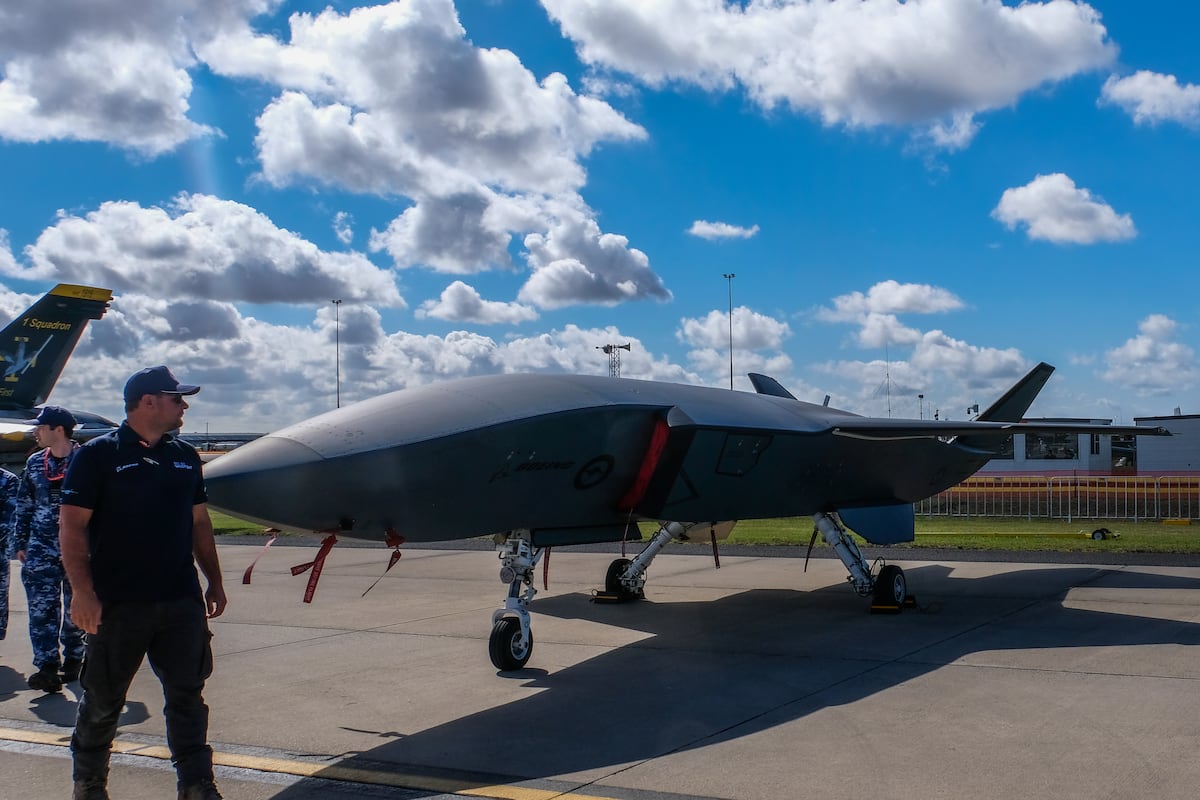
In a strategic move to enhance its military capabilities, Australia is embracing the use of collaborative combat aircraft (CCA) with the MQ-28A Ghost Bat at the forefront. Spearheading this initiative, the Royal Australian Air Force (RAAF) is already testing several units and expanding its fleet to bolster its defense strategies.
As part of the ongoing development, the RAAF currently tests eight Block 1 aircraft, while the first of three Block 2 units, ordered in February 2024, is undergoing ground testing ahead of its inaugural flight. On December 9, 2025, Boeing Defence Australia revealed that the RAAF has secured seven more Ghost Bats, valued at AUS$754 million (US$534 million). This latest acquisition includes six Block 2 units and the pioneering Block 3 aircraft.
The expansion aims to position the RAAF with ten operational Ghost Bats by 2028. Australia’s focus on long-range deterrence, driven by concerns over China’s military growth, underscores the strategic importance of unmanned systems like the Ghost Bat, which enable the country to extend its airpower capabilities.
Recent Demonstrations
In recent months, Boeing Defence Australia showcased its capabilities with two key demonstrations. One involved two MQ-28As flying in formation, coordinated by an E-7A Wedgetail early-warning aircraft. Glen Ferguson, MQ-28 Global Program Director at Boeing Defence, noted at the Singapore Airshow that the mission aimed to execute the “find, fix, track, target” elements of the air-to-air kill chain.
A pivotal moment occurred on December 8, 2025, when the MQ-28A performed its first missile launch, deploying an AIM-120 AMRAAM against a Phoenix drone. This operation, supported by targeting data from an F/A-18F Super Hornet and control from an E-7A, demonstrated the synergy of crewed and uncrewed aircraft in completing the kill chain, as Ferguson emphasized, “We did the engage-assess part of the kill chain, and we did it on purpose to show that all spectrums of the mission can be covered through a mix of crewed and uncrewed teaming.”
The Block 3 Ghost Bat is designed with an internal weapons bay capable of carrying one AMRAAM-sized or two GBU-39/B bomb-sized weapons. Boeing has tested various payloads, including electronic warfare and infrared sensors, though further details were not disclosed by Ferguson.
Production and Prospects
Construction of a dedicated Ghost Bat production site in Toowoomba, Queensland, is nearing completion, with operations slated to begin in 2027. Aiming for cost-effectiveness, Australia intends for the Ghost Bat to be priced at 10% of a crewed combat aircraft, a goal Boeing is confident of meeting. Ferguson noted, “We’re really, really comfortable with our affordability. We’ve built this aircraft from day one to be affordable.”
On the international front, Boeing is engaging in discussions with potential global partners, including Japan, to explore collaborative capabilities. The competitive landscape for CCAs is heating up, with Anduril Industries showcasing its Fury – the YFQ-44 – and General Atomics developing its Gambit series.