Navy’s F-35C Fighters Achieve Milestone on USS John F. Kennedy
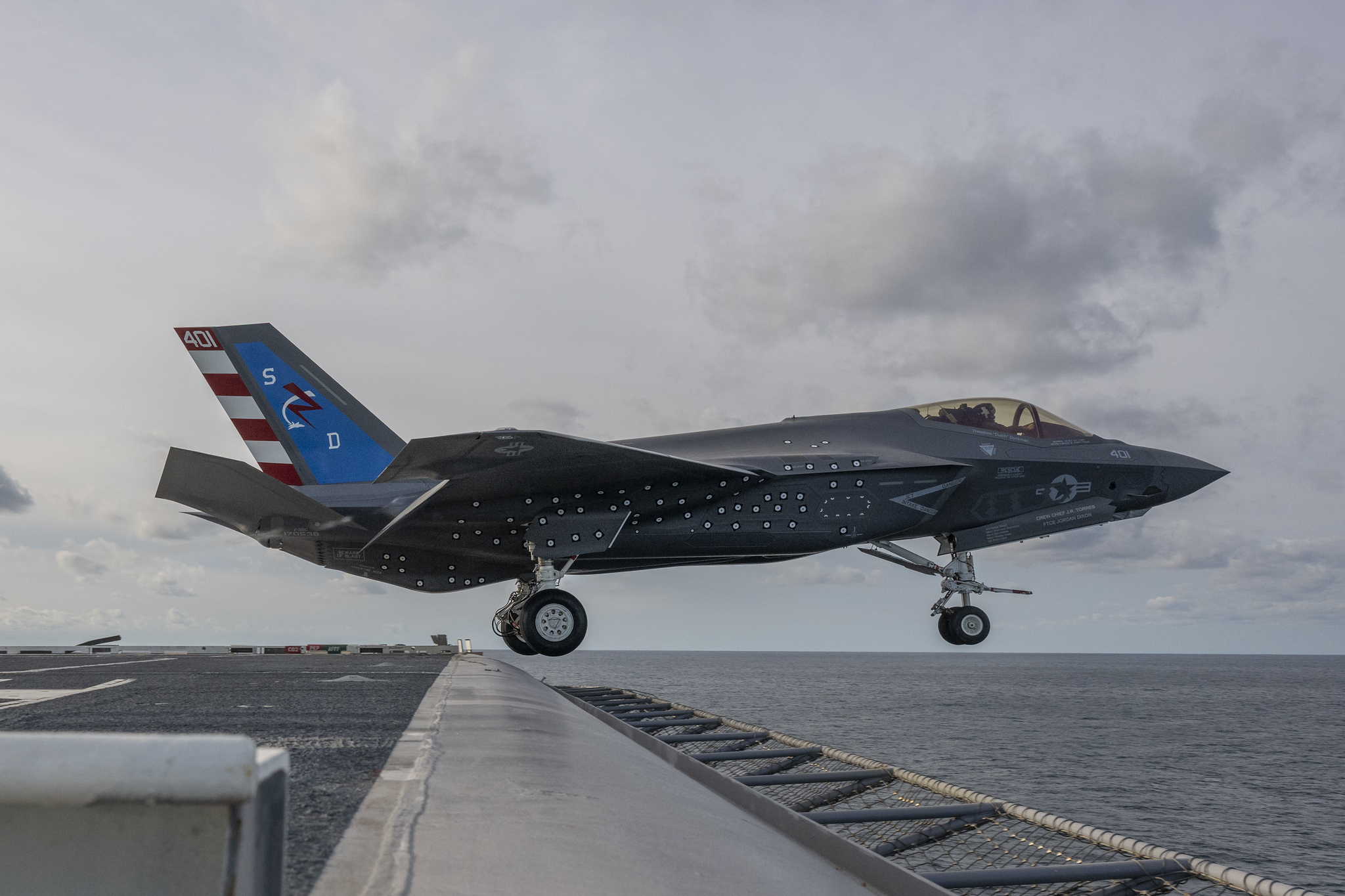
In a significant development for naval aviation, two F-35C Lightning II jets have successfully completed their initial launch and recovery trials on the future USS John F. Kennedy. This marks the first time these advanced jets have been tested aboard the Navy’s second Gerald R. Ford-class aircraft carrier, as reported by Lockheed Martin.
The testing, which spanned 11 days starting on the Navy’s 251st birthday on October 13, involved 34 flights with 122 catapult launches and 122 arrested landings. These operations were conducted by Air Test and Evaluation Squadron 23, or VX-23, also known as the “Salty Dogs,” stationed at Naval Air Station Patuxent River, Maryland.
The trials were a part of Kennedy’s Aircraft Compatibility Testing, designed to evaluate the ship’s launch and recovery systems in conjunction with Navy aircraft. The first arrested landing and catapult launch occurred on October 13 and October 14, respectively, according to Navy records.
Unlike their Nimitz-class predecessors, Ford-class carriers, including the USS John F. Kennedy, utilize the Electromagnetic Aircraft Launch System (EMALS) and Advanced Arresting Gear (AAG). EMALS provides more controlled and smoother launches, while AAG supports a wider range of recovery conditions, as per Lockheed Martin.
Additional modifications on the Ford-class carriers include a smaller island, which is positioned approximately 140 feet further back compared to the Nimitz class. This redesign alters airflow, exhaust patterns, and deck operations, enhancing the carrier’s operational capabilities.
This at-sea testing followed earlier shore-based trials conducted between January 2024 and May 2025. These tests corroborated the jet’s structural models and verified the associated software and equipment for EMALS and AAG systems. The data gleaned from these tests will be instrumental in shaping launch and recovery protocols for Ford-class carriers.
“This is a critical event for the F-35C, Kennedy, and the United States Navy,” stated Sean Jackson, Lockheed Martin’s F-35 Development Program Vice President. “For the first time, the aircraft has demonstrated launch and recovery operations from a Gerald R. Ford-Class flight deck, advancing the integration of fifth-generation fighter capability with the world’s most advanced carrier technology.”
Upon the successful completion of this testing phase, Sean Jackson confirmed, “the Navy has now cleared the F-35C for operations across its entire fleet of aircraft carriers.”
A Lockheed official indicated to Defense News, “The ships are cleared to launch and recover F-35s once the launch and recovery bulletins are published,” although they will not be fully operational until all supporting equipment is installed. The Navy retains “final clearance” authority.
The F-35C’s inaugural carrier landing occurred in November 2014 aboard USS Nimitz near San Diego, and it has since been deployed from modified Nimitz-class carriers. However, the lead Ford-class ship, USS Gerald R. Ford, has yet to deploy with the jet.
In a 2019 statement to USNI News, a Navy spokesperson noted that both carrier classes are designed to operate with F-35Cs but require upgrades like enhanced jet blast deflectors and classified spaces for full deployment efficiency. According to Stars and Stripes, the Navy intends to retrofit the USS Gerald R. Ford to accommodate the F-35C.
The USS John F. Kennedy received these modifications during its construction. In 2020, the Navy amended the ship’s construction contract to comply with legislative requirements for F-35C deployment capability.
The Navy signed off on preliminary acceptance of the Kennedy on September 29, following the completion of acceptance trials in August. This preliminary acceptance permits the crew to conduct sea tests and training while the shipbuilder finalizes its work, with formal delivery expected in spring 2027.