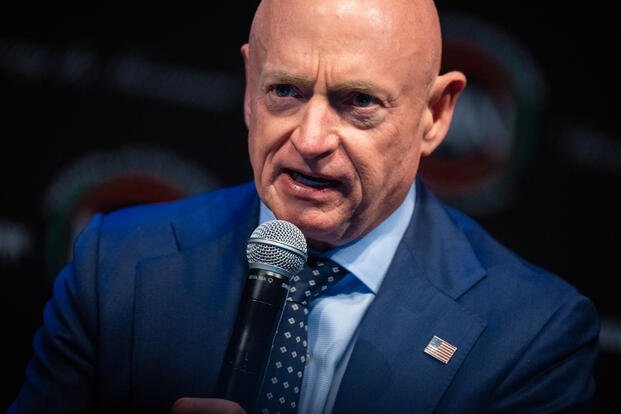
In a dramatic legal turn, 73 former U.S. military leaders, including admirals and generals, have aligned in support of Sen. Mark Kelly, a retired Navy captain and astronaut. Their shared goal is to defend Kelly against the Trump administration’s legal actions stemming from a video advocating for military members’ rights to refuse unlawful orders.
In November 2025, Kelly, along with other Democratic military veterans, produced a video emphasizing the constitutional right of service members to resist illegal orders. This catalyzed a protracted legal conflict with the Trump administration.
An amicus brief, covering 39 pages, was filed by retired senior officers and former military secretaries who collectively served from the Eisenhower era to the Trump administration. The signatories, including 16 four-star officers, stress their extensive leadership experience and dedication to national security.
“This decision is not made lightly: the attempt to punish Sen. Kelly suggests that public disagreement with the secretary—even if made in good faith and supported factually—invites retaliation,” the brief states. It further warns of a “chilling effect” that could stifle dissent from former military personnel, which it describes as vital to American democracy.
Legal backing for the former service members is provided by the Protect Democracy Project, States United Democracy Center, and the Vet Voice Foundation. “The administration’s attempts to silence veterans are an insult to their service and their sacrifice,” commented Beau Tremitiere from Protect Democracy. “We are stronger when our veterans exercise their First Amendment rights and share their wisdom in public debate. Government punishment for veterans who speak up has no place in America, period.”
Background
The controversial video, featuring Kelly and other Democrats, like Sen. Elissa Slotkin and Reps. Jason Crow and Chrissy Houlahan, led to accusations of “seditious behavior” from Trump. Defense Secretary Pete Hegseth initiated an investigation into Kelly, citing violations under the Uniform Code of Military Justice (UCMJ), and censured him for “reckless misconduct.”

Kelly responded by suing the Trump administration in January, challenging attempts to demote his retirement rank and pension. In February, U.S. District Judge Richard J. Leon temporarily blocked Hegseth’s actions, citing free speech and the respect owed to military veterans. The Pentagon has since appealed this order.
Arguments Supporting Kelly
The retired officers’ brief outlines three primary arguments supporting Kelly. Firstly, it emphasizes the essential role of veterans in public debate, arguing that their unique perspectives are invaluable to democratic governance. The brief states that “there must be wide latitude for differing views on public controversies.”
Secondly, it asserts that the duty to disobey illegal orders is crucial, referencing historical lessons from World War II and the Nuremberg Trials. The brief highlights the importance of distinguishing between lawful and unlawful orders.

Finally, the brief argues that the UCMJ’s speech restrictions are not applicable in this context, stating that Kelly’s statements on military policy and law do not warrant disciplinary action under the UCMJ.
The legal representatives for the retired military leaders conclude that the efforts to penalize Kelly for his speech endanger a historic tradition of veteran involvement in public discourse. The court is set to hear oral arguments on May 7.