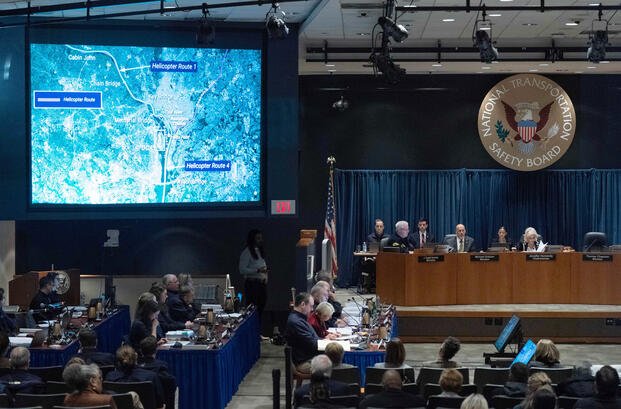
In a stark reminder of aviation safety challenges, the National Transportation Safety Board (NTSB) has voiced grave concerns over long-standing warnings that were disregarded regarding helicopter traffic risks. This followed the tragic collision between an American Airlines jet and an Army Black Hawk helicopter near Washington, D.C., which resulted in the loss of 67 lives.
The NTSB revealed that a helicopter route intersecting the approach path of a runway at Reagan National Airport created a perilous airspace. The irregularity of safety reviews added to the risk, relying too heavily on pilots’ ability to visually avoid other aircraft. Although the Federal Aviation Administration (FAA) initiated corrective measures post-crash, the board stressed a historical pattern of unaddressed risks, including the FAA’s refusal to reduce air traffic at the airport after a regional supervisor’s 2023 request and the failure to alter helicopter routes post a near-miss in 2013.
Families Demand Justice
As the NTSB hearing unfolded, victims’ families sought accountability. Visibly emotional, some family members were taken out after viewing an animation depicting the crash’s final moments. Kristen Miller-Zahn, who lost her brother, remarked, “The negligence of not fixing things that needed to be fixed killed my brother and 66 other people.”
The NTSB’s recommendations aim to bolster airport safety, especially at Reagan, by enhancing training, staffing, and promoting a safety-centric culture within the FAA and the Army. Over 30 recommendations targeted the FAA, including revising the classification of Reagan airport and re-evaluating helicopter routes.
Systemic Failures Exposed
NTSB Chairwoman Jennifer Homendy expressed disbelief at the overlooked risks, stating, “We know over time concerns were raised repeatedly, went unheard, squashed — however you want to put it — stuck in red tape and bureaucracy of a very large organization.” The crash, the deadliest on U.S. soil since 2001, highlighted systemic issues rather than individual errors, according to Todd Inman.
Immediate actions by the FAA following the incident include permanently altering airspace regulations to prevent shared zones between helicopters and planes. However, the NTSB points to deeper systemic issues within the FAA and the Army, such as inadequate data sharing and a lack of awareness among helicopter pilots about near-miss incidents.
Overburdened Air Traffic Controllers
NTSB investigator Katherine Wilson noted that an air traffic controller felt overwhelmed when traffic surged to 12 aircraft shortly before the crash. The situation compromised his situational awareness. Proper division of responsibilities, with separate controllers for helicopters and planes, might have prevented the collision.
Future Safety Measures
The NTSB’s recommendations now await responses from Congress, the Army, and the administration. Proposed legislation could mandate advanced locator systems in aircraft, potentially addressing many NTSB concerns. Adjusting collision avoidance systems to prompt evasive maneuvers closer to the ground is also advocated, which could significantly reduce near misses.
The FAA acknowledged these issues, emphasizing ongoing efforts to improve safety. It has reduced flight arrivals at Reagan and increased tower staff. “We will diligently consider any additional recommendations” from the NTSB, the FAA stated.
Despite recent high-profile aviation incidents, NTSB data indicates a decline in crashes, with the lowest numbers recorded since the pandemic began in 2020.