U.S. Army Expands Training with Long-Range Weapons in Asia Amid Rising Tensions
From the southern reaches of the Philippines to the northern expanse of Japan, U.S. Army soldiers have intensified training with advanced long-range weaponry across the first island chain. This strategic move, in collaboration with regional allies, reflects a significant evolution in military exercises over the past five years.
Liberated from Cold War-era restrictions, the U.S. Army has embarked on a comprehensive upgrade of its missile and rocket artillery systems. This includes developing new long-range systems to counter China’s expanding missile capabilities. Heightened military exercises with Japan and the Philippines underscore mutual concerns regarding China’s growing military prowess.
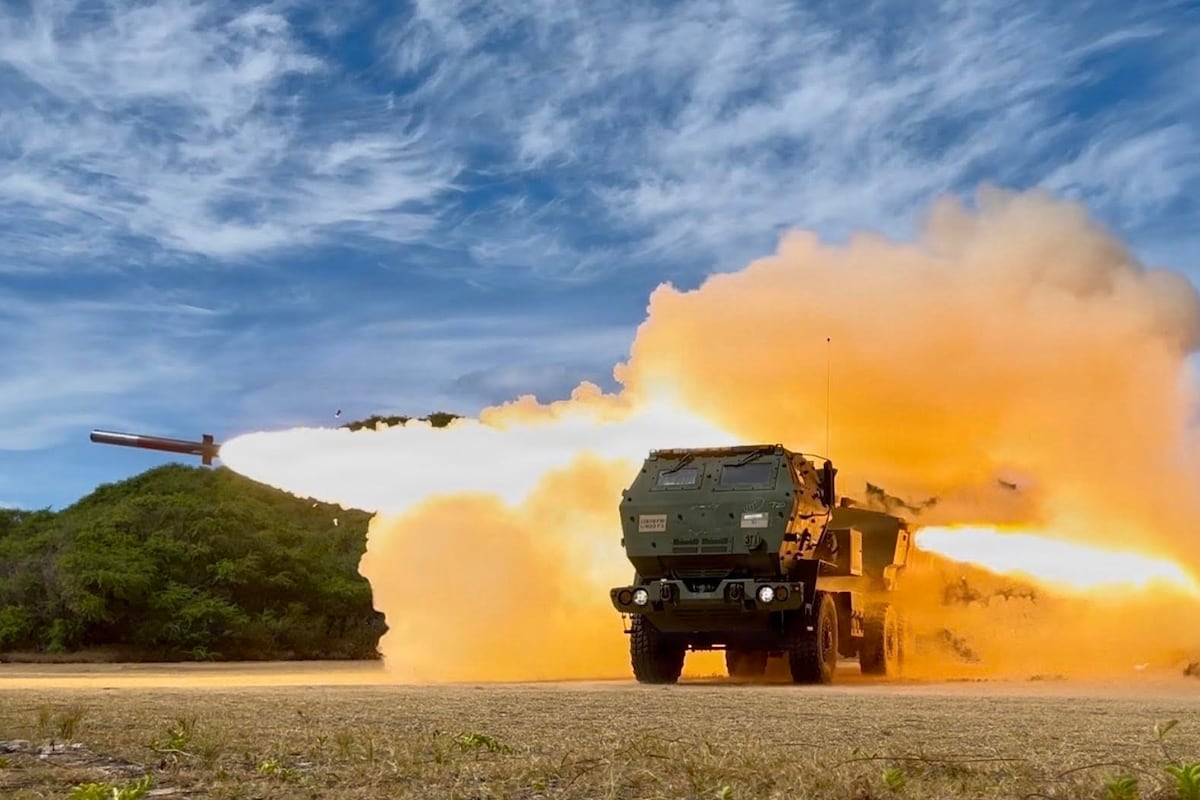
Long-range artillery, like the High Mobility Artillery Rocket System (HIMARS), has become central to these efforts. HIMARS is capable of executing both land-attack and maritime-strike missions using guided rockets and ballistic missiles with significant range.
HIMARS made its debut in Japan during a 2021 exercise in Hokkaido and was later deployed to the Southwest Islands in 2022 for maneuvers near Okinawa. Its presence has since become a staple in joint exercises, notably the Keen Sword exercise, which positioned HIMARS 150 miles east of Taiwan.
In the Philippines, HIMARS has been deployed in new capacities, such as anti-ship roles, and in new regions. Exercises in 2024 and 2025 saw deployments to Palawan and Luzon, strategically facing the South China Sea and Taiwan.
During the recent Balikatan exercise, the U.S. and the Philippines demonstrated their capability to transport HIMARS across the country via land, sea, and air. In April, U.S. forces moved a HIMARS to Itbayat, a mere 100 miles from Taiwan, for a dry-fire exercise. Later, an Army watercraft facilitated a live-fire drill on Balabac Island, highlighting its defensive capabilities for regional shipping lanes.
According to Gen. Ronald Clark, commander of U.S. Army Pacific, this ability showcases alliance integration and sends a strategic message to adversaries. “It’s really a joint success story,” Clark noted at the Association of the U.S. Army’s annual conference in Washington, D.C.
Clark elaborated on a recent operation where HIMARS launchers were airlifted from Washington state to the Philippines, visible to adversaries, culminating in a live-fire exercise. “Being able to do that, it, one, takes a lot of skill. Second, it takes a tremendous amount of partnership with, in this case, allies to assist us,” he said.

The U.S. Army has also introduced its Mid-Range Capability, known as Typhon, which can launch SM-6 and Tomahawk missiles from significant distances. First deployed to the Philippines in 2024, Typhon has since been test-fired and deployed to Japan for regional exercises.
Maj. Gen. Bernard Harrington highlighted the strategic advantage of Typhon’s presence in the Philippines, providing continuous training opportunities and insights into operational logistics. “To be able to do that persistently forward and persistently with our ally in the Philippines and our partners is incredibly important for us,” Harrington stated.
Despite publicized deployments of HIMARS and Typhon, these exercises offer U.S. troops opportunities to enhance communication and command-and-control systems, ensuring effective coordination in potential combat scenarios.
China has expressed concern over these developments, often criticizing the joint exercises as destabilizing. Chinese state media experts suggest that island deployments near Taiwan could face challenges due to limited mobility and resupply difficulties.
These logistical challenges underscore the importance of diversifying U.S. military assets, according to Harrington. “This maximizes options for the Joint Force while also enhancing the protection and survivability of our soldiers,” he explained, citing the deployment of drones and unmanned vessels to complement high-value systems.