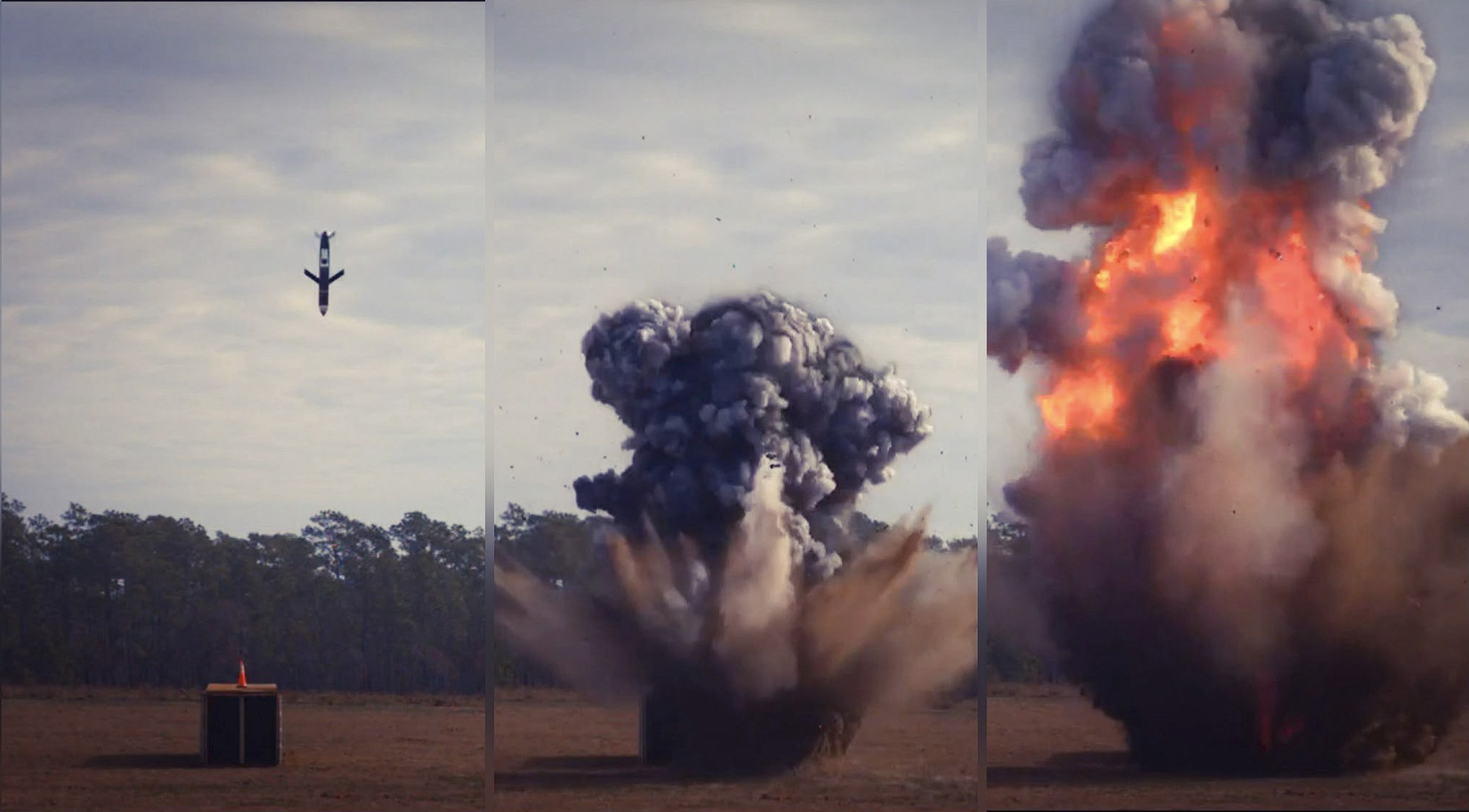
A new American cruise missile built for speed, affordability, and mass production is quietly becoming one of the more significant weapons of the ongoing conflict in Ukraine — and the U.S. Air Force wants industry to ramp up fast. The service has issued a formal request asking defense contractors whether they can deliver large quantities of a next-generation standoff weapon under a tight and aggressive timeline.
The weapon in question is the Extended Range Attack Munition, known as ERAM — a small, air-launched cruise missile that the Air Force describes as “designed to provide affordable mass to the fight” that “delivers a precision-guided, stand-off capability against high-value fixed targets.” That framing reflects a broader Pentagon priority: moving away from low-volume, high-cost munitions toward weapons that can be manufactured quickly and in large numbers.
The Air Force’s new Request For Information, with a deadline of November 19, lays out what ERAM needs to do. Rather than starting with raw numbers, the requirements tell a story about a weapon designed to reach deep into defended territory with precision. The missile must strike within 10 meters of its target — even when GPS is being jammed — carry a 500-pound-class warhead capable of both fragmentation and limited structural penetration, fly faster than Mach 0.6, and reach targets more than 250 nautical miles away.
The development timeline for ERAM has been unusually compressed. In 2024, two small defense firms — Zone 5 Technologies and CoAspire — won Air Force contracts to build prototypes. Less than a year and a half after those contracts were awarded, the Air Force had already conducted a live warhead test at Eglin Air Force Base in Florida — a pace that would have been considered extraordinary for a weapons program of this type just a decade ago.
The urgency extends to production as well. The RFI calls for contractors to begin delivering the first batch of more than 1,000 missiles no later than three months after a contract is awarded, with all deliveries wrapped up within 15 months. That kind of schedule signals that the Air Force is treating ERAM less like a traditional acquisition program and more like an emergency procurement effort.
Ukraine’s Connection to ERAM
Ukraine’s role in driving demand for this missile is hard to overlook. In August 2025, the Trump administration announced an $825 million sale of 3,350 ERAMs to Ukraine — a substantial order for a weapon still in early production. Ukraine operates American-made F-16 fighters, the platform ERAM is designed to fly from, raising the question of whether the missiles are already being used in combat.
That question became more pointed in June 2026, when Ukrainian media reported that the AGM-188A Rusty Dagger — the operational designation for a version of ERAM — may have been used to strike the Voronezh Semiconductor Plant, a Russian facility that manufactures components used in missile systems. If confirmed, it would mark one of the more significant uses of an American standoff weapon in the conflict to date.
The Air Force’s interest in ERAM predates the Ukraine war’s most recent escalation. The service first published an RFI for the program in January 2024, nearly two years after the conflict in Ukraine began drawing down U.S. stockpiles of precision munitions. That timeline has only grown more pressing, as recent military operations against Iran further depleted American inventories of high-cost missiles — underscoring exactly why the Pentagon has been pushing to develop cheaper, faster-to-produce alternatives like ERAM.