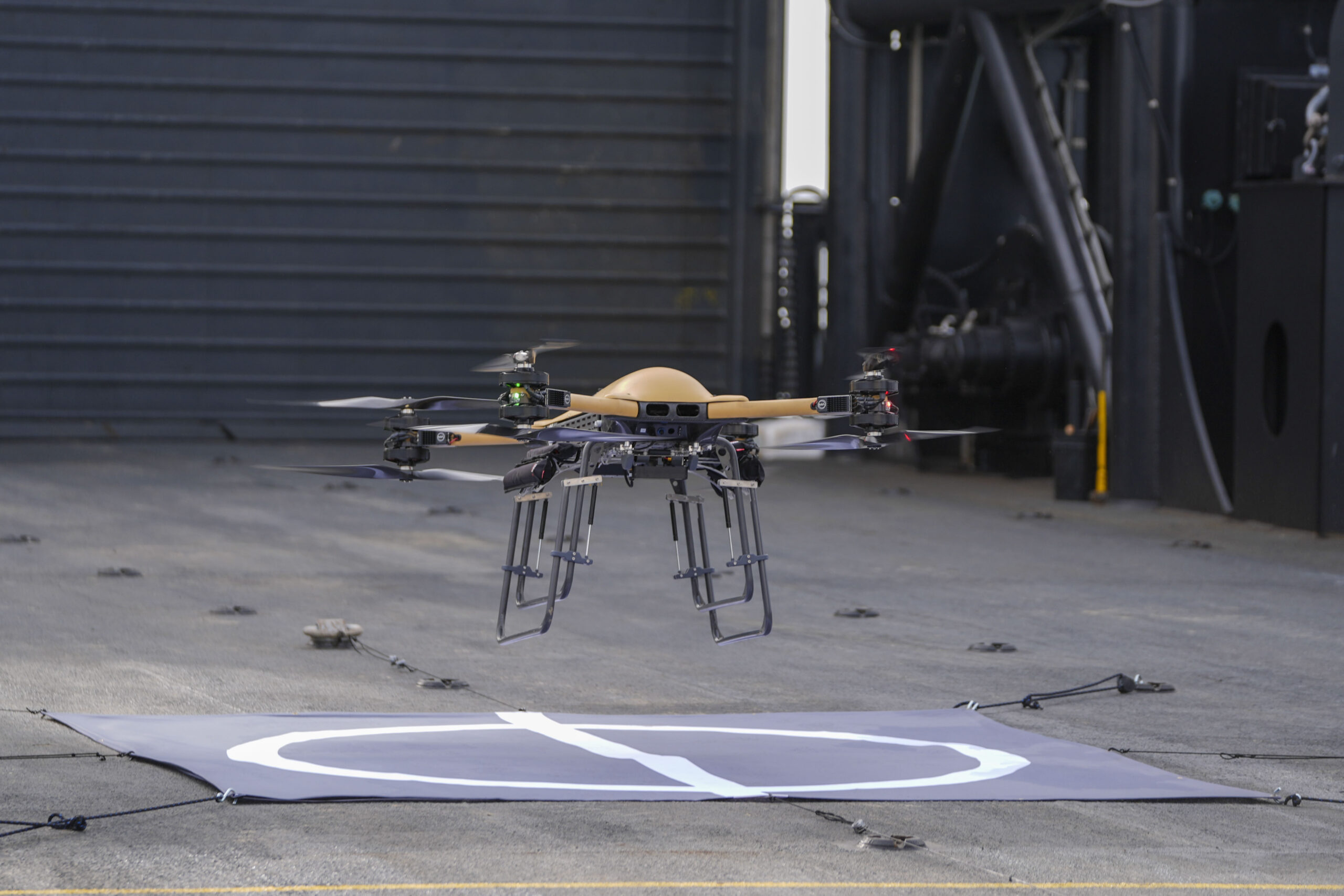
Drones are no longer just tools for surveillance or airstrikes — they are becoming the delivery trucks of the modern battlefield. The U.S. Marine Corps and Navy are now pushing to make autonomous cargo drones a standard part of small-unit military logistics, and a major demonstration next year will help determine which technology makes the cut.
The two services have announced plans for a cargo drone technology demonstration scheduled for January 25 through February 5, 2027, in Huntsville, Alabama. Defense contractors will be invited to show off their unmanned aircraft systems as candidates for the Marine Corps’ TRUAS program — short for Tactical Resupply Unmanned Aircraft System — specifically its Increment II phase.
What TRUAS Is Designed to Do
According to a formal announcement from the Navy’s Air Warfare Program Management Office, which is sponsoring the event, TRUAS Increment II aims to
“provide an organic aerial distribution capability for small-unit logistics support across the last tactical mile in expeditionary advanced base operations and distributed operations.”
In plain terms, that means getting critical supplies to small groups of Marines operating in remote or contested areas where conventional resupply is difficult or dangerous.
During the demonstration, contractors will conduct up to five flights and must also show how quickly and easily their systems can be set up on the ground in preparation for a mission.
What the Drones Will Have to Prove
The required test flights are demanding. The first flight requires the drone to carry a 100-pound payload at least 40 nautical miles under calm conditions, deliver it — either automatically or by manual control — and return to its launch point without stopping to refuel. The second flight shortens the range to 10 nautical miles but raises the payload requirement to at least 150 pounds.
All competing drones must fly at a minimum speed of 50 knots and stay below 1,000 feet in altitude. Importantly, they must be capable of launching and landing without mechanical assistance — meaning no catapults, arresting nets, or cables are allowed. After the two required flights, the Navy noted that
“participants may be given the opportunity to perform up to three additional flights to demonstrate unique features and/or capabilities.”
Longer-term performance goals are also outlined in the specifications. The Marine Corps wants systems that can eventually operate at altitudes up to 8,000 feet and reach speeds of 150 knots, even when flying in crosswinds of 20 to 30 knots.
Autonomy and Survivability Are Top Priorities
The Marine Corps wants more than a flying delivery vehicle. It wants one that can think on its feet — or wings. The desired system would be capable of evaluating a landing zone on its own, assessing conditions
“before and during landing, day and night, and detect and avoid personnel, equipment, structures, excessive slope, and other terrain hazards.”
As drone traffic increases across modern battlefields, the ability to avoid mid-air collisions is also essential. The Marines are calling for an
“organic airborne sense-and-avoid capability for manned and unmanned aircraft at cruise speed, with performance comparable to a human pilot operating under Visual Flight Rules and sufficient reaction time for collision avoidance.”
The system also needs to survive hostile environments. Because cargo drones may need to deliver supplies even under enemy fire, the program requirements specify that TRUAS
“shall minimize the time required to descend from cruise altitude to the LZ [landing zone] to enhance survivability by reducing the window for hostile detection.”
A fast descent could mean the difference between a successful drop and a lost aircraft.
What’s Happening on the Global Stage
The timing of this program is not coincidental. Battlefield drone capabilities are advancing rapidly around the world. Last month, Ukraine claimed to have performed the world’s first drone medevac, airlifting a wounded soldier from a frontline position. Ukraine’s 92nd Separate Assault Brigade released a video showing a wounded soldier suspended in a sling beneath a large hexacopter drone.
Ukrainian media reported that
“heavy Russian drone activity and mined terrain made evacuation by an unmanned ground vehicle impossible,”
and that troops, working with the drone’s manufacturer, developed a technical solution that allowed the heavy drone to carry the wounded soldier while remaining stable in flight, preventing it from tipping over or swaying excessively.
The Marine Corps has not specified what types of cargo its TRUAS drones will carry once the program is operational. But the direction is clear: unmanned aircraft are increasingly being looked to not just for combat, but for the unglamorous — and vital — work of keeping troops supplied and alive in the field.