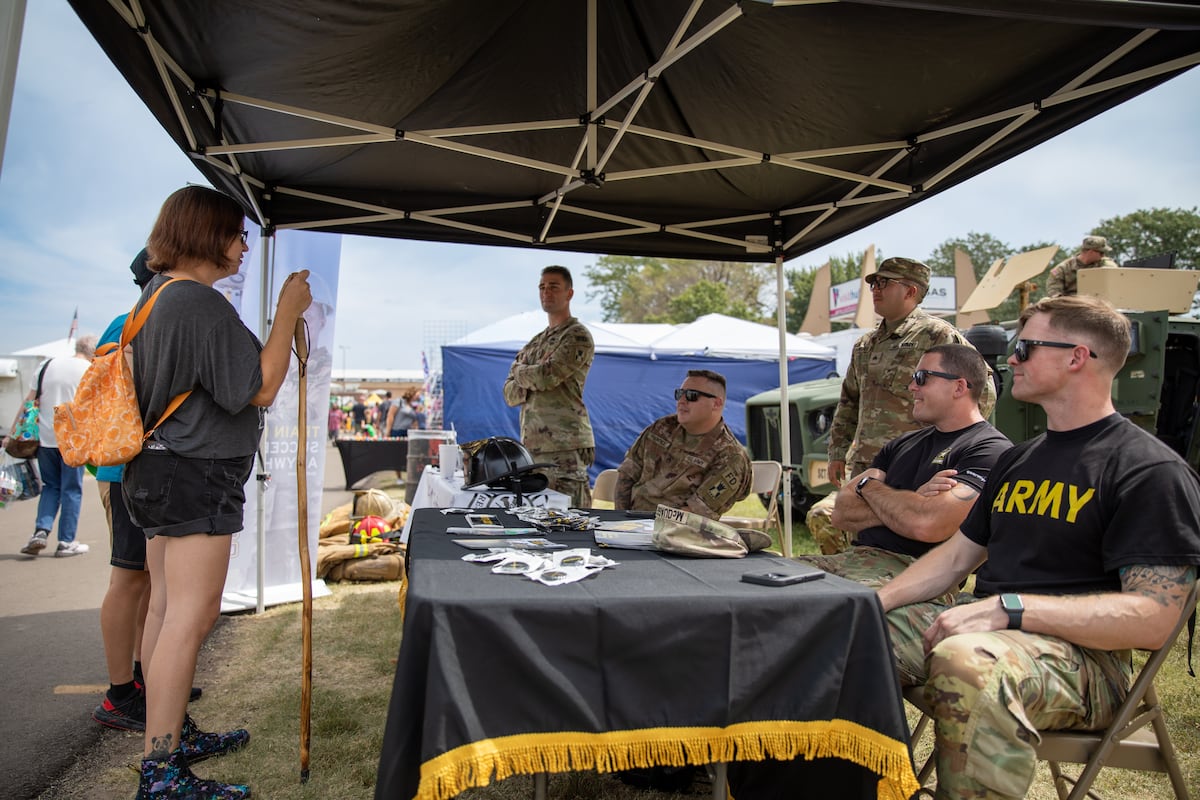
A military program that gave newly trained soldiers a chance to return home before heading to their first duty station has been quietly put on hold — and may not return. The Army’s Hometown Recruiter Assistance Program, which has existed in some form since the 1980s, is now suspended after officials concluded it wasn’t delivering results worth its cost.
Lt. Gen. Johnny Davis, head of U.S. Army Recruiting Command, confirmed the suspension at a forum hosted by the Association of the United States Army. The program, known as HRAP, had offered soldiers completing Advanced Individual Training a paid 14-day window to go home before reporting to their first duty station — in exchange for helping local recruiters spread the word about Army service. In practice, Davis said, that second part rarely happened the way the Army intended.
“I would tell you, when the program was initiated and really delivered to the Army years ago and executed, that we had some good return on investment — about, you know, one or two percent,”
Davis said at the forum.
The numbers, while modest, weren’t the only issue. Davis said tens of thousands of young soldiers returning home were understandably focused on seeing family and friends — not staffing a recruiting office.
“But, bottom line, what we’ve learned over the years is that 20, 30,000 young superstars, when they were headed back home, were good; they got to go home,”
he added.
“But they weren’t really working with the recruiters as much as we wanted them to.”
Davis acknowledged the human side of the situation — that soldiers treated the period as extra, uncharged leave rather than an active recruiting duty. But with finite resources, Army leadership had to weigh whether the expense made sense.
A Similar Problem During the Holidays
The Hometown Recruiter Assistance Program wasn’t the only arrangement that fell short. Davis also noted that National Guard and Reserve soldiers had historically been allowed to return home during the Christmas Exodus holiday break, again with the expectation they would serve as recruiting ambassadors in their communities.
“During that Christmas holiday, was there a lot of recruiters in the recruiting stations working with them? No,”
Davis said.
“So we’re really thinking through: is this return on investment, and is it worth the cost to the Army? Or can we take those funds and spend them in other ways to help our men and women.”
Davis said Army leaders are now exploring other ways to give soldiers access to hometown leave that isn’t tied to the recruiting mission.
What HRAP Was Designed to Do
At its best, the program was built on a straightforward idea: a soldier who had just gone through basic training and AIT was a living example of what military service could do for someone from any town in America. Sending that soldier back to their community — in uniform, with a story to tell — could be more persuasive than any advertisement.
Staff Sgt. Colton Dunbar, a recruiting center station commander in Missouri, described this approach in a 2022 Army news release.
“We try to get the most out of them while they’re here by bringing them to the high school where they graduated and their communities to show everyone that this person was in your community six months ago as a civilian, but look at them now,”
he said.
“It helps to break down any barriers because they know that person in uniform — it helps show we are people just like everybody else.”
But that kind of deliberate, structured engagement was the exception, not the rule. Army social media pages began signaling the suspension of HRAP as early as January, though the service had not made any formal public statement until Davis addressed it at the AUSA forum.
Decades of Measurement Problems
The challenge of proving HRAP’s value is not new. A 1983 study from the U.S. Army Research Institute for the Behavioral and Social Sciences found it difficult to evaluate participants’ effectiveness because their influence on potential recruits was hard to track beyond direct office visits.
The study did note, however, that the program’s benefits weren’t always captured in the numbers.
“Aides are credited for individuals they brought to the recruiter who subsequently enlist, but the total effect of the aide’s efforts is more subtle than the sum of their recruits,”
the study found.
“For example, aides can ‘plant seeds’ or lay the groundwork months in advance of an enlistment decision and receive no credit for an enlistment that occurs months after his or her departure.”
In its most recent form, HRAP required soldiers to be selected and approved by a company commander before participating. Whether that structure continues in any form remains to be seen — Davis said the program is being “looked at” but the Army has not announced a timeline for a final decision.
For more coverage of military news, benefits, and policy, visit Army Times. Recent stories include updates on century-old homes being renovated at Fort Bragg, a planned DEERS outage that could affect Tricare beneficiaries, an ongoing legal dispute between veterans over for-profit claims processing, nearly 500,000 veterans receiving a three-month life insurance premium break, and the legacy left by the outgoing AAFES director.
Also available from Army Times video coverage: an interview with Medal of Honor recipient and retired Maj. Nicholas Dockery, a look at Powerus’ development of fully autonomous drone interceptors, Leonardo DRS’ Stick It to Cancer initiative at AUSA Annual, and how Kaizen is working to accelerate military counter-drone procurement.