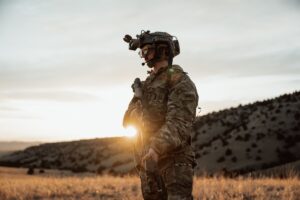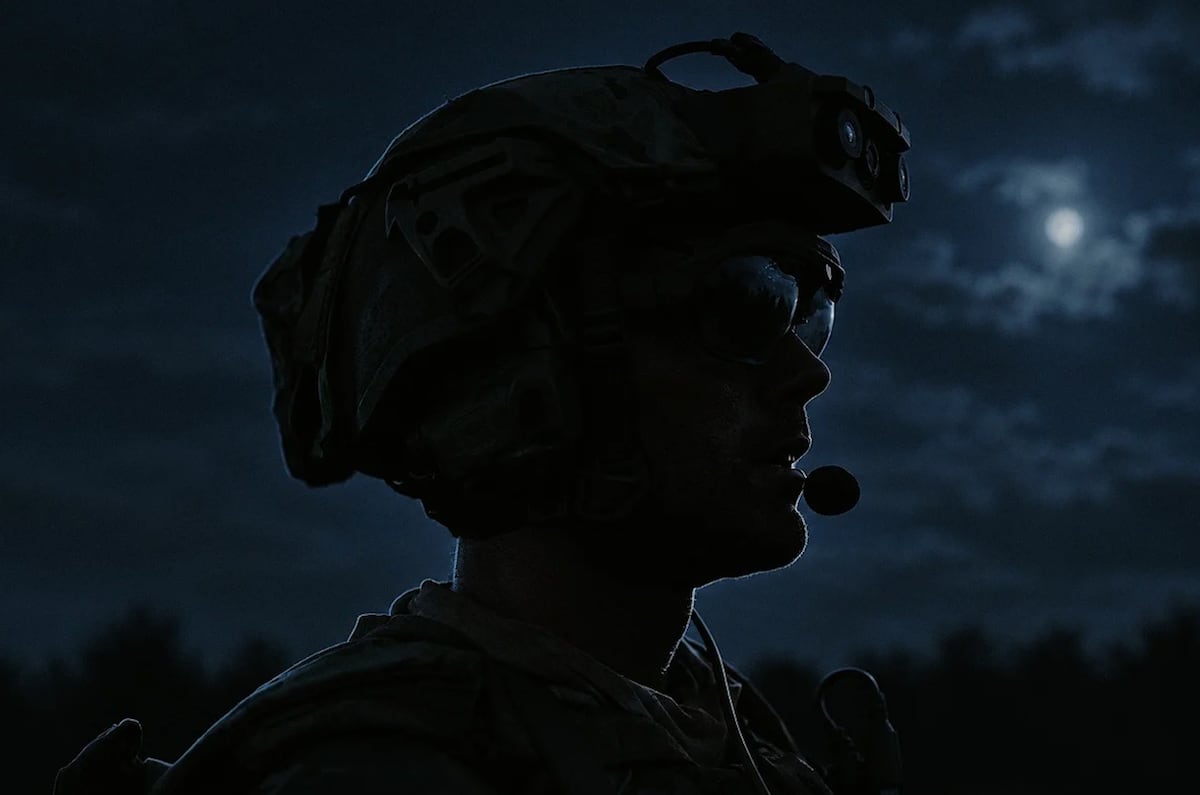
A rebranded American defense company made a high-profile entrance at one of the military industry’s biggest annual showcases this week, bringing with it a next-generation wearable designed to give soldiers a clearer, smarter picture of the battlefield. The technology on display signals a significant step forward in how the U.S. Army equips its troops for modern combat environments.
Elbit Systems’ American subsidiary, now operating under the name Twenty-Six Defense, made its debut at the Association of the United States Army (AUSA) expo this week as a newly branded Texas-based firm. The centerpiece of its showcase was a wearable system called Primex — a lightweight heads-up display built to give soldiers night-vision capabilities and augmented reality without overwhelming them in high-stakes situations.
According to Twenty-Six Defense, Primex was engineered specifically for long-duration missions. The company says it achieved
“the lightest head-borne load and near-neutral center of gravity”
in its design — a critical factor for soldiers who may wear the device for extended periods in the field. The system draws on low-light sensors, thermal imaging, and real-time data processing to deliver what the company describes as an ultra-low-latency digital perception layer, allowing operators to make sense of their surroundings even in difficult conditions.
What the company wants buyers to understand is that Primex isn’t built on experimental or unproven science. Twenty-Six Defense points out that its technology foundation comes from hardware that has already been deployed. The firm currently produces the AN/PSQ-44 Enhanced Night Vision Goggles, a fielded system with rapid target acquisition features and augmented reality overlays that informed the development of Primex. That lineage, the company argues, sets Primex apart from other advanced display systems competing for military contracts.
Connecting Soldiers to the Broader Battlefield Picture
The capabilities of Primex tie directly into a larger Army initiative. In August, Ernie Basic, Twenty-Six Defense’s senior director of research and development, explained his company’s work on the Soldier Borne Mission Command program, an Army effort to field augmented reality wearables across infantry units. Basic described the technology as a fusion of fighter-pilot-style display systems and traditional night-vision gear, giving ground troops what he called
“the full operational picture.”
Basic laid out just how expansive that picture can be.
“You are not only seeing what is in front of you. You can leverage a feed coming from a drone or from other assets,”
he said.
“You can start seeing what is going on behind a house or another structure, cue a squad to a different location, and continuously update them.”
That kind of real-time situational awareness — pulling feeds from drones and other assets directly into a soldier’s field of view — represents a meaningful shift in how individual troops interact with information on the battlefield.
Primex wasn’t the only system Twenty-Six Defense brought to the AUSA floor. The company also displayed a range of defensive weapons and platforms, including the XM1168 mobile 120mm mortar system, the Autonomous Relocatable Surveillance Tower, and the SkyStriker Block 4E loitering munition.
For more on what was showcased at AUSA this year, including coverage of autonomous systems and counter-drone technology, see related reporting on AI at the Edge and the Future of Battlefield Autonomy, Forterra’s OASIS-OneLink system, Honeywell’s counter-drone solutions, and Oshkosh’s advances in tactical mobility.