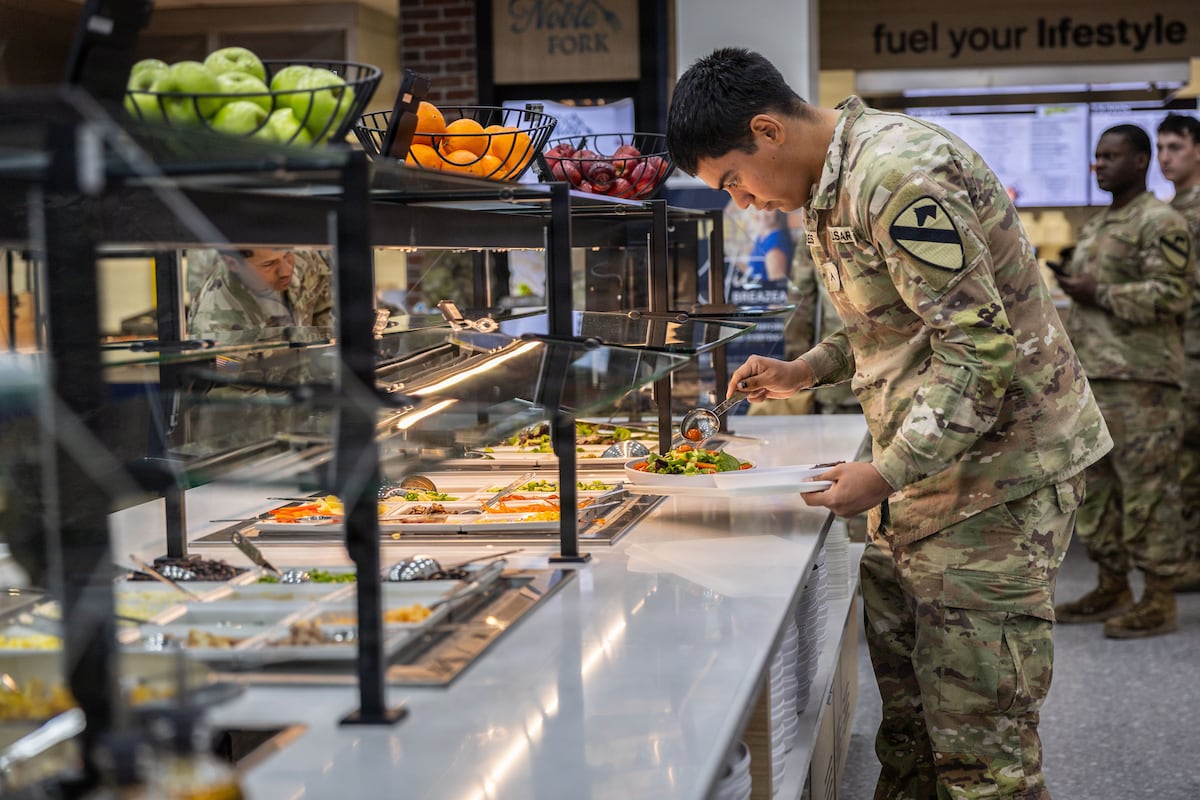
For the hundreds of thousands of active-duty service members stationed at U.S. Army bases across the country, daily life — including something as basic as when and where to eat — is shaped by decisions made far above their pay grade. Now, the Army is rethinking one of those decisions in a significant way, and early results suggest soldiers are welcoming the change.
The U.S. Army is rolling out a new generation of campus-like dining facilities and partnerships with restaurant franchises designed to modernize how troops eat. Army officials presented updates on these programs at the Association of the United States Army annual meeting in Washington, D.C., on Wednesday, pointing to strong soldier participation rates as evidence the reforms are working.
Jason Condrey, acting deputy chief of staff of Army Materiel Command, summed up what drove the need for change:
“Chow halls operated on decades-old schedules that clashed with modern soldier work shifts.”
What’s Actually Changing on Base
The centerpiece of the Army’s dining overhaul is the campus-style dining venue, or CSDV — a concept modeled after college dining halls that offers more flexible hours, broader food options, and a more welcoming environment than traditional military chow halls. These facilities launched in September 2025 and are now operating at five installations: Fort Bragg, North Carolina; Fort Stewart, Georgia; Fort Carson, Colorado; Fort Hood, Texas; and Fort Drum, New York.
Unlike traditional garrison dining halls, which are run by the base and staffed by soldiers, CSDVs are operated by private contractors. The Army is also running a separate initiative — the flexible eating and extended dining program, known as FEED — at select installations in the continental United States.
One notable quality-of-life improvement: family members can now dine alongside their soldiers at CSDVs, though dependents still pay for their meals. Traditional dining halls have generally allowed dependents only in limited circumstances, such as holidays.
The Numbers Behind the Rollout
Army officials shared usage data that suggests soldiers are taking full advantage of the new venues. Sgt. Maj. Damarco Wyatt of Army Materiel Command reported roughly 67% utilization among soldiers living in the barracks at Fort Carson, and about 56% utilization among barracks soldiers at Fort Hood.
Sydney Smith, director of materiel management at the Office of the Deputy Chief of Staff, offered additional context on just how dominant the new model has become at some installations:
“If we look at the two that have been open the longest — at Hood and at Carson — Hood’s a very large installation, and yet the Army is serving about 55% of its meals from the CSDV. At Carson, about 85% of meals are being served out of that one CSDV.”
Those figures indicate that at Fort Carson, one single dining venue is now the primary source of meals for the entire installation — a significant shift from the traditional distributed model.
Contractors Foot the Bill — and Draw Some Scrutiny
The commercial partners running the new facilities are also financing their own equipment and setup. Scott Kindberg, executive director for support operations at the Army Sustainment Command, explained the arrangement:
“The contractors are willing to pay for that themselves, so that they can be successful.”
But the shift to private management hasn’t gone without pushback. Some critics have questioned whether handing food production to commercial entities is the right move, pointing to documented problems with commercially built military housing as a cautionary example of what can go wrong when private contractors take over services that directly affect troops’ well-being.
Despite those concerns, the Army says it plans to expand the CSDV program beyond its current five installations.
A Broader Push for Military Quality of Life
The dining overhaul is part of a wider quality-of-life push across the U.S. military. Earlier this month, Camp Pendleton in California opened a chow hall drive-thru to better accommodate Marines and sailors, signaling that the appetite for reform extends well beyond the Army.
At Fort Hood, soldiers who are of legal drinking age can purchase wine, beer, cider, and hard seltzer during designated hours at the CSDV. Whether other installations will offer alcohol remains an open question — the decision has been left to each installation’s senior commander. The commanding general of Army Materiel Command said in February that the call would be made at the local command level.
For service members and their families, these changes represent something tangible: a daily environment that better reflects their actual lives and schedules. How the program scales — and whether contractor-run dining maintains quality over time — will be worth watching as the Army moves toward broader implementation. Those interested in related military quality-of-life issues can find additional coverage at Army Times, including topics such as Army efforts to improve family access to medical records, upcoming cost-of-living increases for retirees and veterans, and historic housing renovations at Fort Bragg. Service members and their families eligible to vote by absentee ballot are also encouraged to take action now ahead of the November election, and to stay informed about potential disruptions like the planned DEERS outage that could affect Tricare eligibility verification.